1. Unlocking Efficiency in Chemical & Pharmaceutical R&D with High-Performance Lab Evaporators
The Role of Lab Evaporators in Industrial R&D
In modern chemical synthesis, pharmaceutical formulation, and food safety testing, solvent removal remains one of the most frequent yet critical processing steps. Lab evaporators serve as the core workstation for concentration, distillation, crystallization, and solvent recycling. By applying controlled thermal energy alongside precise pressure regulation, these systems lower the boiling point of volatile solvents, preventing thermal degradation of delicate target compounds.
As research pipelines transition from analytical testing to pilot-scale evaluation, the operational consistency of lab evaporators directly influences batch-to-batch reproducibility, solvent recovery efficiency, and overall lab safety. Enterprise buyers looking to equip multi-user research facilities or upscale production capacity require systems that deliver high evaporation rates, chemical inertness, and stable continuous operation under deep vacuum conditions.
Core Operational Pillars of Lab Evaporators:
Thermal Transfer: Precision heating bath with strict temperature control
Vacuum Reduction: Lowers boiling points and preserves thermal sensitivity
Mechanical Motion: Film formation for rapid surface-area evaporation
Vapor Condensation: High-surface glass coil for maximum solvent recovery
Balancing Process Precision and Throughput
Procurement managers face a recurring challenge when equipping high-frequency labor environments: balancing precision control with high volume throughput. Standard benchtop units might excel at micro-gram analytical preparations, whereas pilot-scale setups demand heavy-duty drive motors, high-capacity heating baths, and reinforced glass assemblies to process liters of solution per hour without continuous manual intervention.
To address these diverse operational scales, Shanghai Heqi Glassware Co., Ltd. has established four specialized manufacturing bases across Songjiang, Chengdu, Jiaxing, and Yancheng. By replacing traditional, variable manual glassblowing with mechanized line processes and standardized assembly, Shanghai Heqi Glassware Co., Ltd. ensures that every glass component—from standard-mouth ground joints to heavy-wall condenser coils—maintains uniform wall thickness and strict dimensional tolerances. This industrial consistency eliminates structural weak points, allowing lab evaporators to maintain deep vacuum levels over prolonged continuous runs.
Direct-from-Factory Advantage in Equipment Sourcing
Sourcing processing equipment directly from an integrated manufacturer provides distinct structural advantages for enterprise sourcing teams:
Cost Control through Process Integration: Eliminating intermediary trading margins while leveraging optimized production methods lowers the total capital expenditure per unit.
Component-Level Quality Assurance: Direct oversight of metalworking, electronic assembly, and glassware fabrication prevents component mismatch and early seal degradation.
Customization Flexibility: Factory-direct engineering teams can modify glass joint sizes, condenser configurations, and mounting frames to match specific bench footprints or existing fluid circulation systems.
Long-Term Spare Parts Availability: Direct access to standard replacement seals, vapor ducts, and flask joints reduces system downtime over multi-year lifecycles.
2. Core Classification and Application Matrix of Lab Evaporators
Selecting the appropriate evaporation architecture depends on fluid viscosity, sample volume, thermal stability, and the target throughput. Below is an engineering overview of the primary lab evaporators utilized across industrial research facilities.
Rotary Lab Evaporators (Rotovaps)
Rotary lab evaporators remain the industry standard for general solvent recovery and sample concentration.
Mechanism: The evaporation flask rotates within a temperature-controlled heating bath under reduced pressure. Rotation creates a continuous, thin liquid film along the inner surface of the glass flask, expanding the evaporation surface area while preventing localized overheating and bumping.
Target Applications: High-volume solvent stripping, ethanol recovery, organic synthesis purification, and general extract concentration.
Nitrogen Evaporators / Blowdown Concentrators
Designed for micro-volume processing where sample recovery from multi-well plates or test tubes is required.
Mechanism: Directs a controlled flow of inert gas (typically nitrogen) onto the liquid surface while heating the sample block. The gas stream constantly sweeps away the vapor boundary layer, accelerating evaporation without boiling.
Target Applications: LC-MS/GC-MS sample preparation, drug metabolite screening, environmental residue analysis, and high-throughput analytical testing.
Centrifugal Lab Evaporators
Centrifugal systems process multiple small-volume containers simultaneously under vacuum without cross-contamination.
Mechanism: Combines vacuum distillation with centrifugal force. The rotation forces the liquid downward against the bottom of the tube, eliminating solvent bumping and boiling over during fast pressure drops.
Target Applications: DNA/RNA purification, proteomics, biological sample drying, and parallel synthesis fractions.
Wiped-Film and Thin-Film Lab Evaporators
Engineered for thermal-labile, highly viscous, or high-boiling-point mixtures that cannot tolerate prolonged exposure to elevated temperatures.
Mechanism: Mechanical wiper blades spread the feed liquid into an extremely thin, turbulent film along the inner surface of a heated glass or stainless steel cylinder. The short residence time (often mere seconds) minimizes thermal degradation.
Target Applications: Botanical extract purification, heavy oil fractioning, polymer devolatilization, and high-purity pharmaceutical intermediate purification.
Technical Parameter & Specification Comparison Matrix
| Specification / Feature |
Rotary Lab Evaporators |
Nitrogen Evaporators |
Centrifugal Evaporators |
Wiped-Film Evaporators |
| Primary Mechanism |
Rotating thin-film under vacuum |
Inert gas blowdown + dry heat |
Vacuum + Centrifugal force |
Mechanical wiper thin-film |
| Typical Sample Volume |
50 mL to 50 Liters |
0.5 mL to 50 mL per tube |
0.2 mL to 250 mL (multi-vial) |
Continuous feed (0.5 to 20 L/h) |
| Throughput Type |
Batch (Single Flask) |
Parallel (12 to 96 samples) |
Parallel (Up to 100+ samples) |
Continuous Flow |
| Operating Pressure |
Atmosphere down to less than 2 mbar |
Atmospheric pressure |
Atmosphere down to less than 1 mbar |
Deep Vacuum down to 0.001 mbar |
| Heating Medium |
Water or Oil Bath (20°C to 180°C) |
Dry heating block or water bath |
Heated chamber / Infrared |
Heated jacketed mantle |
| Thermal Exposure Time |
Moderate (Minutes to Hours) |
Moderate (15 to 60 Mins) |
Moderate (30 to 120 Mins) |
Extremely Short (Seconds) |
| Viscosity Handling |
Low to Medium |
Low |
Low |
Very High / Heavy Residues |
| Primary Industry |
Synthesis, Extraction, Pharma |
Analytical QC, Environmental |
Genomics, Proteomics, Biotech |
Fine Chemicals, Natural Extracts |
3. Engineering & Technical Evaluation Standards for Large-Scale Buyers
Evaluating lab evaporators requires an analysis of core engineering sub-systems. High-frequency industrial use demands robust construction, chemical resistance, and repeatable operational tolerances.
Vacuum Integration & Seals Integrity
The ultimate limit of an evaporator's efficiency is determined by its vacuum seal integrity. A pressure drop leads to elevated boiling temperatures, slower processing times, and potential sample degradation.
Dynamic Seal Design: Seals must withstand continuous mechanical rotation while exposed to corrosive solvent vapors. High-grade PTFE (Polytetrafluoroethylene) reinforced with graphite or viton cores provides chemical resistance against harsh organic solvents (such as dichloromethane, chloroform, and DMF).
Vapor Path Inertness: Every component along the vapor path—including the vapor duct, seal ring, and condenser inlet—must be non-reactive. Shanghai Heqi Glassware Co., Ltd. combines specialized chemical R&D with precision metalworking and glass assembly workshops, producing integrated PTFE-to-glass interfaces that eliminate vapor leakage and prevent seal deformation during extended runs.
Thermal Efficiency & Condenser Design
Heat transfer efficiency dictates both energy consumption and solvent recovery rates.
Condenser Configurations:
Vertical Coil Condensers: Compact footprint, ideal for standard boiling point solvents.
Horizontal Condensers: Recommended for height-restricted bench space or setup under fume hoods.
Cold Trap / Dry Ice Condensers: Essential for low-boiling-point solvents (such as ether, acetone) where recirculating liquid chillers cannot achieve low enough condensation temperatures.
Heating Bath Control: Heating baths must utilize PID digital controllers to maintain fluid temperatures within plus or minus 0.1°C. Dual-insulation walls prevent exterior heat loss and protect operators from burn risks.
Automation, Drive Systems & Safety Interlocks
Modern multi-user laboratories require integrated automated features to lower operator workload and reduce glass breakage risks:
Motorized Lifts with Auto-Raise: In the event of a power interruption or system shutoff, an automated motorized lift lifts the evaporation flask out of the hot oil/water bath, preventing thermal decomposition of the sample.
Brushless DC Drive Motors: Provides smooth rotation speed regulation (10 to 280 RPM) with high torque, handling heavy liquid loads without vibration or speed drift.
Integrated Safety Circuits: Over-temperature protection cutoffs, dry-run bath protection, and burst-proof glass coating options (PLASTIC-coated safety glass) contain glass fragments and toxic solvents in the event of accidental implosion under vacuum.
Scalability & Glassware Standardizations
Standardization simplifies inventory management across multi-lab facilities.
Standard-Mouth Interchangeability: Equipment built around international glass joint standards (such as ST 29/32, 24/40, 45/50) allows research teams to swap flasks, adapter necks, and vapor traps without purchasing proprietary adapters.
Modular Upgradability: A standardized chassis design permits future system additions, such as integrating automated vacuum controllers, secondary vapor traps, or continuous feeding valves as processing requirements expand.
To support complex custom setups and pilot-scale operations, Shanghai Heqi Glassware Co., Ltd. utilizes in-house glass fabrication, machining, and assembly facilities to build customized small-scale and pilot-scale equipment solutions. Bringing chemical R&D experts together with mechanical and electronic control engineers ensures that standard glassware, glass reactors, rotary evaporators, and temperature circulation systems interoperate seamlessly.
4. Quality Control, Manufacturing Standards, and Production Rigor
Ensuring consistent performance across multi-unit orders requires strict manufacturing protocols and standardized quality management.
International Manufacturing Certifications
Industrial equipment must comply with global safety and environmental framework standards:
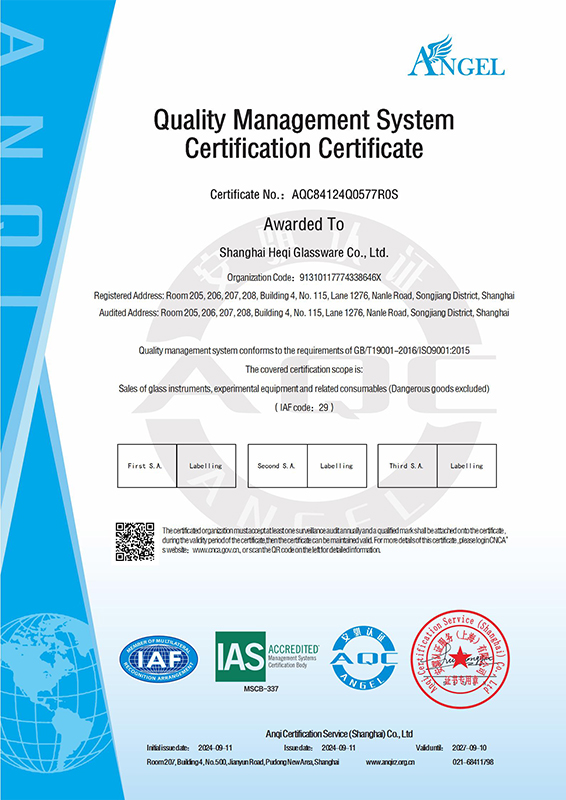
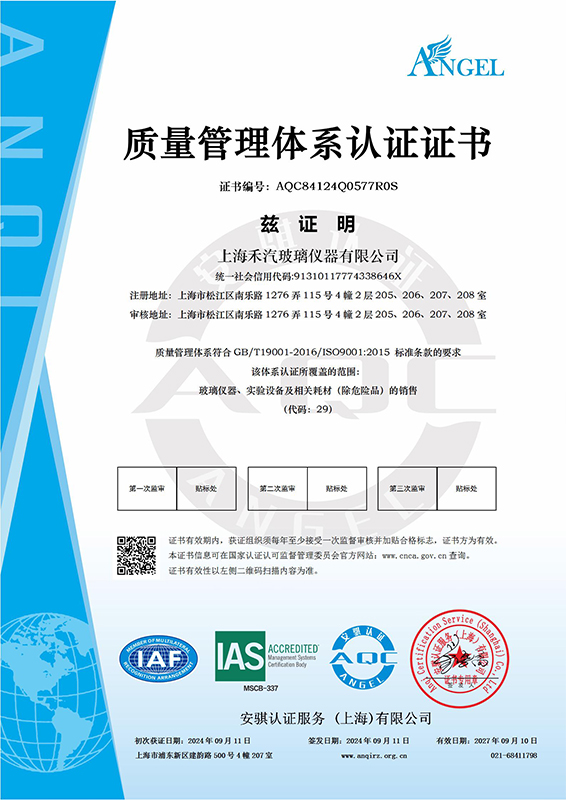
ISO 9001 Quality Management: Ensures every production phase—from raw glass tubing inspection to final electrical testing—follows documented, traceable standard operating procedures (SOPs).
CE & Electrical Compliance: Verification that drive motors, heating elements, and electronic displays meet low-voltage directives and electromagnetic compatibility (EMC) standards.
Material Traceability: Certificates of Conformance (CoC) for PTFE seals and Borosilicate 3.3 glass components verifying chemical resistance profiles and thermal shock limits.
In-House Manufacturing Control
Relying on outsourced sub-assemblies can introduce dimensional inconsistencies and material defects. Integrated in-house manufacturing resolves these risks through systematic controls:
Mechanized Glass Annealing: Computer-controlled annealing ovens eliminate internal stress lines within blown glass assemblies, preventing thermal stress fractures during rapid temperature swings.
Precision Metalworking: CNC-machined bath interiors, support rods, and drive shafts maintain tight physical tolerances, preventing motor strain and shaft wobble.
Vacuum Hold Testing: Every fully assembled unit undergoes a timed vacuum decay test to verify that dynamic seals and standard joints meet helium leak-rate standards prior to final packaging.
Batch Consistency & Qualification Protocols
For pharmaceutical and biotech clients operating under cGMP conditions, equipment installation must follow documented verification frameworks:
Installation Qualification (IQ): Formal documentation verifying that the equipment, glass components, sensors, and utility connections match engineering specifications.
Operational Qualification (OQ): Documented verification that the heating bath accuracy, rotation speed stability, vacuum seal integrity, and safety shutoffs function within defined operational parameters.
5. Customization Framework & Direct Supply Partnership Models
Large research operations, equipment distributors, and enterprise buyers frequently require custom mechanical, glass, or control configurations tailored to proprietary workflows.
Customization Capabilities for Enterprise Buyers
A fully integrated factory provides flexible design options, including:
Glassware & Vapor Path Engineering: Custom flask geometries, multi-neck receiving flasks, specialized splash heads, and continuous-feed glass loops tailored to unique distillation chemistry.
Explosion-Proof (EX-Proof) Configurations: ATEX/EX-rated drive motors, sealed control boxes, and explosion-resistant heating elements for processing flammable solvents in hazardous environments.
Control Interface & Brand Customization: Customized digital interfaces, private-label casing designs, and specialized mounting hardware for seamless integration into complete lab setups.
With specialized workshops dedicated to glass working, metalworking, and final assembly, Shanghai Heqi Glassware Co., Ltd. builds tailored equipment solutions that match specific operational requirements, moving from technical drawings to working prototypes without sub-contracting delays.
Supply Chain Reliability & Production Scale
Enterprise buyers require guaranteed delivery timelines and flexible order fulfillment options:
Scalable Line Production: Assembly-line manufacturing accommodates both single-unit custom pilot builds and high-volume orders for regional distribution.
Buffer Stocking Programs: Maintaining ample inventory of core glass components, standard seals, heating elements, and vacuum pumps ensures fast dispatch and minimal delivery lead times.
Tiered Volume Structures: Direct factory partnerships eliminate middleman markups, yielding transparent pricing structures that protect distributor margins and keep enterprise procurement within budget.
6. Total Cost of Ownership (TCO) & Post-Procurement Support
Evaluating the purchase of lab evaporators extends beyond initial capital expenditure. Calculating the Total Cost of Ownership (TCO) involves assessing energy consumption, solvent recovery efficiencies, maintenance schedules, and long-term service support.
Energy Efficiency & Solvent Recovery Economics
In high-throughput facilities running multiple lab evaporators continuously, operational utility costs accumulate rapidly:
Condenser Thermal Optimization: High-surface-area cooling coils lower cooling fluid circulation requirements, reducing the load on external chillers and decreasing electrical draw.
Solvent Loss Reduction: Advanced vacuum tight seals achieve recovery rates exceeding 98%. Recovering expensive, high-purity solvents reduces fresh chemical purchasing costs and lowers hazardous waste disposal expenses.
Maintenance Schedules & Spare Part Management
Systematic wear-and-tear management prevents unexpected production halts:
Routine Seal Replacement: Dynamic PTFE vacuum seals represent the primary consumable item in high-use evaporators. Standardizing joint geometries ensures that replacement seal kits remain low-cost and quick to install.
Consumable Availability: Maintaining local or factory-backed inventory of vapor ducts, vacuum valves, and standard flasks minimizes operational downtime when accidental breakage occurs.
To maintain quick fulfillment and service continuity, Shanghai Heqi Glassware Co., Ltd. combines stocked regional warehouse facilities with a dedicated customer support commitment: "You make a call, we handle the rest." Clients receive full operational support backed by complete spare parts availability, fast shipping, and technical assistance.
Global Technical Support & Service Commitments
Securing direct manufacturer warranty coverage and technical assistance ensures predictable operating costs:
Warranty Coverage: Comprehensive 1-to-3-year warranties covering mechanical drive systems, heating baths, and electronic control modules.
Remote Technical Diagnostics: Access to technical staff for troubleshooting control parameters, vacuum seal assembly, or fluid circulation balance.
Component-Level Repair Services: Dedicated metalworking and glass repair capabilities extend system lifespans by refurbishing existing assemblies rather than requiring full unit replacements.
7. Procurement FAQ & Technical Knowledge Base
Part A: Commercial & Procurement Questions
Q1: What is the typical factory lead time for bulk procurement of lab evaporators?
A: Standard catalog configurations are typically dispatched within 10 to 15 business days from stocked inventory. For large bulk orders or specialized OEM/ODM custom setups—such as explosion-proof motor integrations or custom glass manifold builds—production lead times range from 3 to 5 weeks.
Q2: What packaging and transport protections are utilized for fragile international shipments?
A: All complete systems and glass components are packed in export-grade, heavy-duty wooden crates lined with high-density, custom-molded EVA foam. Glassware undergoes shock-absorption drop tests prior to dispatch, and shipments carry full transport insurance coverage to guarantee safe delivery.
Q3: How do factory-direct lab evaporators compare in performance and value to traditional Western premium brands?
A: Factory-direct units engineered with standardized assembly lines utilize identical core materials—such as High-Borosilicate 3.3 glass, pure PTFE dynamic seals, and precision PID electronics. They provide matching thermal efficiency, vacuum hold, and operational stability while reducing capital expenditure by 30% to 50%, maximizing procurement return on investment.
Q4: Are custom private-label branding, customized user interfaces, and multi-language manuals supported?
A: Yes. Comprehensive white-label manufacturing services are provided for equipment distributors and system integrators. This includes customized exterior chassis powder coating, custom control panel overlays, branded serial plates, and multi-language user operation manuals.
Part B: Technical & Operational Knowledge
Q5: How do lab evaporators prevent solvent bumping during active vacuum distillation?
A: Solvent bumping (rapid, uncontrolled flash boiling) is prevented through three primary mechanisms:
Flask Rotation: Continuous rotation creates a uniform thin film along the inner glass wall, releasing dissolved gases and promoting smooth, controlled vapor generation.
Vacuum Ramping Control: Advanced digital vacuum controllers allow operators to gradually reduce pressure rather than applying immediate deep vacuum, matching pressure drops to the solvent's boiling curve.
Anti-Bumping Bulbs & Sensors: Specialized glass bump traps installed between the vapor duct and evaporation flask physically catch erupting liquid, preventing contamination of the condenser vapor path.
Q6: What routine maintenance procedure maximizes the lifespan of PTFE vacuum seals?
A: To ensure long-term seal integrity:
Clean dynamic PTFE seals weekly using a non-abrasive solvent (such as ethanol or warm water) to remove chemical residues and salt deposits.
Never apply hydrocarbon-based greases or petroleum jellies to PTFE vacuum seals, as this damages the seal compound and degrades vacuum performance.
Inspect seals regularly for mechanical wear, scoring, or thermal deformation, and replace them promptly to protect drive shaft assemblies.
Q7: How should an operator choose between a water bath and an oil bath for lab evaporators?
A: The selection depends on the target operational temperature:
Water Baths: Ideal for heating temperatures up to 99°C. They provide rapid heat transfer, clean operation, and easy disposal. Water baths are suitable for low-boiling-point solvents such as ethanol, methanol, acetone, and ethyl acetate.
Oil Baths: Required for processing temperatures ranging from 100°C to 180°C (or higher using high-temperature silicone oil). Oil baths are necessary for high-boiling-point solvents like DMF, DMSO, toluene, and xylene.
Q8: What glass properties are necessary for industrial lab evaporators operating under high thermal strain?
A: Glassware must be fabricated from High-Borosilicate 3.3 Glass (conforming to ISO 3585 standards). This material features a low linear coefficient of thermal expansion, offering exceptional resistance to thermal shock, high mechanical strength under deep vacuum conditions, and universal chemical inertness against aggressive organic solvents, concentrated acids, and neutral solutions.


 English
 Français
 Español