English
 Français
 Español
Chemistry Laboratory Equipment Funnel Guide: Types, Selection and Care Tips
A funnel looks like the simplest piece of glassware on the bench, which is exactly why it is so often taken for granted. In practice, this small cone of glass decides whether a filtration finishes in five minutes or stalls halfway through, whether a two-phase mixture separates cleanly on the first attempt, and whether a reagent reaches the flask or the bench top. After more than two decades of producing standard ground joint glassware, we have learned that the funnel is rarely the cheapest part of a setup and almost always the part that determines how smoothly the whole setup runs.
This guide walks through the funnel families used in chemistry laboratories, explains how to match a funnel to the method in front of you, and shares the details that experienced bench chemists actually care about: cone angle, stem length, pore size, stopcock material, joint size, and the small habits that keep glassware working for years.
What a Chemistry Laboratory Equipment Funnel Actually Does
Every funnel performs at least one of four jobs, and knowing which job you need is the fastest way to pick the right one.
- Guiding a liquid or a powder. A wide mouth and a narrow stem direct material into a narrow-neck vessel. A 60 degree cone with a short stem is the classic all-purpose choice, while a powder funnel with a wider stem suits solids that tend to bridge or stick.
- Filtering. Filter paper, a fritted disc or a membrane sits in the cone or on a perforated plate, and either gravity or vacuum pulls liquid through while the solid stays behind.
- Separating immiscible phases. A separatory funnel with a stopcock lets you draw off the lower layer while the upper layer remains in the body, which is the backbone of extraction and washing steps.
- Adding reagent at a controlled rate. Addition funnels, including pressure-equalizing designs, deliver a steady stream or dropwise flow without building pressure inside a closed system.
One design detail is worth remembering. The standard 60 degree cone is not an arbitrary choice. It matches the angle at which fluted filter paper folds, so the paper seats flat against the glass, the air path stays open, and gravity filtration proceeds at its natural speed. Change the cone angle and you change how the paper sits, how fast liquid flows, and how likely the paper is to float or channel.
The Main Funnel Families Found in Chemistry Labs
Most laboratories keep several funnel types on hand because each one solves a different problem. The table below summarizes the families we see most often, together with the job each one does best.
| Funnel type | Primary job | Typical construction | Best fit |
|---|---|---|---|
| 60 degree gravity funnel | Gravity filtration with fluted paper | Borosilicate 3.3 glass, short or long stem | Routine clarification, teaching laboratories |
| Powder funnel | Charging solids into narrow necks | Wide stem, often with a standard taper joint | Adding reagents to flasks and columns |
| Buchner funnel | Vacuum filtration with filter paper | Porcelain or glass body, perforated plate | Fast recovery of crystalline solids |
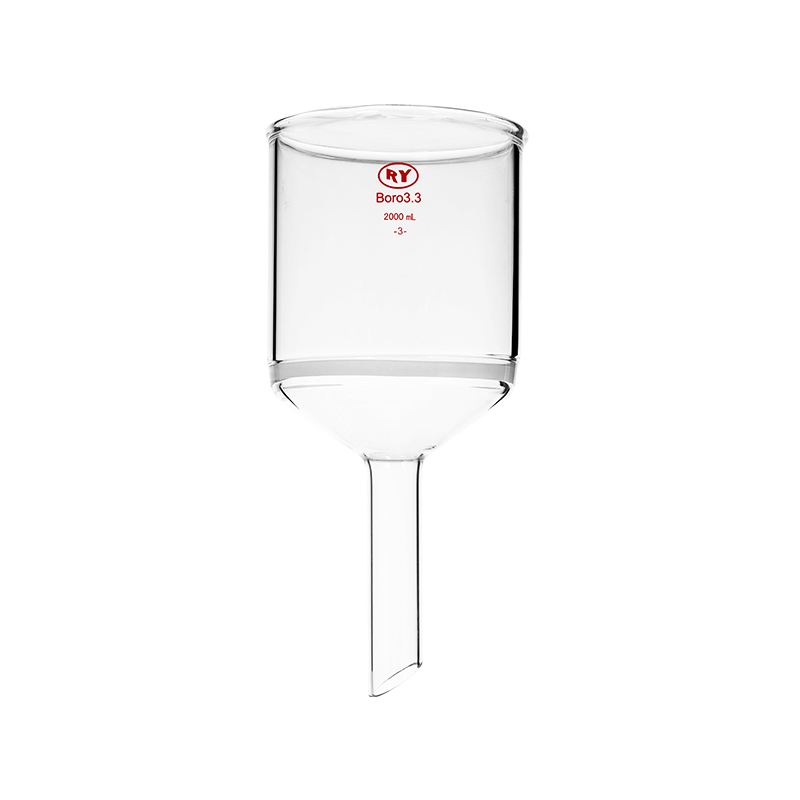
| Sintered glass funnel | Vacuum filtration without paper | Fritted disc, standard taper joint | Fine precipitates, corrosive media |
| Separatory funnel | Liquid-liquid extraction | Pear or cylindrical body, PTFE or glass stopcock | Workup, washing and phase isolation |
| Pressure-equalizing addition funnel | Controlled reagent addition | Side pressure arm, stopcock, joint | Air-sensitive or sealed reactions |
The table cannot capture everything. A gravity funnel with a long stem is the better choice when you need to reach below the neck of a flask or when you are layering liquids, while a short stem is easier to clean and drains faster. A cylindrical separatory funnel gives a longer path for phase settling and is often preferred when emulsions are stubborn, whereas a pear-shaped body offers a finer taper for drawing off the last millilitres of the lower layer. Pressure-equalizing addition funnels matter most when the reaction vessel is sealed, because they let liquid flow without creating a vacuum above it.
Matching the Funnel to the Method in Front of You
Before ordering or reaching for a funnel, four checks cover most of the decisions. These are the points our customers raise most often when they call to specify glassware for a new method.
Pore size and retention
Fritted discs are graded from coarse to fine. Coarse grades flow quickly and suit bulky solids, while fine grades hold small particles that would otherwise pass through paper. Choose the grade that traps your solid without blinding the disc.
Joint size and stem length
A standard taper joint must match the neck of your flask. Measure the joint rather than assuming, and decide whether the stem must reach below the neck for layering or phase removal.
Stopcock material
PTFE plugs resist alkaline solutions and rarely seize. Glass plugs offer excellent inertness and very fine flow control but can stick when traces of base are present. Threaded stopcocks hold up better under repeated torque.
Vacuum rating
Not every funnel or flask is made for reduced pressure. Suction work should use thick-walled or vacuum-rated components, and any component with a star crack should be retired immediately.
Speed is the other variable chemists weigh. The chart below is a qualitative guide to typical bench experience rather than measured laboratory data, but it reflects the pattern most people notice after a few weeks in the lab: vacuum does the heavy lifting, while gravity methods trade speed for simplicity.
Figure 1. Relative filtration speed by setup, shown as a qualitative guide for method planning.
Separatory Funnels and the Art of a Clean Extraction
Extraction is where funnel technique shows. A pear-shaped separatory funnel with a PTFE plug is the workhorse for washing an organic layer, removing acid or base residues, and isolating a product from an aqueous phase. The pear shape narrows to a fine tip, which makes it easier to see the interface and stop the flow at exactly the right moment, while the PTFE plug keeps the stopcock turning freely even after contact with dilute alkali.
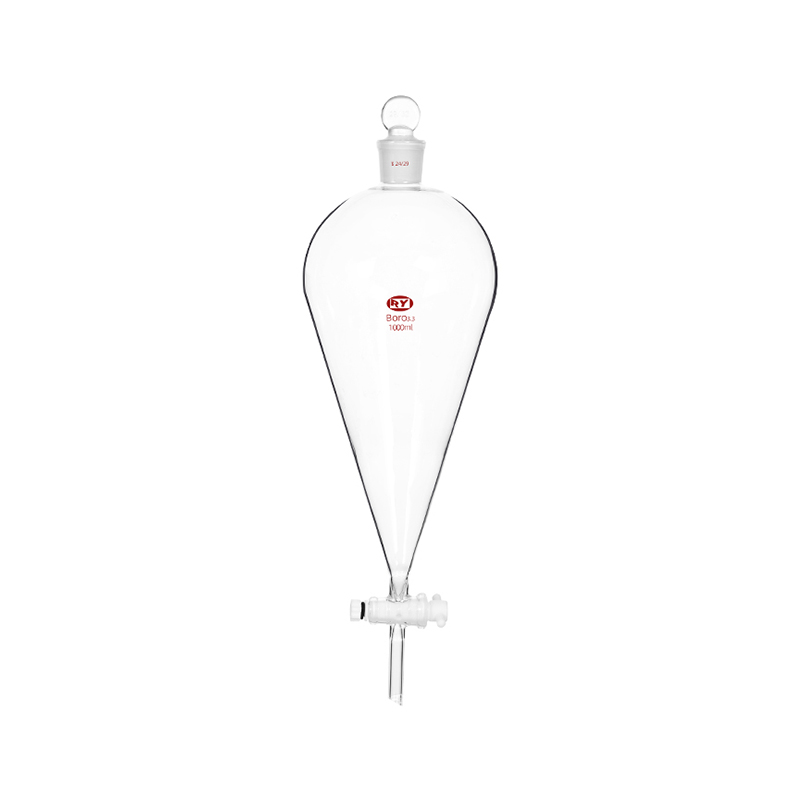 Pear-Shaped Separatory Funnel with PTFE Stopcock PlugFor solvent extraction and washing, its fine tip and chemical-resistant PTFE plug help control layer separation and resist dilute alkali.View Product →
A few habits make the difference between a clean separation and a lost batch. Never fill the funnel more than about two thirds, because you need room to swirl. Close the stopcock, hold the stopper firmly, invert the funnel, and vent through the stopcock every few shakes, because volatile solvents build pressure quickly at room temperature. Let the layers settle without agitation before you drain, and if an emulsion forms, gentle swirling or a brief rest will usually resolve it before you resort to adding brine.
Choose a cylindrical body when your mixture tends to emulsify or when the volume is large, and a pear shape when precision at the interface matters more. Both benefit from a stand ring that matches the stem diameter, so the funnel stays vertical and the stopcock does not take the weight of the contents.
Vacuum Filtration: Buchner and Sintered Glass Funnels
When speed and dryness matter, vacuum filtration is the answer. A Buchner funnel with a perforated plate and a circle of filter paper is the fastest way to recover a crystalline solid, because the paper can be replaced in seconds when a batch is finished. It handles coarse and medium crystals well, and the paper grade can be changed to suit the particle size of the product.
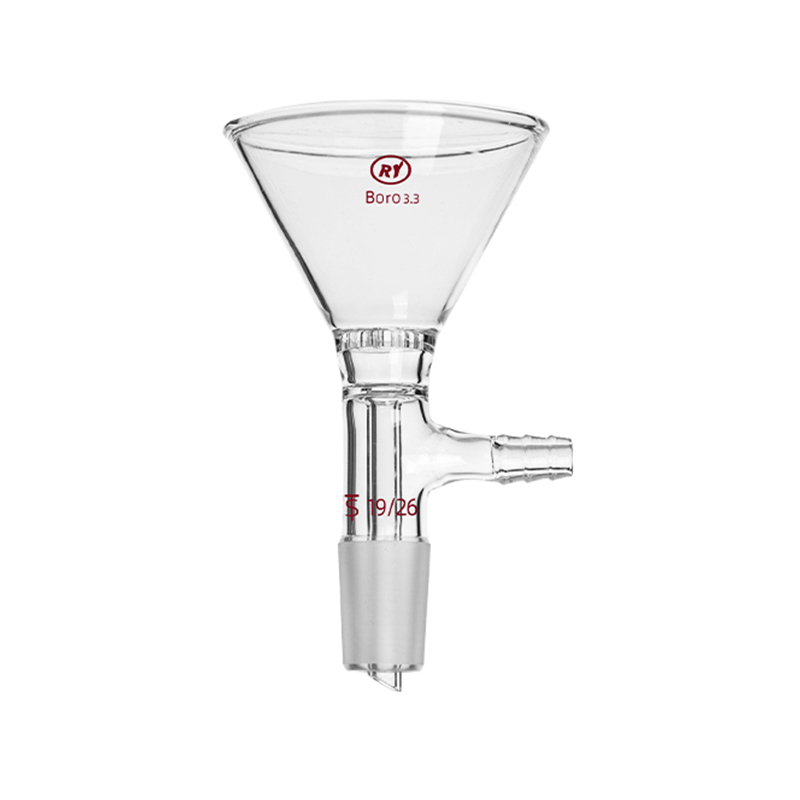 Borosilicate Glass Buchner Funnel for Vacuum FiltrationA fast option for recovering crystalline solids, compatible with suction flasks and available in several plate and joint sizes.View Product →
A sintered glass funnel solves the cases where paper is a liability. A porous glass disc will not shed fibres, tolerates aggressive solvents that would destroy cellulose, and can be cleaned and reused for hundreds of filtrations. Fine precipitates that creep through paper are usually retained by a fine grade disc. The trade-offs are a slower flow rate for gravity work, a disc that must be cleaned properly, and a higher initial cost per unit.
Whichever route you take, assemble the train the same way: funnel seated in a joint that matches the filtering flask, a clamp or support ring holding the funnel upright, and tubing routed so that liquid can never be drawn into the vacuum source. Empty the flask before it fills past the side arm, because a flask that overflows sends filtrate straight into the pump or the manifold.
Material, Joint and Stopcock Choices That Prevent Leaks
Most failures with laboratory funnels come down to three things: the wrong material, a mismatched joint, or a stopcock that was never lubricated or never serviced.
Borosilicate 3.3 glass is the default for good reason. It resists thermal shock, tolerates the acids and most solvents used in a chemistry lab, and holds its dimensions through repeated washing and autoclaving. Where alkali resistance or impact resistance matters more than transparency, polypropylene and PTFE versions have their place, particularly for funnels used with strong bases.
Joints deserve the same attention as the funnel body. Standard taper joints are manufactured to a defined taper ratio, and a worn or mismatched pair will leak or seize. Our standard ground joint glassware is produced to hold that taper consistently, which matters most when you are assembling a filtration or distillation train from parts that were bought at different times. For larger assemblies, spherical joints and flanges handle the same connection problem with more flexibility and a wider bore.
On stopcocks, the practical rules are simple. Match the plug material to the chemistry, apply the correct grease sparingly or use a PTFE sleeve where grease is unacceptable, and secure the plug with a retaining clip or stopper tie whenever the funnel may be handled or shaken. A stopcock that leaks during an extraction wastes solvent, sample and time.
Care, Cleaning and the Mistakes We See Most Often
Glassware that is washed properly at the end of the day lasts for years. These steps cover the routine we recommend.
- Rinse the funnel with the solvent used in the method immediately after use, before residues dry inside the stem.
- Wash with a warm laboratory detergent solution and a soft brush, then rinse with tap water followed by distilled water.
- For fritted discs, soak in a suitable cleaning solution, rinse from both faces under pressure, and dry in an oven at a moderate temperature.
- Dry the funnel inverted or on a peg rack so water cannot sit in the stem and leave mineral deposits.
- Inspect the cone rim, stem and frit for chips and star cracks before the next vacuum filtration.
The mistakes we hear about most often are equally predictable.
- Using a thin-walled flask or a cracked funnel under vacuum, which is the most common cause of breakage in a filtration train.
- Over-greasing a stopcock, so grease migrates into the sample or the stopcock becomes sticky in cold conditions.
- Storing a separatory funnel with the stopcock fully closed and the stopper jammed in, which makes both harder to free later.
- Trying to clean a blinded frit with a brush, which pushes particles deeper into the pores instead of removing them.
- Nesting funnels inside each other in a drawer, which is a reliable way to chip the rims.
Putting Together a Complete Filtration Setup
A funnel is only as good as the parts around it. A typical suction filtration train needs the funnel itself, a filtering flask with a side arm, an adapter or a joint to connect the two, a support ring or clamp, and tubing that will not collapse under vacuum. For gravity work, you need a stand, a ring sized to the stem, and a receiving vessel that fits under the stem without knocking the funnel out of alignment.
 Sintered Glass Filtration Funnel with Sand Core DiscFor solids filtration and analytical sample preparation, with sintered discs, chemical resistance, and gravity or vacuum use across many capacities.View Product →
This is where buying from a single source saves time. Our company has been producing standard ground joint glassware since 2002, and we build funnels alongside the flasks, adapters, stopcocks and support hardware that fit them. Because we also stock complementary glassware, consumables and equipment from other manufacturers, a single order can cover a complete setup, and our team is used to matching joint sizes and stem lengths over the phone rather than leaving you to guess. If a method calls for something outside the standard range, our workshops can produce custom components in glass, which is often the fastest route when a method is still being scaled up.
For labs that would rather plan a whole workstation at once, our filtration and separation glassware range covers funnels, fritted assemblies, filtering flasks and the supporting hardware that keeps them upright and leak-free.
Frequently Asked Questions
What is the difference between a Buchner funnel and a sintered glass funnel?
A Buchner funnel uses a removable filter paper disc on a perforated plate, so the filtration medium is replaced after each use. A sintered glass funnel has a porous glass disc fused into the funnel, so there is no paper to change, no fibre contamination, and better resistance to aggressive solvents, at the cost of a slower flow rate and more careful cleaning.
Which funnel is best for vacuum filtration of fine precipitates?
A sintered glass funnel with a fine grade disc is usually the better choice, because fine particles that creep through paper are retained by the glass frit. Use a coarse or medium grade when the solid is bulky and the priority is flow rate.
How do I stop a separatory funnel from leaking?
Check that the plug and the barrel are a matched pair, clean both surfaces, apply the correct lubricant sparingly or fit a PTFE plug, and secure the plug with a retaining clip. If the plug has been overtightened or stored dry for a long time, it may need to be freed and reseated before use.
Can I use a fritted funnel for gravity filtration?
You can, but expect a slow flow. Fritted discs are designed for suction, and a gravity filtration through a fine disc can take a long time. For routine gravity work, a 60 degree funnel with fluted paper is faster and easier to keep clean.
How do I choose the right funnel size for my filter paper?
Fold the paper so it sits inside the cone without extending above the rim, and leave a small gap between the paper edge and the glass so air can escape. If the paper sits too high or touches the sides completely, filtration slows down noticeably.
How should I clean a fritted glass funnel?
Soak the disc in a suitable cleaning solution, then rinse it from both faces under pressure so particles are pushed out the way they came in. Avoid brushing the disc, and dry it at a moderate temperature. For stubborn organic residues, a brief soak in an appropriate solvent followed by a thorough water rinse usually restores the flow rate.