English
 Français
 Español
Borosilicate Glass Melting Point: What It Is and Why It Matters for Lab Glassware
Imagine you are setting up a distillation that needs to run at 300 °C. You glance at the spec sheet for a borosilicate flask and see that borosilicate “melts at about 1,650 °C.” That number sounds reassuring, but it is misleading. Borosilicate glass does not have a single melting point like a pure metal. It softens over a wide range, and the practical temperature limit for lab glassware is far lower than the melting point. The number you should remember is about 820 °C—the softening point—and a maximum continuous working temperature of roughly 268 °C for standard borosilicate 3.3 glass. This distinction matters when you are choosing flasks, condensers, or reaction vessels for a real procedure.
What “melting point” means for borosilicate
Glass is an amorphous solid, not a crystalline one. Instead of melting at a sharp temperature, it gradually moves from a rigid state to a viscous liquid. The transition is described by viscosity-dependent points. For borosilicate 3.3 (the same family as many laboratory glassware products), the key reference values are:
- Strain point: about 515–520 °C. Below this, cooling relieves internal stress very slowly.
- Annealing point: about 560–565 °C. At this temperature, internal stress is relieved within minutes.
- Softening point: about 820 °C. This is where the glass begins to sag under its own weight.
- Working point: around 1,250–1,300 °C. This is the temperature where glass can be blown and formed by hand.
- Melting point: varies by composition, but often reported in the range of 1,250–1,400 °C. Some sources quote a higher value (around 1,650 °C) for the fully liquid state. The wide range is a natural consequence of borosilicate’s formulation and the different testing methods used.
Key temperature values for borosilicate glass
The table below gives the practical temperature points you should know when using borosilicate 3.3 glassware.
| Thermal event | Typical value (°C) | What it means for you |
|---|---|---|
| Strain point | 515–520 | Glass is brittle below this; avoid rapid cooling. |
| Annealing point | 560–565 | Stress relief occurs here. |
| Softening point | 820–830 | Glass deforms under its own weight; do not use as a working limit. |
| Working point | 1250–1300 | Glass can be shaped by a glassblower. |
| Melting range | 1250–1400 | Fully molten for manufacturing. |
| Max continuous working temp | ~268 | Safe upper limit for everyday lab use. |
Why this matters when choosing lab glassware
If a flask is rated for “high temperature” only because borosilicate melts above 1,000 °C, that rating tells you little about safe use in a laboratory. The real constraints are thermal shock and the continuous service temperature. A round-bottom flask used in a heating mantle or oil bath will see temperatures in the 200–400 °C range. Standard borosilicate 3.3 can handle that, provided the heating is gradual and the glass is not subjected to a large thermal gradient. However, if you place it directly on a hotplate and heat it too quickly, the strain point and annealing behavior come into play.
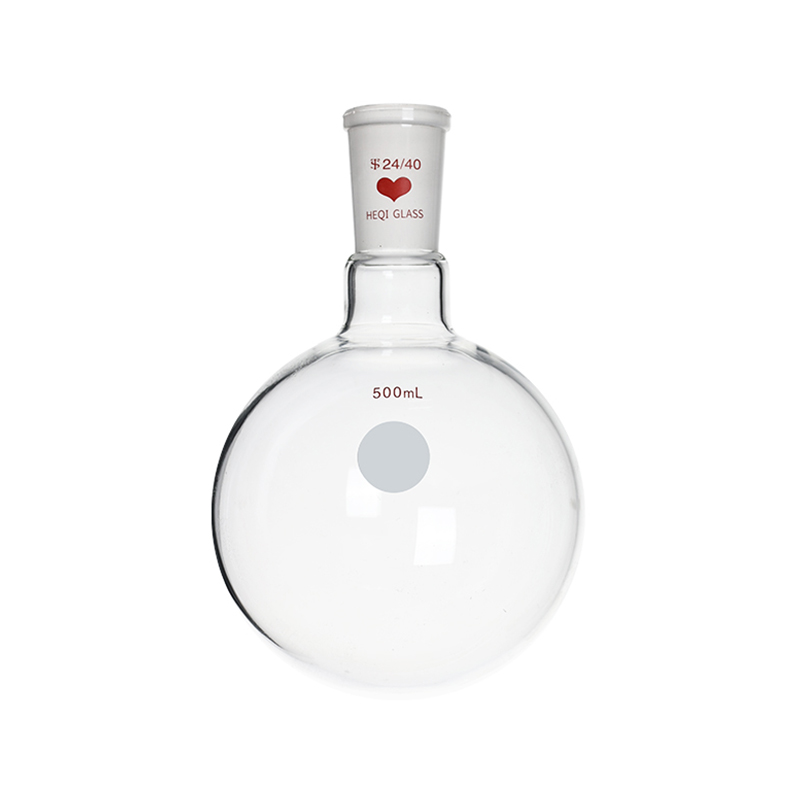 Single Neck Round Bottom Flask (Class A)Class A single neck round bottom flask, used for heating, distillation and basic chemical reaction in labs.View Product →
For example, a single-neck round-bottom flask with a standard taper joint is a common choice for reactions that require controlled heating. Its thick wall and uniform geometry help distribute thermal stress, but it is still important to avoid rapid temperature changes.
For larger-scale synthesis or reactions that need long, even heating, a jacketed reaction flask or benchtop reactor is better. The jacket is designed to hold a circulating heat-transfer fluid, which can hold the glass body at a steady temperature and prevent the localized hot spots that cause cracking. Even with these systems, the fluid temperature must stay within the glass’s practical range.
 3-Neck Jacketed Reaction Flask(Class A)Class A jacketed 3-neck flask, used for constant temperature reaction, catalytic synthesis and extraction under control.View Product →
Practical advice for working near the temperature limit
Borosilicate glass will not suddenly melt at 500 °C, but it can fail from thermal shock long before it reaches the softening point. The most common lab mistakes include placing a cold flask on a hot plate, using a burner that concentrates heat on a small area, and cooling a hot flask with water. To extend the life of your glassware, preheat the flask in a heating mantle or oil bath, use a heat shield when needed, and never exceed the manufacturer’s continuous service temperature. For routine work, staying below 250 °C keeps a wide margin of safety.
Following standard lab safety principles can help you develop good heating habits, especially when you need to push a setup to its limits.
In short, borosilicate glass melts well above any temperature you are likely to use in a lab. The thermal values that actually dictate safe operation are the softening point, the annealing point, and the continuous service temperature. Choose your glassware with those numbers in mind, and it will perform reliably for years.