English
 Français
 Español
Borosilicate Glass Temperature Limit: What Labs Should Really Know Before Heating
Content
- 1 The Short Answer: What Temperature Can Borosilicate 3.3 Take?
- 2 Strain Point, Annealing Point and Softening Point: What the Numbers Mean
- 3 Why the Printed Limit Is Rarely the Limit You Can Use
- 4 Thermal Shock: The Failure Mode Behind Most Broken Lab Glass
- 5 Working Limits in Everyday Laboratory Operations
- 6 Reflux, Distillation and Condensers at Higher Temperatures
- 7 Joints, Seals and Hardware: Where Temperature Meets Mechanics
- 8 Practical Rules for Heating and Cooling Borosilicate Safely
- 9 When Borosilicate Is Not the Right Answer
- 10 How We Approach Temperature Ratings at Heqi Glassware
- 11 Frequently Asked Questions
- 11.1 What is the maximum temperature for borosilicate glass?
- 11.2 Can borosilicate glassware go into a muffle furnace at 600 °C?
- 11.3 Will borosilicate glass crack in an oven at 150 °C?
- 11.4 Is borosilicate 3.3 the same as borosilicate 5.1?
- 11.5 Can I autoclave borosilicate glassware?
- 11.6 Can borosilicate glass be used with liquid nitrogen?
- 11.7 How can I tell whether my glassware has been overheated?
Anyone who has spent a week in a synthesis lab eventually asks the same question: how hot can borosilicate glass actually get before something goes wrong? It is a fair question, and it deserves a better answer than a single number copied from a product label.
We manufacture standard taper glassware for a living, so this question reaches our desk almost every day. In this guide we walk through what the temperature limit of borosilicate glass really means, where the useful numbers come from, and how to heat and cool glass in a way that protects both your reaction and your hands.
The Short Answer: What Temperature Can Borosilicate 3.3 Take?
If you only remember one figure, remember this one: borosilicate 3.3 laboratory glassware is normally rated for short-term exposure up to about 500 °C, and for continuous service somewhere between 250 °C and 400 °C. Those two numbers describe very different situations, and mixing them up is the source of most disappointment.
Nothing dramatic happens at 500 °C. The glass does not melt; it softens. In the softening range a flask will slowly sag under its own weight, a distillation head will lean, and a ground joint will deform permanently even after it cools down. That is why the practical ceiling for everyday work is always lower than the impressive number printed on a specification sheet.
Our rule of thumb: design normal setups around 250 to 400 °C, treat anything above 450 °C as a short and supervised exception, and never allow a hot part to touch a cold surface.
The table below collects the reference values we use when customers ask us to explain a rating.
| Property | Typical value | What it means on the bench |
|---|---|---|
| Coefficient of thermal expansion | about 3.3 ppm per degree Celsius | Low expansion is why the glass survives fast temperature change |
| Strain point | about 515 °C | Internal stress stops relaxing here, so it is not a working temperature |
| Annealing point | about 560 °C | The temperature used to remove stress during manufacturing |
| Softening point | about 820 °C | The glass deforms under its own weight; flame work happens above this |
| Short-term working temperature | about 500 °C | Only for unloaded, well supported parts with even heating |
| Continuous service temperature | about 250 to 400 °C | The range where most laboratory glassware actually lives |
| Safe thermal shock difference | roughly 100 to 140 °C | Between a hot part and whatever it touches next |
Strain Point, Annealing Point and Softening Point: What the Numbers Mean
Manufacturers quote several temperatures for the same glass, which is exactly why the topic feels confusing. These values are not competing limits. They describe different physical behaviours, and only one of them is really a usage limit.
- Strain point, around 515 °C: below this temperature, internal stress in the glass effectively stops relaxing. It is a reference point for stress, not an invitation to work there.
- Annealing point, around 560 °C: the temperature at which residual stress can be released in a reasonable time. Our furnace schedules are built around this value.
- Softening point, around 820 °C: the glass begins to flow under its own weight. Sealing, bending and flame working happen above this range, using a torch rather than an oven.
- Coefficient of thermal expansion, around 3.3 ppm per degree Celsius: the low value that gives borosilicate 3.3 its resistance to sudden temperature change. If you would like the material science behind it, we wrote a separate note on how SiO2 and B2O3 shape borosilicate 3.3.
When a catalogue says "temperature limit", it usually means the working temperature, not the strain point. When a laboratory technician says "it broke at 200 °C", it is nearly always a thermal shock problem rather than a softening problem.
Why the Printed Limit Is Rarely the Limit You Can Use
A published rating is measured on an idealised sample: clean, unstressed, evenly heated and unclamped. Your fume hood is not an idealised sample. Several ordinary factors quietly reduce the usable ceiling.
- Wall thickness and shape: thin walls follow temperature changes quickly, while thick walls hold stress for longer.
- Geometry: necks, shoulders, sealed joints and thick bases concentrate stress.
- Load: a filled flask carries weight, and a clamped flask carries bending forces that push the softening point down.
- Chemicals: hot alkali solutions and hydrofluoric acid attack the glass surface and reduce its strength over time.
- Attached hardware: PTFE, silicone and elastomer parts usually fail long before the glass does.
- Heating method: an oven heats evenly, while a flame or an uncovered mantle heats locally and unevenly.
In other words, the temperature limit of borosilicate glass is a property of your whole assembly, not of the glass alone.
Thermal Shock: The Failure Mode Behind Most Broken Lab Glass
Most broken laboratory glassware does not fail because it became too hot. It fails because one part of it became hot while another part stayed cold, and the difference arrived too quickly. Glass expands when heated; when one region expands faster than its neighbour, stress builds along the boundary between them. With borosilicate 3.3, a difference of roughly 100 to 140 °C between two areas of the same piece is usually where trouble begins.
The classics are familiar to anyone who has worked a late shift: a hot flask rinsed under the cold tap, cold water switched on abruptly through a hot condenser jacket, a crucible lifted straight from a hotplate onto a steel bench, or room-temperature solvent poured into a flask that has just come off a mantle. None of these involve a temperature anywhere near the softening point, yet all of them can crack good glassware.
Thin-walled items deserve particular respect. Condensers, test tubes and graduated pipettes have little material to absorb stress, so they are the first items to complain when temperature changes too fast.
Working Limits in Everyday Laboratory Operations
Most procedures sit comfortably inside the safe range. The list below reflects what we see in practice, and it is a useful sanity check before you plan a heating step.
- Autoclaving: saturated steam at 121 °C is routine for borosilicate glassware. Avoid opening the chamber quickly, because rapid depressurisation is harder on seals and joints than the heat itself.
- Drying ovens: 150 to 200 °C for several hours is normal. The risk is not the temperature but the transfer of hot glass onto cold surfaces.
- Heating mantles and oil baths: up to about 250 °C covers the vast majority of reflux work. Silicone oil baths are usually limited by the oil, not by the glass.
- Atmospheric distillation: the glass is fine; the joints, grease and thermometer adapters are the weak points.
- Vacuum distillation: here the mechanical load matters more than the temperature. Round-bottom vessels should be supported and the vacuum released slowly.
- Muffle furnaces above 550 °C: borosilicate is the wrong material. Porcelain, quartz or metal crucibles belong in that environment.
- Cryogenic work: borosilicate 3.3 handles liquid nitrogen temperatures well, provided the cooling is gradual and the glass is not simultaneously under mechanical stress.
- Microwave digestion: this requires dedicated pressure vessels rather than ordinary glassware, regardless of the material.
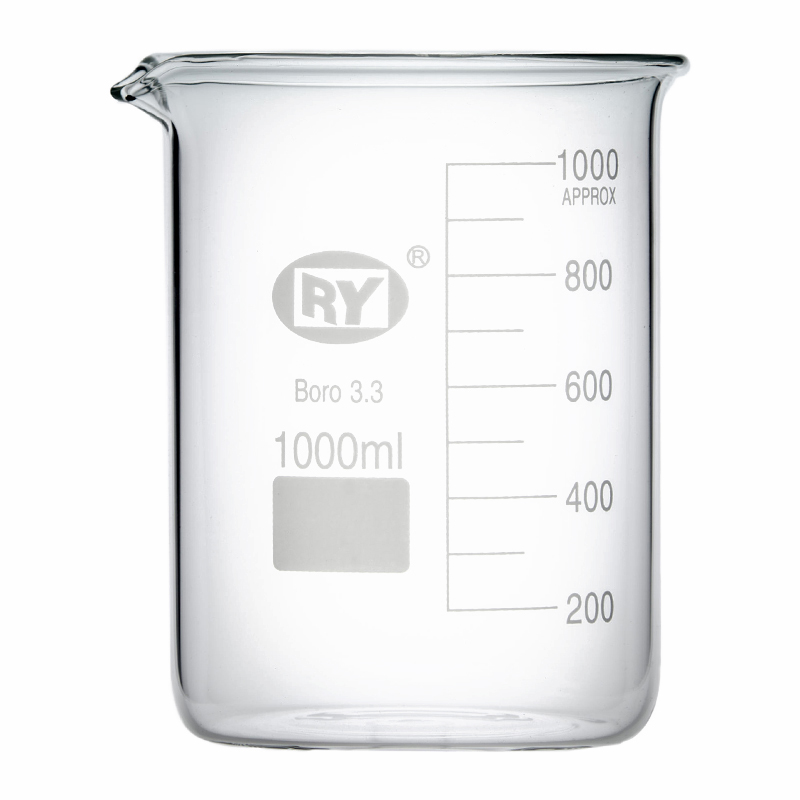
For routine oven and mantle work, consistent wall thickness matters more than any headline number, because uneven walls create uneven stress. That is one reason we keep our borosilicate 3.3 beaker bodies uniform from base to rim.
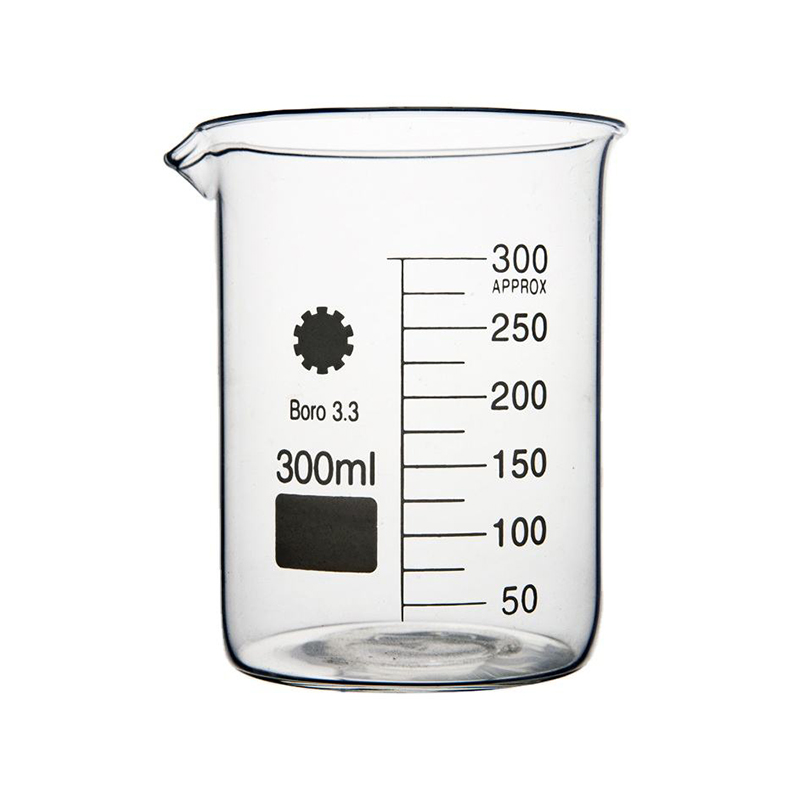 HEQI GLASS Low Form Borosilicate 3.3 BeakerUniform-wall borosilicate 3.3 beaker with clear body, ceramic markings, pouring spout, and stable base for routine heating and analytical work.View Product →
Reflux, Distillation and Condensers at Higher Temperatures
Condensers are the thinnest and most exposed part of a hot assembly, which makes them the place where temperature limits and thermal shock meet. Allihn, Graham, Liebig and cold finger designs all do the same job with different efficiency, and each of them prefers a different kind of heat load.
A few habits keep condensers alive longer. Start the cooling water before you start heating, so the jacket is already at operating temperature when vapour arrives. Never switch cold water into a jacket that is already hot. Insulate the vapour path when the boiling point is high, and consider an air condenser for very hot vapours, because a liquid-cooled jacket can create too steep a gradient. If the coolant ever stops flowing, switch off the heat source first and let the assembly cool in place.
For general reflux duty, a bulb condenser gives a good balance between surface area and pressure drop, and it tolerates the moderate shock of a hot vapour meeting a cooled wall.
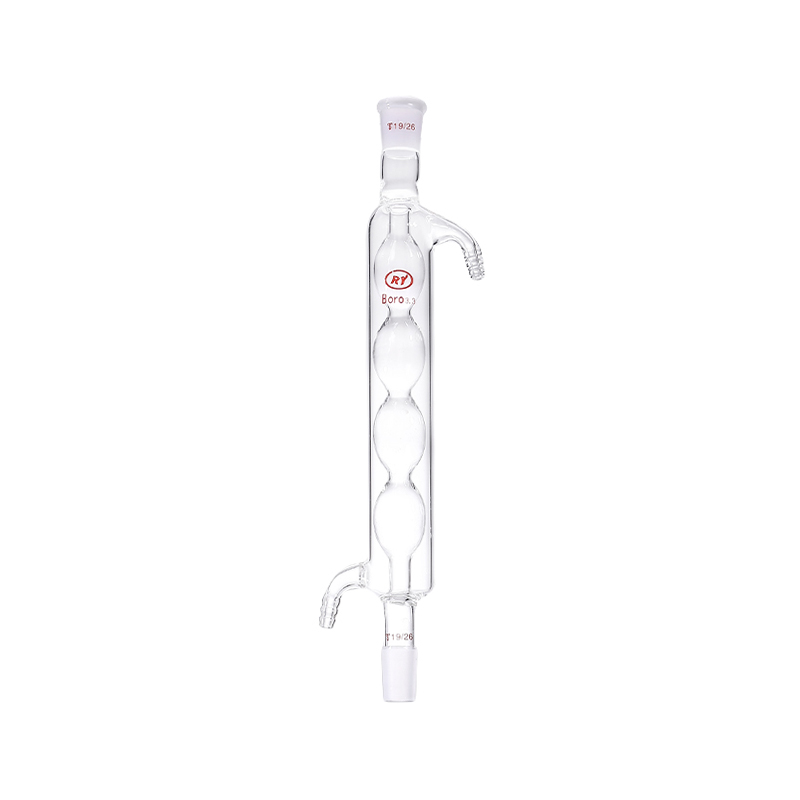 Allihn Borosilicate Glass Condenser for Reflux and DistillationSpherical-bulb condenser suited to routine reflux and distillation, available in multiple joint sizes and bulb counts for varied laboratory setups.View Product →
Joints, Seals and Hardware: Where Temperature Meets Mechanics
Once a glass assembly goes above roughly 200 °C, the components around the glass start to set the real limit. Hardware is often overlooked until a stopcock seizes or tubing hardens, so it is worth planning for.
- PTFE components: continuous use up to about 260 °C, with deformation beginning beyond that range.
- Silicone tubing and vacuum grease: degrade well below 250 °C and may release volatiles that contaminate a reaction.
- Ground joints: at high temperature, standard taper joints can seize. Keep them clean, avoid over-tightening, and separate them while still warm if a run has been hot.
- Vacuum: a vacuum adds mechanical load to the same part that is already hot, which is why vacuum distillations deserve slower heating ramps.
- Clamps and supports: metal clamps conduct heat away from glass and create local cold spots. Use a flexible support ring or a soft collar where possible.
Practical Rules for Heating and Cooling Borosilicate Safely
These are the habits we recommend to every laboratory we supply, and they solve the majority of breakage complaints without any change of equipment.
- Heat gradually, and allow at least a few minutes for a large vessel to reach an even temperature.
- Preheat the whole assembly, including adapters and receivers, rather than the flask alone.
- Support every vessel properly, and never leave a round-bottom flask standing unsupported on a hot surface.
- Never quench hot glass in cold water, and never pour cold liquid into a hot flask.
- Use a mantle, oil bath or sand bath for thin-walled items; keep open flames for flame-working tasks only.
- Inspect glassware before each run for chips, star cracks and cloudy joints, and retire damaged pieces.
- Keep a slow cooling path open at the end of a run, and let the assembly reach room temperature before disassembly.
- Label high-temperature setups clearly so that a colleague does not start cooling or dismantling them by reflex.
When Borosilicate Is Not the Right Answer
Borosilicate 3.3 covers most laboratory needs, but it is not the universal choice. Comparing continuous-use ceilings for common lab materials makes the trade-offs obvious.
Bar lengths are proportional to the typical continuous-use ceiling of each material, not to any single product rating.
Above roughly 550 °C, fused quartz becomes the natural upgrade because its expansion coefficient is even lower and its softening point is far higher, although it costs considerably more and is less tolerant of alkali attack. Porcelain and metal take over for ashing and ignition work, while PTFE remains useful for chemical resistance at moderate temperatures. Choosing the right material at the planning stage is almost always cheaper than replacing cracked glassware in the middle of a campaign.
How We Approach Temperature Ratings at Heqi Glassware
We have been making standard taper glassware since 2002, and temperature behaviour has shaped the way we build things. Our borosilicate 3.3 and neutral glass products are formed on mechanised and semi-mechanised lines rather than at individual benches, because consistent wall thickness is one of the most effective ways to reduce stress concentration. Our Class A volumetric and measuring items follow the same logic: an even wall and a well annealed body behave predictably when the temperature moves.
Our catalogue goes well beyond basic vessels. Alongside adapters, flasks, condensers, funnels and stopcocks, we supply the high-temperature resistant lab glassware that laboratories rely on for reflux, distillation, filtration and drying work. For groups moving from bench scale into pilot scale, our team also designs and produces custom glass components, benchtop reactors and process reactors, where the temperature question becomes a system question involving jackets, circulators, stirrers and seals at the same time.
 Custom Lab Benchtop Reactor with Integrated ControlCompact benchtop reactor integrating heating, stirring, and temperature control, made of thick-walled borosilicate 3.3 glass for small-scale synthesis and optimization.View Product →
Frequently Asked Questions
What is the maximum temperature for borosilicate glass?
Roughly 500 °C for short-term exposure with even heating and no mechanical load, and about 250 to 400 °C for continuous service. The lower figure is the one that matters in daily laboratory work.
Can borosilicate glassware go into a muffle furnace at 600 °C?
No, that is beyond the intended range. Repeated exposure to such temperatures causes deformation and permanent stress. Use quartz, porcelain or metal crucibles for ashing and ignition procedures.
Will borosilicate glass crack in an oven at 150 °C?
Not from the temperature itself. Drying ovens are routine for this material. Cracking usually comes from taking hot glass out and placing it on a cold bench, or from rinsing it too early.
Is borosilicate 3.3 the same as borosilicate 5.1?
No. The number refers to the coefficient of thermal expansion, so 3.3 glass expands less than 5.1 glass and withstands thermal shock better. Material identification matters when you write specifications.
Can I autoclave borosilicate glassware?
Yes. Steam at 121 °C is well within range. Let the chamber depressurise gradually and allow the load to cool before removing it, because the pressure change is more demanding than the temperature.
Can borosilicate glass be used with liquid nitrogen?
Generally yes, provided the cooling is gradual and the vessel is not simultaneously loaded or clamped in a way that adds stress. Direct immersion of a warm, stressed part is where problems appear.
How can I tell whether my glassware has been overheated?
Look for a sagging or distorted profile, a cloudy surface that no longer cleans, joints that no longer seat smoothly, or a permanently milky appearance. Any of these signs means the piece should be retired from heating duty.
Temperature limits are one of those topics where a single number never tells the whole story, and that is precisely why we like talking about them. Whether you are choosing a condenser for a high-boiling solvent, planning a pilot run in a jacketed reactor, or simply replacing a set of beakers that has served a long and honest life, we are happy to help you work out what your setup can safely handle.
Send us your procedure, your solvent and your scale, and we will suggest a glass configuration that suits all three.