Understanding Modern Distillation Systems in Commercial and R&D Settings
The Evolution of Distillation Technology in Industrial Laboratories
The landscape of chemical separation has undergone a profound transformation over the past two decades. What was once reliant on manual glassblowing and loose-fitting cork assemblies has evolved into highly engineered, automated, and tightly integrated chemical processing systems. In modern research facilities and pilot plants, precision is paramount. The shift from basic laboratory glassware to advanced lab distillation equipment has been driven by the need for higher purity yields, tighter thermal control, and rigorous safety compliance in scale-up operations.
Behind this technological evolution is a shift in manufacturing methodologies. Established production pioneers like Shanghai Heqi Glassware Co., Ltd., founded in March 2002, recognized early on that traditional workshop-style fabrication could no longer meet the stringent demands of modern industrial chemistry. By integrating mechanized and semi-mechanized techniques alongside assembly-line industrial processes across its major production bases in Songjiang, Chengdu, Jiaxing, and Yancheng, the industry has bridged the gap between artisanal glass craft and heavy-duty industrial engineering. This evolution ensures that every piece of lab distillation equipment delivers consistent thermal shock resistance, exact standard-taper joint tolerances, and structural reliability required for continuous commercial operation.
Key Sectors Relying on High-Purity Distillation
Advanced separation technology underpins a wide variety of industrial and scientific sectors. Procurement teams in these fields look for robust apparatus capable of handling heavy chemical loads without degrading.
Pharmaceutical and API Synthesis: Active pharmaceutical ingredient (API) production requires absolute solvent recovery and trace-level impurity removal. High-grade lab distillation equipment ensures that sensitive organic compounds are isolated under controlled thermal profiles, preventing degradation during multi-step synthesis.
Petrochemical Analysis and Quality Control: Refineries and fuel testing laboratories utilize fractional and atmospheric distillation units to determine boiling range distributions, flash points, and volatile hydrocarbon fractions with strict adherence to international testing standards.
Chemical Manufacturing and Solvent Recovery: Industrial chemical plants rely on continuous distillation systems to reclaim expensive or hazardous solvents, drastically reducing waste disposal overhead and lowering raw material procurement costs.
Essential Oils, Food Processing, and Botanical Extraction: Large-scale extraction facilities utilize specialized distillation setups to isolate pure botanical compounds, terpenes, and food-grade aromas without exposing delicate matrices to excessive heat degradation.
To support these diverse sectors efficiently, operational supply chains must be robust. Operating under a commitment of “you make a call, we handle the rest,” Shanghai Heqi Glassware Co., Ltd. not only manufactures its own specialized lines of glass instruments and experimental machinery but also maintains ample inventory of high-quality lab consumables and auxiliary equipment. This comprehensive supply capability ensures that corporate procurement managers face minimal operational downtime, backed by fast delivery and specialized technical support from initial inquiry to final plant commissioning.
Essential Categories of Lab Distillation Equipment for Large-Scale Operations
Simple and Fractional Distillation Units
For routine purification, solvent cleanup, and boiling-point separation, simple and fractional distillation setups remain staple assets in both R&D labs and pilot production floors. Standard configurations must balance ease of assembly with structural durability. Industrial-grade lab distillation equipment in this category typically features heavy-wall borosilicate glass components coupled with precision ground-glass joints (such as standard-taper 24/40 or larger flange connections) to prevent vacuum leaks under high-temperature reflux conditions.
| Parameter / Feature |
Simple Distillation Configuration |
Fractional Distillation Configuration |
| Primary Application |
Separation of liquids with boiling point differences greater than 70 degrees Celsius |
Separation of closely boiling liquids with delta bp less than 25 degrees Celsius |
| Column Type |
Straight air or water-cooled condenser |
Vigreux, packed column (Raschig rings), or Oldershaw plates |
| Theoretical Plates |
Low (1 to 2) |
High (10 to 30+ depending on column height) |
| Typical Material Base |
Heavy-duty borosilicate glass 3.3 |
Borosilicate glass 3.3 with insulated vacuum jackets |
Short-Path Molecular Distillation Systems
When processing thermally sensitive compounds, high-boiling-point organics, or heavy molecular weight oils, standard distillation methods often fail due to thermal decomposition. Short-path molecular distillation solves this by maintaining a high vacuum environment (0.001 to 1 mbar) and minimizing the distance the vapor travels from the heated evaporator surface to the internal condenser.
Procurement specialists evaluating short-path lab distillation equipment must look closely at surface area ratios, wiper-blade mechanisms (roller wiper vs. sliding wiper systems for continuous film distribution), and cold trap integration. Shanghai Heqi Glassware Co., Ltd. addresses these complex engineering requirements through its dedicated R&D team—bringing together chemical research experts, mechanical designers, and electronic control specialists within its specialized glass, metalworking, and assembly workshops—to produce highly efficient short-path units tailored for pilot-scale output.
Rotary Evaporators and Industrial-Scale Evaporation Integration
Solvent removal is often the most time-consuming bottleneck in chemical processing lines. The integration of rotary evaporators with downstream lab distillation equipment allows facilities to scale operations seamlessly from benchtop formulation to multi-liter production.
Benchtop Units (1L to 5L): Ideal for academic research, small-batch formulation, and initial chemistry screening.
Pilot and Production Units (20L to 50L and above): Designed for continuous plant operation, featuring motorized lift mechanisms, explosion-proof digital rotation drives, and high-capacity vertical condensers designed for rapid solvent stripping.
Fractional Columns and Specialized Glassware/Metalware
Achieving high theoretical plate counts requires specialized internal column architecture. Facilities scaling up processes frequently transition between different column designs depending on throughput and separation efficiency goals:
Vigreux Columns: Feature internal indentations that maximize vapor-liquid contact surface area while maintaining a compact vertical profile.
Packed Columns: Utilizes inert packings (such as stainless steel or glass helices and rings) to facilitate intensive mass transfer.
Jacketed Metal Columns: For high-pressure or high-stress industrial environments, custom metal columns integrated into the lab distillation equipment assembly offer unmatched mechanical impact resistance compared to standard glass.
Crucial Technical Specifications and Material Compliance for Buyers
Material Integrity: Borosilicate Glass vs. Stainless Steel (SS304/SS316L)
The selection of construction materials dictates the lifespan, chemical compatibility, and operational safety of any heavy-duty processing setup. When procuring lab distillation equipment for commercial or pilot-plant environments, engineering teams must evaluate whether borosilicate glass or industrial-grade stainless steel best suits their chemical streams.
Borosilicate Glass (3.3): Renowned for its exceptional resistance to thermal shock and broad chemical inertness against most acids, organic solvents, and halogens (with the exception of hydrofluoric acid and hot phosphoric acid). Glass allows operators visual oversight of reflux and phase separation in real time.
Stainless Steel (SS304 / SS316L): Indispensable for high-pressure or high-volume setups where mechanical durability and thermal conductivity supersede the need for visual transparency. SS316L, in particular, offers superior resistance to chloride-induced pitting corrosion.
| Material Property |
Borosilicate Glass (3.3) |
Stainless Steel (316L) |
| Max Operating Temperature |
Approximately 500 degrees Celsius (short-term) / 230 degrees Celsius (recommended continuous) |
Greater than 600 degrees Celsius depending on gasket ratings |
| Thermal Shock Resistance |
High (delta T approximately 100 degrees Celsius to limits) |
Excellent (unaffected by rapid thermal cycling) |
| Visual Monitoring |
Complete transparency for reaction and phase observation |
Opaque; requires sight glasses or digital sensors |
| Corrosion Resistance |
Universal for acids and organics; vulnerable to HF/alkalies |
High resistance to pitting and organic solvents; varies with strong halides |
To meet rigorous international manufacturing benchmarks, Shanghai Heqi Glassware Co., Ltd. implements strict material traceability protocols. Operating across specialized workshops dedicated to glassblowing, precision metalworking, and final electrical assembly, the company ensures that every piece of lab distillation equipment—whether featuring standard-taper borosilicate glassware or custom stainless steel reactor flanges—complies with FDA, USP, and industrial GMP guidelines for purity and structural safety.
Automation, Temperature Control, and Safety Integration
Modern chemical processing demands precise environmental management to prevent thermal runaway and product degradation. Enterprise-grade lab distillation equipment relies on sophisticated control automation rather than manual oversight.
Digital PID Temperature Controllers: Ensure precise heating mantle and oil bath regulation within plus or minus 0.1 degrees Celsius, critical for fractional distillation cuts.
Explosion-Proof Ratings: Integration of Class I, Division 1 or ATEX-certified stirrer motors, heating elements, and electrical control boxes when handling flammable organic vapors.
Fail-Safe Interlocks: Automated coolant flow monitors, over-temperature thermal cutoffs, and digital vacuum relief valves designed to shut down the system automatically if cooling water pressure drops or system pressure spikes.
Through the close collaboration of its chemical R&D, mechanical design, and electronic control specialists, Shanghai Heqi Glassware Co., Ltd. builds integrated control architectures directly into its distillation systems, minimizing human error and maximizing facility safety compliance.
Customization Capabilities for Specific Plant Requirements
Off-the-shelf catalog configurations rarely fit every unique industrial workflow. Facility engineers frequently face spatial constraints, specialized port requirements, or non-standard utility connections when integrating new machinery into existing plant infrastructure.
Addressing this challenge requires a manufacturing partner with deep in-house fabrication flexibility. Leveraging its integrated design and custom production capabilities for both glass components and metal infrastructure, Shanghai Heqi Glassware Co., Ltd. supports chemical and pharmaceutical producers by tailoring jacketed reaction vessels, condenser surface areas, distillation column heights, and flange dimensions. This custom fabrication approach ensures that the installed lab distillation equipment aligns seamlessly with plant piping, thermal circulation loops, and auxiliary vacuum infrastructure without costly facility retrofits.
Strategic Sourcing: Evaluating Manufacturers and OEM/ODM Partnerships
Direct-from-Factory Advantage vs. Distributor Sourcing
When scaling up infrastructure, enterprise procurement managers face a fundamental choice between purchasing through third-party catalog distributors or engaging directly with established manufacturing plants. Sourcing lab distillation equipment through intermediary traders often introduces unnecessary markup, extended communication chains, and limited technical flexibility.
Partnering directly with an experienced production facility eliminates these bottlenecks. Direct manufacturing partnerships ensure transparent pricing, direct engineering consultations for custom builds, and strict quality control over every production batch. Operating multiple dedicated production bases across Songjiang, Chengdu, Jiaxing, and Yancheng, Shanghai Heqi Glassware Co., Ltd. exemplifies this direct-from-factory model. By shifting from traditional manual methods to mechanized assembly-line production, the company controls overhead costs while maintaining meticulous craftsmanship over every glass instrument, rotary evaporator, and distillation unit leaving the facility.
Quality Assurance and Factory Acceptance Testing (FAT)
Industrial buyers handling hazardous chemicals or regulated pharmaceutical compounds cannot afford equipment failure. Rigorous quality assurance protocols must be verified before any heavy machinery is shipped to a plant site.
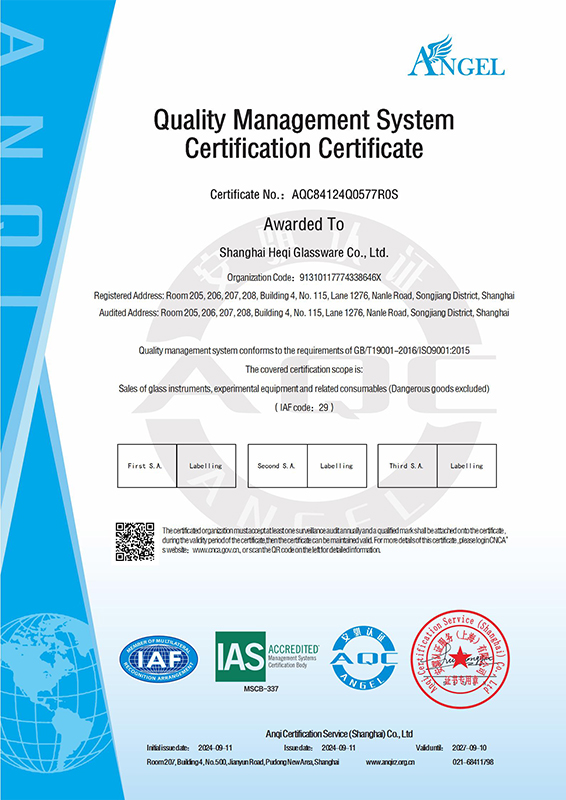
ISO 9001 and CE Compliance: Validates that the manufacturing environment adheres to internationally recognized quality management and safety standards.
Factory Acceptance Testing (FAT): Involves hydrostatic pressure testing of vessels, vacuum integrity checks, and electrical safety inspections.
Material Test Reports (MTRs): Documentation verifying the exact metallurgical composition of stainless steel components (such as SS316L flanges) and purity grades of borosilicate glass (3.3).
| Sourcing Evaluation Metric |
Third-Party Distributor |
Direct Factory Partner (e.g., Shanghai Heqi Glassware Co., Ltd.) |
| Price Competitiveness |
Moderate to High (includes intermediary markups) |
Direct-to-buyer factory pricing with volume scaling |
| Customization Flexibility |
Extremely limited (off-the-shelf catalog only) |
Full OEM/ODM support for custom glass and metal configurations |
| Technical Support Depth |
Relies on general sales reps |
Direct access to in-house chemical, mechanical, and electronic engineers |
| Lead Time & Inventory Visibility |
Variable; dependent on third-party supply chain |
Direct production tracking and ample active stock inventory |
Minimum Order Quantities (MOQs), Pricing Tiers, and Bulk Logistics
Procuring heavy industrial and laboratory machinery requires careful coordination of shipping logistics, freight insurance, and payment terms. Because lab distillation equipment combines fragile high-grade borosilicate glass with heavy stainless steel frameworks, transport logistics demand specialized handling.
Corporate buyers benefit from working with partners that offer flexible volume pricing tiers, transparent Minimum Order Quantities (MOQs), and tailored export packaging. Upholding its commitment of "you make a call, we handle the rest," Shanghai Heqi Glassware Co., Ltd. maintains robust active inventory and coordinates closely with international freight forwarders. By utilizing custom-engineered export-grade wooden crating, shock-absorbent internal reinforcement, and comprehensive customs documentation, the company ensures that delicate distillation assemblies and auxiliary experimental equipment arrive at global plant sites intact, on schedule, and ready for commissioning.
After-Sales Support, Warranty, and Lifecycle Management for Enterprise Buyers
Comprehensive Warranty Coverage and Spare Parts Availability
Purchasing high-throughput laboratory and industrial machinery is a long-term capital investment. For plant managers and procurement teams, the relationship with a equipment manufacturer does not end upon delivery; it requires continuous lifecycle support to maximize operational uptime. Sudden component failures—such as a cracked condensation coil, worn PTFE vacuum seals, or a degraded heating element—can bring an entire pilot production line to a costly halt.
To mitigate operational risk, enterprise buyers must prioritize suppliers that offer robust warranty terms and ready access to replacement parts. Shanghai Heqi Glassware Co., Ltd. addresses this need by maintaining ample active inventory across its major regional hubs. Beyond its core manufacturing output of glass reactors, rotary evaporators, and distillation units, the company ensures that critical wear-and-tear components and specialized lab consumables are always readily available. This logistical preparedness guarantees that replacement parts can be dispatched swiftly, minimizing unplanned downtime and keeping facility operations running smoothly.
Technical Training, Installation Support, and Documentation
Complex distillation systems—ranging from short-path molecular setups to multi-stage fractional columns—demand precise installation and calibration. Improper setup can compromise separation efficiency, vacuum integrity, and plant safety.
A reliable manufacturing partner provides comprehensive technical documentation and engineering assistance to streamline commissioning. This includes detailed standard operating procedures (SOPs), electrical wiring schematics, and optional IQ/OQ (Installation Qualification and Operational Qualification) validation protocols tailored for highly regulated pharmaceutical and chemical manufacturing environments.
| Lifecycle Support Phase |
Enterprise Requirement |
Value Delivery & Implementation |
| Initial Commissioning |
Clear setup guides and technical guidance |
Provision of comprehensive user manuals, wiring diagrams, and remote engineering troubleshooting support. |
| Regulatory Compliance |
Complete documentation packages |
Supply of material test reports (MTRs), pressure test logs, and validation support packages for QA/QC audits. |
| Maintenance & Servicing |
Rapid access to replacement components |
Immediate dispatch of high-turnover spares (seals, glassware, heating mantles) from extensive active stock. |
To deliver on its core service promise of “you make a call, we handle the rest,” Shanghai Heqi Glassware Co., Ltd. backs its equipment with responsive technical support. The company’s dedicated R&D team—comprising specialists in chemical engineering, mechanical design, and electronic control systems—stands ready to assist plant engineers with remote troubleshooting, custom installation advice, and operational optimization.
Total Cost of Ownership (TCO) Considerations
When evaluating capital expenditures (CAPEX) for lab distillation equipment, sophisticated corporate buyers look beyond the initial purchase price to calculate the total cost of ownership over the equipment's lifecycle. A low-cost system that suffers from frequent component degradation, high energy consumption, or poor chemical resistance will quickly incur steep operational expenses (OPEX) through maintenance overhead and lost production time.
Investing in heavy-duty, expertly engineered machinery drastically reduces long-term operational friction. By utilizing mechanized and semi-mechanized production methods to ensure consistent wall thickness in borosilicate glass and precision welding in stainless steel structures, Shanghai Heqi Glassware Co., Ltd. helps enterprise clients lower their overall maintenance overhead. Durable materials, energy-efficient heating controls, and modular design architectures combine to extend equipment lifespan, providing chemical plants and research facilities with a high return on investment and reliable, day-in, day-out performance.
Frequently Asked Questions (FAQ) and Technical Insights
What are the primary differences between benchtop units and pilot-plant lab distillation equipment?
The distinction between benchtop and pilot-plant systems lies primarily in scale, throughput capacity, automation level, and construction materials. Benchtop units—such as 1L to 5L rotary evaporators or simple glassware setups—are engineered for initial chemical screening, academic research, and small-batch formulation. They prioritize compact footprints and rapid manual adjustments.
In contrast, pilot-plant scale systems are built for continuous, high-volume processing (20L to 50L and above). They integrate heavy-duty stainless steel frameworks, advanced digital automation, explosion-proof electrical ratings, and high-capacity auxiliary support systems. To accommodate these varying operational scales, Shanghai Heqi Glassware Co., Ltd. utilizes specialized workshops dedicated to glassblowing, metalworking, and electrical assembly, enabling the production of both agile benchtop instruments and large-scale industrial distillation units tailored to exact facility requirements.
| Operational Parameter |
Benchtop Lab Distillation Units |
Pilot-Plant Distillation Systems |
| Capacity / Volume |
1L to 5L |
20L to 50L+ (custom scalable) |
| Primary Material |
Heavy-wall borosilicate glass 3.3 |
Hybrid borosilicate glass and heavy-duty stainless steel (316L) |
| Automation Level |
Manual or semi-automated rotation and heating |
Full digital PID control, automated fraction collection, and remote safety interlocks |
| Environment Suitability |
Standard laboratory fume hoods |
Dedicated pilot plant floors; explosion-proof options available |
How do factory-direct suppliers ensure the safe global transport of fragile distillation setups?
Transporting complex distillation assemblies requires specialized packaging engineering. Because these systems combine fragile high-grade borosilicate glass components with heavy metal frames, standard shipping methods are insufficient.
Established manufacturing plants mitigate transit risks by employing custom-engineered, export-grade wooden crating reinforced with high-density, shock-absorbent internal foam molding designed to isolate individual glassware pieces from external vibrations and impacts. Shanghai Heqi Glassware Co., Ltd. coordinates closely with international freight forwarders to ensure that sensitive experimental equipment and delicate glass components arrive at global enterprise sites intact, fully protected, and ready for immediate deployment.
Can manufacturers customize distillation units for hazardous or explosive chemical environments?
Yes. Chemical and petrochemical processing often involves volatile organic solvents that present severe explosion hazards. Standard commercial electronics and heating mantles are unsuitable for these environments.
Compliant manufacturers integrate specialized safety ratings into their machinery. For instance, systems destined for hazardous zones can be built using ATEX or Class I, Division 1 explosion-proof motors, non-sparking mechanical drives, and sealed control panels. Drawing upon its in-house mechanical design and electronic control expertise, Shanghai Heqi Glassware Co., Ltd. regularly customizes its distillation units, reactors, and circulation systems to meet precise hazardous-location safety classifications required by international chemical plants.
What documentation is typically provided with commercial orders for regulatory compliance?
Operating within regulated industries such as pharmaceuticals, fine chemicals, and food processing requires comprehensive documentation to satisfy strict quality assurance and government audits. When procuring commercial-grade lab distillation equipment, enterprise buyers should expect a complete technical package accompanying the shipment.
Standard documentation packages typically include material test reports (MTRs) for wetted stainless steel parts, certificate of conformity for borosilicate glass purity (3.3), pressure test logs for jacketed vessels, detailed wiring diagrams, and operational user manuals. For heavily audited facilities, optional IQ/OQ (Installation Qualification and Operational Qualification) validation protocols are also provided. Upholding its commitment of "you make a call, we handle the rest," Shanghai Heqi Glassware Co., Ltd. supplies thorough documentation with every order, ensuring plant engineers and quality control managers have full traceability from initial factory production to final plant commissioning.


 English
 Français
 Español