The Working Concept of Lab Inert Gas Vacuum Manifolds
In many advanced laboratory processes, controlling the atmosphere inside an experimental system is just as important as controlling temperature, pressure, and chemical conditions. Experiments involving air-sensitive materials, reactive compounds, organometallic chemistry, and high-purity sample preparation often require the removal of oxygen and moisture while maintaining a stable inert environment.
Lab Inert Gas Vacuum Manifolds are specialized laboratory devices designed to combine vacuum evacuation and inert gas supply functions in a single system. By alternating between vacuum and inert gas operations, these manifolds allow researchers to create controlled atmospheres for sensitive experiments while improving safety, efficiency, and reproducibility.
Widely used in chemistry, pharmaceutical research, material science, and advanced synthesis laboratories, inert gas vacuum manifolds have become essential tools for experiments requiring precise atmospheric control.
A Lab Inert Gas Vacuum Manifold is a specialized distribution system that connects a vacuum source and an inert gas supply line to multiple laboratory reaction vessels or experimental setups.
Unlike standard vacuum manifolds that only distribute vacuum pressure, inert gas vacuum manifolds are designed for two-way operation. They allow researchers to remove unwanted gases from a system and then introduce high-purity inert gases such as nitrogen or argon.
| Operation Mode |
Main Function |
| Vacuum Mode |
Removes air, oxygen, moisture, and volatile contaminants from the experimental system |
| Inert Gas Mode |
Introduces nitrogen, argon, or other protective gases into the system |
| Cycle Operation |
Repeats vacuum and gas filling cycles to achieve a highly controlled atmosphere |
| Isolation Control |
Allows individual reaction vessels or chambers to be operated independently |
This vacuum-inert gas switching capability makes these manifolds particularly valuable for experiments where exposure to oxygen or moisture may affect reaction results.
Why Inert Gas Vacuum Manifolds Are Important in Laboratories
Many chemical substances are highly sensitive to oxygen and water vapor. When exposed to normal atmospheric conditions, they may oxidize, degrade, or react unexpectedly.
Lab Inert Gas Vacuum Manifolds provide researchers with a controlled environment by replacing unwanted gases with stable inert atmospheres.
| Laboratory Challenge |
Solution Provided by Inert Gas Vacuum Manifold |
| Oxygen-sensitive reactions |
Removes oxygen and maintains an inert atmosphere |
| Moisture-sensitive materials |
Reduces water vapor contamination |
| Air exposure during transfer processes |
Provides controlled gas replacement procedures |
| Multiple experimental stations |
Distributes vacuum and inert gas through multiple channels |
Main Components of Laboratory Inert Gas Vacuum Manifolds
The performance of an inert gas vacuum manifold depends on the precision and compatibility of each component. A typical system includes several key parts.
| Component |
Function |
| Vacuum Port |
Connects to a vacuum pump for gas removal |
| Inert Gas Port |
Connects to nitrogen, argon, or other gas sources |
| Branch Connections |
Provides multiple experimental connection points |
| Control Valves |
Regulates vacuum and gas flow independently |
| Pressure Monitoring Interface |
Allows observation and adjustment of system conditions |
| Glass or Metal Structure |
Provides chemical resistance and mechanical stability |
High-quality components and precise sealing are critical because even small leaks may affect the purity of the inert atmosphere.
Applications of Lab Inert Gas Vacuum Manifolds
Air-Sensitive Chemical Synthesis
In organic and inorganic chemistry, many reactions involve compounds that react with oxygen or moisture. Inert gas vacuum manifolds allow researchers to prepare and maintain oxygen-free environments during synthesis.
They are commonly used with Schlenk techniques, reaction vessels, and specialized laboratory glassware.
Pharmaceutical Research
Pharmaceutical development often requires precise control of reaction conditions. Inert gas systems help protect sensitive compounds during synthesis, purification, and preparation procedures.
Material Science Research
Advanced materials such as catalysts, polymers, and specialty chemicals may require oxygen-free processing environments. Vacuum manifolds help researchers maintain stable conditions during material preparation.
Battery and Energy Material Development
Research involving lithium-based materials and other reactive substances often requires controlled atmospheres. Inert gas vacuum manifolds provide protection against moisture and oxygen contamination.
Comparison Between Standard Vacuum Manifolds and Inert Gas Vacuum Manifolds
| Feature |
Standard Vacuum Manifold |
Inert Gas Vacuum Manifold |
| Main Function |
Vacuum distribution |
Vacuum evacuation and inert gas replacement |
| Gas Control |
Mainly controls vacuum flow |
Controls both vacuum and protective gas flow |
| Typical Applications |
Filtration, evaporation, drying |
Air-sensitive synthesis and controlled atmosphere experiments |
| System Complexity |
Relatively simple |
Requires precise valves and sealing design |
| Atmosphere Control |
Limited |
High-level oxygen and moisture control |
Material Requirements for Inert Gas Vacuum Manifolds
Because inert gas vacuum manifolds are frequently used with reactive chemicals and high-purity experiments, material selection is extremely important.
High borosilicate glass is widely used in laboratory inert gas systems because it provides excellent chemical stability and thermal resistance.
| Material Feature |
Laboratory Advantage |
| Chemical Resistance |
Compatible with various solvents and reactive substances |
| Low Thermal Expansion |
Improves safety during temperature changes |
| Transparency |
Allows researchers to observe internal conditions |
| Surface Smoothness |
Reduces contamination and simplifies cleaning |
Shanghai Heqi Glassware: Supporting Advanced Laboratory Vacuum Solutions
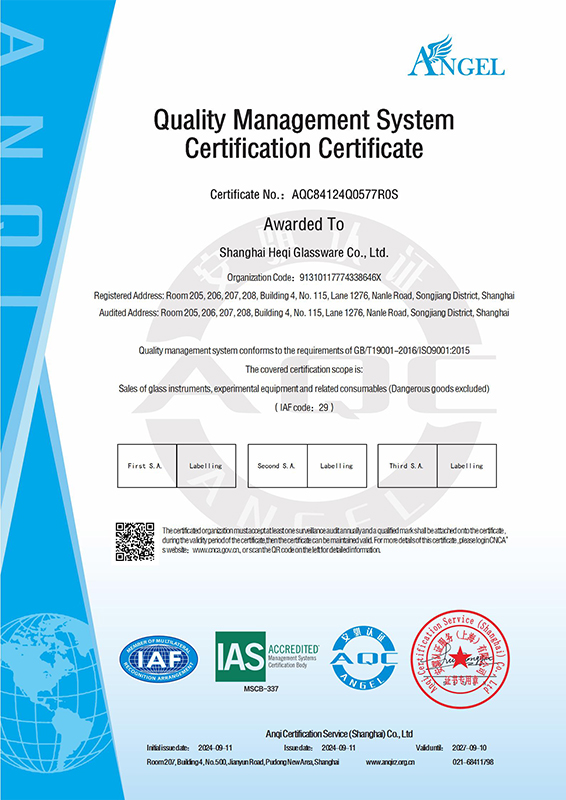
Shanghai Heqi Glassware Co., Ltd. specializes in the research, development, and production of high borosilicate glass instruments and laboratory equipment. The company provides professional glass solutions for scientific research, chemical laboratories, and industrial applications.
The R&D team consists of more than ten experienced engineers dedicated to the design and optimization of high borosilicate glass instruments and equipment. By continuously integrating internationally advanced technologies and developing solutions based on customer requirements, Shanghai Heqi improves product performance and application adaptability.
More than 10% of annual revenue is invested in technological development to support continuous innovation and maintain the company’s competitive position in the laboratory glassware industry.
During manufacturing, Shanghai Heqi’s production team follows strict quality standards. All factory personnel receive professional skills training, while automated production equipment and advanced quality control systems ensure consistent product quality throughout every production stage.
Following the principle that "details define quality", Shanghai Heqi focuses on precision in glass processing, structural design, product inspection, and performance reliability.
The company’s customer service team provides comprehensive support from product consultation and customized solutions to technical assistance and after-sales service. Through efficient logistics management and professional technical support, Shanghai Heqi helps customers achieve reliable laboratory operations.
Future Trends of Lab Inert Gas Vacuum Manifolds
With increasing demand for precision chemistry, advanced materials, and controlled laboratory environments, inert gas vacuum manifold technology continues to develop.
| Development Trend |
Future Direction |
| Higher Sealing Performance |
Improved leak prevention for high-purity applications |
| Modular Design |
Flexible configurations for different experimental systems |
| Automation Integration |
Connection with digital monitoring and control systems |
| Advanced Materials |
Greater chemical resistance and durability |
| Miniaturized Systems |
Compact solutions for modern research laboratories |
As laboratories continue to require safer and more controlled experimental environments, Lab Inert Gas Vacuum Manifolds will remain an important technology for achieving precise atmosphere management in advanced scientific research.


 English
 Français
 Español