Understanding the Role of Lab Rotary Evaporator Condensers in Modern Chemical Processing
In modern chemical synthesis, pharmaceutical formulation, and botanical extraction laboratories, efficient solvent separation and recovery form the backbone of daily operations. At the heart of this process lies the rotary evaporator, and more specifically, the Lab Rotary Evaporator Condensers that dictate how rapidly and completely vaporized solvents return to liquid form. For large-scale procurement managers, laboratory directors, and enterprise purchasing committees, understanding the mechanics of these components is crucial for optimizing throughput, minimizing solvent loss, and maintaining absolute vacuum integrity in high-demand environments.
The Fundamental Function in Solvent Recovery
The primary objective of a rotary evaporator setup is the gentle removal of solvents from samples by evaporation. However, the efficiency of the entire system relies heavily on the cooling capacity and design of the Lab Rotary Evaporator Condensers. When vaporized solvents travel upward from the rotating flask, they encounter the cold surface of the condenser coils. A well-designed condenser rapidly extracts latent heat, transforming the vapor back into liquid distillate with minimal atmospheric escape or vacuum degradation.
In industrial pilot plants and high-throughput research facilities, even a minor drop in condensation efficiency can translate to significant financial losses through wasted solvents and extended batch times. High-performance Lab Rotary Evaporator Condensers are engineered to maximize heat transfer coefficients, ensuring that recovery rates consistently approach or exceed 98 percent.
Engineering Excellence and Manufacturing Integration
Achieving reliable performance under continuous industrial operation requires rigorous manufacturing standards. Recognizing these stringent demands, Shanghai Heqi Glassware Co., Ltd. has spent over two decades refining the production of precision glass instruments since its founding in March 2002. By establishing dedicated production bases across Songjiang, Chengdu, Jiaxing, and Yancheng, the company has transitioned from traditional workshop-style manufacturing to advanced mechanized and assembly-line industrial processes.
This evolution allows for the precise fabrication of internal coil geometries and uniform glass thickness required in heavy-duty Lab Rotary Evaporator Condensers. Furthermore, with dedicated workshops specializing in glassblowing, metalworking, and final assembly, the R&D team, comprising experts in chemical engineering, mechanical design, and electronic control, ensures that every component meets rigorous tolerance levels. This integrated manufacturing model enables Shanghai Heqi Glassware Co., Ltd. to provide large-scale buyers with direct access to robust, customizable pilot-scale equipment solutions without the bottlenecks typical of multi-layered supply chains.
System Integration and Vacuum Integrity
Beyond standalone performance, Lab Rotary Evaporator Condensers must operate in seamless synergy with other laboratory infrastructure, including heating baths, digital motor lifts, recirculating chillers, and chemical-resistant vacuum pumps. A stable vacuum environment lowers the boiling point of targeted solvents, preventing thermal degradation of sensitive compounds. However, any micro-imperfection in the condenser's sealing surfaces or glass joints can introduce leaks, destabilizing the negative pressure and halting production.
To support enterprise clients in maintaining continuous, trouble-free operations, Shanghai Heqi Glassware Co., Ltd. adheres to the service philosophy that you make a call, we handle the rest. Backed by ample inventory, fast delivery schedules, and comprehensive support for experimental equipment, enterprise procurement teams gain a reliable partner capable of delivering both standard units and specialized, custom-engineered glass components tailored to unique pilot-plant architectures.
Technical Specifications and Design Variations of Lab Rotary Evaporator Condensers
When outfitting pilot plants or high-volume chemical processing laboratories, selecting the correct condenser geometry is just as critical as choosing the rotary evaporator base unit itself. Different chemical applications, solvent boiling points, and spatial constraints dictate distinct configurations of Lab Rotary Evaporator Condensers. Enterprise procurement teams must evaluate these variations carefully to ensure maximum recovery efficiency and operational safety across diverse project scales.
Condenser Geometries and Operational Profiles
| Condenser Type |
Primary Structural Design |
Ideal Solvent Applications |
Key Operational Advantage |
| Vertical Condensers |
Straight, vertical configuration with double-layer cooling coils |
Standard organic solvents, medium-to-high boiling points |
Space-saving footprint, ideal for standard fume hoods and multi-unit lab benches |
| Diagonal Condensers |
Angled upward configuration |
Lower-boiling-point solvents, routine distillations |
Highly traditional, straightforward vapor flow path with minimal resistance |
| Cold Finger or Dry Ice Condensers |
Central cold-well chamber filled with dry ice or acetone |
Highly volatile, low-boiling-point solvents, such as pentane and diethyl ether |
Eliminates the need for external refrigerated chillers and handles extreme low temperatures |
| Vertical Reflux or Double-Layer Condensers |
Extended surface area with concentric dual-spiral coils |
High-throughput synthesis, multi-stage fractionation |
Maximizes heat transfer surface area for near complete recovery under heavy loads |
Understanding these configurations allows laboratory directors to match equipment directly to workflow demands. To support varying pilot-scale requirements, Shanghai Heqi Glassware Co., Ltd. utilizes advanced in-house glassblowing and metalworking workshops in its production bases across Songjiang, Chengdu, Jiaxing, and Yancheng. This manufacturing flexibility allows the company to supply a comprehensive lineup of Lab Rotary Evaporator Condensers tailored to both standard laboratory protocols and specialized custom setups.
Material Integrity and Chemical Resistance
Industrial chemical processing exposes glassware to aggressive acids, reactive organic compounds, and severe thermal shocks. Consequently, the material composition of Lab Rotary Evaporator Condensers is a vital purchasing criterion.
High-Purity Borosilicate Glass (GG-17): Premium units utilize low-expansion borosilicate glass, which offers exceptional thermal shock resistance, withstanding sudden temperature differentials exceeding 100 degrees Celsius, and high chemical inertness against most acids, salts, and organic solvents.
PTFE Sealing Components: Fluoropolymer seals and connectors are integrated into the vapor ducts and joint interfaces to prevent chemical corrosion, eliminate sample contamination, and maintain long-term vacuum stability without degrading under continuous rotation.
Building upon its founding expertise in standard-mouth glass instruments established in March 2002, Shanghai Heqi Glassware Co., Ltd. implements mechanized and semi-mechanized production techniques to replace traditional manual fabrication. This industrial standardization ensures uniform wall thickness, high optical clarity, and precise joint grinding across all Lab Rotary Evaporator Condensers, minimizing the risk of micro-cracks or structural failure during intensive, round-the-clock industrial processing.
Key Operational Parameters for High-Throughput Laboratory Environments
In industrial production lines and high-capacity pilot plants, achieving maximum solvent recovery is directly tied to how well operators manage the operational parameters of their equipment. When scaling up processes, minor inefficiencies in cooling or vacuum control compound rapidly, leading to prolonged batch times and increased operating expenses. Enterprise procurement teams evaluating Lab Rotary Evaporator Condensers must look beyond basic dimensions and examine the core performance metrics that dictate daily output and reliability.
Cooling Efficiency and Surface Area Correlation
The fundamental principle governing any condenser is heat transfer. The speed at which vaporized solvent turns back into liquid is directly proportional to the available cooling surface area and the temperature differential between the vapor and the coolant.
| Evaporator Capacity |
Recommended Condenser Surface Area |
Typical Coolant Flow Rate |
Maximum Distillation Rate for Ethanol and Water |
| 1L to 2L Laboratory Scale |
0.10 square meters to 0.15 square meters |
1 to 2 Liters per minute |
0.8 to 1.2 Liters per hour |
| 5L to 10L Pilot Scale |
0.25 square meters to 0.40 square meters |
3 to 5 Liters per minute |
3.5 to 5.0 Liters per hour |
| 20L to 50L Industrial Scale |
0.50 square meters to 1.50 square meters |
8 to 15 Liters per minute |
10.0 to 25.0 Liters per hour |
By utilizing optimized double-layer spiral and vertical reflux configurations, Lab Rotary Evaporator Condensers maximize heat exchange within a compact vertical footprint. To ensure these industrial-grade systems meet exact performance specifications, Shanghai Heqi Glassware Co., Ltd. leverages its dedicated R&D team, comprising specialists in chemical engineering, electronic control, and mechanical design, to calibrate surface area-to-volume ratios precisely for heavy-duty applications.
Thermal Management and Chiller Integration
A high-performance condenser cannot function in isolation; it requires a stable, precisely controlled recirculation loop. Maintaining sub-zero or low-temperature coolant flow is vital, especially when dealing with volatile organic compounds or low-boiling-point solvents.
To support seamless laboratory integration, Shanghai Heqi Glassware Co., Ltd. supplies a comprehensive suite of high- and low-temperature circulation systems, vacuum pumps, and chillers designed to pair directly with its rotary evaporators and distillation units. This coordinated equipment ecosystem ensures that coolant temperatures remain stable under heavy, continuous thermal loads, preventing vapor breakthrough and safeguarding the vacuum pump from solvent contamination.
Vacuum Sealing and Leak Prevention
System pressure stability is just as critical as thermal management. A stable negative pressure lowers the boiling point of target solvents, protecting heat-sensitive compounds from thermal degradation. However, maintaining a reliable vacuum across rotating joints and glass interfaces requires exceptional engineering precision.
Reflecting its commitment to quality craftsmanship since March 2002, Shanghai Heqi Glassware Co., Ltd. utilizes advanced assembly-line industrial processes and specialized metalworking workshops to fabricate tight-tolerance connection ports and heavy-duty seals. This manufacturing rigor ensures that every Lab Rotary Evaporator Condensers unit maintains absolute vacuum integrity, minimizing leakage rates and offering purchasing managers a durable, low-maintenance solution for continuous industrial operation.
Evaluating Manufacturing Standards: What Enterprise Buyers Must Look For
When procurement committees and laboratory directors invest in heavy-duty chemical processing infrastructure, equipment reliability is paramount. A substandard glass component or a poorly calibrated seal can lead to catastrophic vacuum failures, hazardous solvent vapor leaks, and costly downtime in active pilot plants. Evaluating how a manufacturer designs, tests, and builds Lab Rotary Evaporator Condensers ensures long-term operational safety and protects capital investments.
Industrial Compliance and Quality Benchmarks
Enterprise-grade laboratory equipment must adhere to rigorous international standards to guarantee safety, chemical inertness, and structural integrity under high-stress conditions.
| Evaluation Parameter |
Standard Industrial Requirement |
Enterprise Purchasing Benchmark |
| Material Certification |
Low-expansion borosilicate glass compliant with ISO 3585 and GG-17 standards |
Guarantees high thermal shock resistance and minimal chemical leaching when exposed to aggressive acids. |
| Pressure Tolerances |
Full vacuum capability down to less than 1 millibar |
Ensures stable negative pressure without structural distortion or implosion risks during high-throughput distillation. |
| Quality Management |
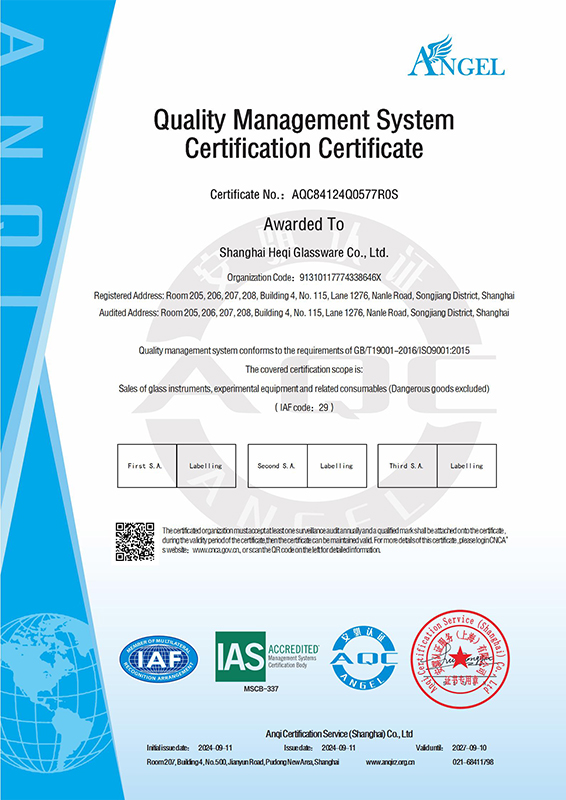
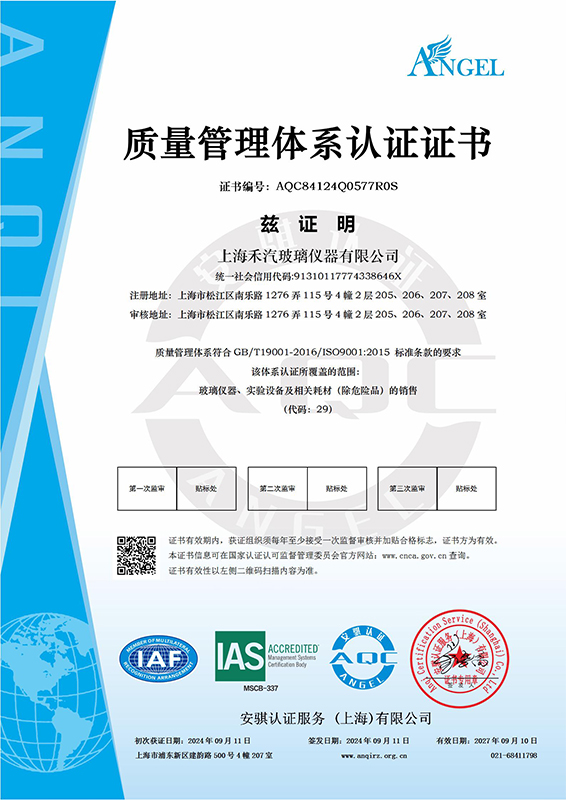
ISO 9001 certified manufacturing workflows |
Verifies consistent batch-to-batch production quality, wall thickness uniformity, and precise joint grinding. |
Rather than relying on outsourced parts, Shanghai Heqi Glassware Co., Ltd. manages its production internally across specialized workshops dedicated to glassblowing, metalworking, and final assembly. This vertical integration allows the company's dedicated R&D team, comprising specialists in mechanical design and electronic control, to implement strict quality control protocols at every stage of production. From raw borosilicate tubing selection to final pressure testing, each Lab Rotary Evaporator Condensers unit undergoes rigorous stress testing to meet the demanding standards of pharmaceutical and chemical processing facilities.
Quality Control and Pressure Testing Protocols
Before equipment reaches an enterprise facility, it must undergo multi-stage inspection processes. Because rotary evaporators operate under continuous mechanical rotation and negative pressure, glass components experience complex mechanical stresses.
Burst-Pressure and Vacuum Integrity Checks: Condensers are subjected to simulated operating vacuums to verify that seal interfaces and glass walls maintain zero leakage over extended operational cycles.
Thermal Stress Resistance Testing: Units are exposed to rapid temperature differentials to ensure the borosilicate glass structure can handle intense heating bath transitions and chilled coolant cycles without micro-fissures.
Optical and Dimensional Clarity Inspection: Precision measurement of standard-mouth connections ensures seamless interchangeability with existing laboratory infrastructure, reactors, and circulation systems.
OEM and Customization Capabilities for Large-Scale Projects
Every chemical synthesis line or pilot plant has unique spatial and operational constraints. Off-the-shelf catalog items occasionally fall short when integrating into complex, multi-stage distillation setups.
To bridge this gap, Shanghai Heqi Glassware Co., Ltd. leverages its extensive manufacturing foundation, developed across production bases in Songjiang, Chengdu, Jiaxing, and Yancheng since March 2002, to offer robust OEM and ODM custom fabrication services. Whether an enterprise project requires custom flange orientations, specialized condenser surface areas, or integrated small-scale pilot equipment configurations, the company combines mechanized production techniques with skilled craftsmanship. This ensures that purchasing managers can secure bespoke Lab Rotary Evaporator Condensers tailored precisely to their facility's architectural and workflow requirements.
Economic Benefits and Bulk Procurement Strategies for Enterprise Buyers
When enterprise purchasing committees evaluate laboratory infrastructure, the decision-making process extends far beyond initial purchase prices. For large-scale chemical processing plants, pharmaceutical laboratories, and university research facilities, the true financial impact of equipment is determined by total operating costs, energy efficiency, maintenance downtime, and supply chain reliability. Securing high-performance Lab Rotary Evaporator Condensers through strategic sourcing channels plays a vital role in protecting long-term capital investments.
Total Cost of Ownership (TCO) Analysis
Operating heavy-duty distillation and solvent recovery units incurs ongoing expenses related to water consumption, electricity usage, seal replacements, and labor hours spent on maintenance. Premium glassware and efficient thermal design directly reduce these operational burdens.
| Cost Factor |
Substandard Equipment Impact |
Premium Enterprise Equipment Impact |
| Energy and Coolant Consumption |
High heat loss and poor condensation require extended chiller runtimes and excessive water or glycol usage. |
Optimized heat transfer surface areas minimize energy demands on connected chillers and circulation systems. |
| Maintenance and Downtime |
Frequent vacuum leaks, seal degradation, and glass cracking lead to halted production batches and expensive repairs. |
Durable borosilicate construction and high-grade PTFE seals ensure thousands of hours of continuous, trouble-free operation. |
| Solvent Recovery Rate |
Inefficient condensation results in significant solvent loss into vacuum exhausts, wasting expensive reagent budgets. |
Recovery rates consistently exceeding 98 percent maximize chemical retention and lower raw material overhead. |
By prioritizing robust build quality, enterprise buyers minimize unexpected maintenance overhead. To support cost-effective scaling, Shanghai Heqi Glassware Co., Ltd. has successfully transitioned from traditional manual fabrication to mechanized and semi-mechanized assembly-line industrial processes across its production bases in Songjiang, Chengdu, Jiaxing, and Yancheng. This manufacturing evolution significantly reduces production costs while elevating structural quality, allowing enterprise procurement teams to acquire top-tier Lab Rotary Evaporator Condensers with an optimized total cost of ownership.
Factory-Direct Sourcing versus Multi-Tiered Distribution
Navigating the supply chain for specialized laboratory apparatus often involves multiple middlemen, leading to inflated equipment costs, delayed lead times, and communication gaps regarding technical customizations. For enterprise procurement managers overseeing large facility upgrades, partnering directly with an established manufacturer offers distinct logistical advantages.
| Procurement Channel |
Lead Times and Logistics |
Customization Flexibility |
Pricing and Supply Stability |
| Multi-Tiered Distributors |
Variable and often dependent on intermediate warehouse stock and third-party shipping schedules. |
Highly limited, restricted to off-the-shelf catalog items with little room for custom engineering. |
Subject to multiple markups and fluctuating regional pricing tiers. |
| Factory-Direct Manufacturer |
Streamlined logistics supported by ample inventory and dedicated production lines. |
Full in-house capability for custom glassblowing, metalworking, and specialized pilot-scale integration. |
Tiered volume pricing, direct technical support, and reliable long-term supply continuity. |
Operating on the service commitment that you make a call, we handle the rest, Shanghai Heqi Glassware Co., Ltd. combines ample in-house inventory with rapid delivery capabilities. Because the company produces a comprehensive range of experimental equipment, including rotary evaporators, glass reactors, high- and low-temperature circulation systems, vacuum pumps, and stirrers, enterprise clients can source entire integrated processing lines from a single, reliable manufacturing partner.
After-Sales Support and Supply Chain Risk Mitigation
Supply chain disruptions and a lack of readily available spare parts can cripple active research and pilot-production timelines. When investing in Lab Rotary Evaporator Condensers, procurement managers must verify that the supplier maintains long-term inventory for replacement glassware, specialized seals, and technical documentation.
Established in March 2002 and backed by specialized workshops for glass, metalworking, and assembly, Shanghai Heqi Glassware Co., Ltd. provides comprehensive after-sales support and engineering backup. This in-house manufacturing depth ensures that replacement parts match exact dimensional tolerances, eliminating compatibility risks and safeguarding enterprise facilities against extended operational downtime.
Frequently Asked Questions
When enterprise procurement teams and laboratory directors invest in advanced solvent recovery infrastructure, technical inquiries frequently arise regarding equipment selection, system compatibility, and maintenance protocols. Below are answers to key questions concerning Lab Rotary Evaporator Condensers to help streamline your purchasing decisions and operational workflows.
How do I select the right condenser type for volatile versus high-boiling solvents?
Matching the condenser geometry to your specific solvent properties is critical for maximizing recovery rates and ensuring safety:
| Solvent Category |
Boiling Point Range |
Recommended Condenser Configuration |
Operational Rationale |
| Highly Volatile Solvents, such as pentane and ether |
Below 40 degrees Celsius |
Cold Finger or Dry Ice Condenser |
Utilizes dry ice or acetone wells to achieve extreme sub-zero cooling without requiring an external refrigerated chiller, preventing vapor escape. |
| Low-to-Medium Boiling Solvents, such as ethanol, acetone, and ethyl acetate |
40 to 100 degrees Celsius |
Vertical or Diagonal Condenser |
Standard double-layer cooling coils provide efficient heat exchange for routine organic distillations within a standard lab footprint. |
| High-Boiling or Heat-Sensitive Compounds, such as high-molecular-weight oils and DMF |
Above 100 degrees Celsius under vacuum |
Vertical Reflux or Double-Layer Condenser |
Extended surface area and high coolant flow capacity ensure complete condensation under heavy thermal loads and deep vacuum pressures. |
What are the primary indicators that a condenser requires cleaning or replacement?
Maintaining optimal performance requires regular inspection of the glass coils and sealing surfaces. Key signs that a Lab Rotary Evaporator Condensers unit requires maintenance include:
Decreased Recovery Rates: If solvent collection drops significantly under identical heating and vacuum parameters, internal fouling or mineral scale buildup on the cooling coils may be insulating the surface and reducing heat transfer.
Vacuum Instability: Difficulty maintaining a stable negative pressure often points to micro-cracks in the glass, worn PTFE sealing rings, or degraded joint interfaces.
Internal Etching: Exposure to aggressive acids or strong alkaline solutions over prolonged periods can cause cloudiness or surface pitting in standard glassware, requiring immediate replacement to prevent structural failure under vacuum.
Can factory-direct manufacturers supply custom-sized condensers for specialized industrial lines?
Standard catalog equipment occasionally fails to meet the precise spatial or architectural demands of custom pilot plants and industrial synthesis loops. To address this, Shanghai Heqi Glassware Co., Ltd. leverages dedicated workshops specializing in glassblowing, metalworking, and final assembly. Because the company has cultivated expertise in standard-mouth glass instruments since March 2002, its R&D team can collaborate directly with enterprise clients to design and fabricate customized Lab Rotary Evaporator Condensers featuring specialized flange sizes, non-standard connection ports, or tailored surface areas to fit unique processing architectures.
What coolant temperature and flow rate are recommended for optimal recovery efficiency?
Achieving near complete solvent recovery depends heavily on maintaining the correct thermal differential between the vapor stream and the cooling fluid.
Coolant Temperature Setpoint: As a general rule of thumb, the chiller temperature should be set 15 to 20 degrees Celsius lower than the boiling point of the target solvent under the active operating vacuum. For example, if ethanol boils at 40 degrees Celsius under vacuum, a coolant temperature of 20 degrees Celsius or lower ensures rapid condensation.
Coolant Flow Rate: Adequate flow prevents localized warming within the condenser coils. For pilot-scale units ranging from 5L to 50L, flow rates ranging from 3 Liters per minute to 15 Liters per minute, supplied by robust high- and low-temperature circulation systems, maintain stable thermal equilibrium during continuous round-the-clock operations.


 English
 Français
 Español