English
 Français
 Español
Borosilicate 3.3 vs Regular Glass: Key Differences for Lab Glassware Buyers
When a lab procurement list asks for round-bottom flasks for a reflux setup, the material specification is usually the first line after the capacity. Borosilicate 3.3 or soda-lime glass? The price difference is real, but it is a fraction of the cost of a cracked flask that ruins a synthesis run or a contaminated sample that ruins an analysis. This article explains how the two materials actually differ in the ways that matter during lab work: thermal shock resistance, chemical durability, and dimensional stability.
Borosilicate glass is the safer default for heated and reactive lab work
Yes, borosilicate 3.3 is the safer default for most laboratory applications that involve heat, pressure, or reactive chemicals. The "3.3" designation refers to a coefficient of thermal expansion of 3.3 × 10⁻⁶ per kelvin. That value is roughly two and a half times lower than the expansion of regular soda-lime glass. In practice, this means that when you take a borosilicate flask off a hot plate and place it on a cold countertop, the glass tolerates the temperature gradient without cracking. A soda-lime flask in the same situation has a much higher chance of fracturing.
But thermal tolerance is only part of the picture. Borosilicate glass is also less reactive with a broad range of laboratory chemicals. Volumetric glassware made from borosilicate holds its dimensions better across temperature fluctuations, which directly affects measurement accuracy. In a lab, these three advantages—thermal tolerance, chemical inertness, and dimensional stability—compound over the lifetime of the glassware.
What actually separates borosilicate from regular glass
| Property | Borosilicate 3.3 | Soda-lime glass |
|---|---|---|
| Coefficient of thermal expansion (20-300°C) | 3.3 × 10⁻⁶ / K | 8-9 × 10⁻⁶ / K |
| Thermal shock resistance | High (survives temperature change above 150°C) | Low (usually fails at temperature change above 30-40°C) |
| B2O3 content | ~13% | Negligible |
| Chemical durability | Good against acids, alkalis, salt solutions | Poor against strong alkalis, prone to sodium leaching |
| Softening point | ~820°C | ~700°C |
| Typical lab applications | Reaction flasks, condensers, volumetric glassware | Reagent storage, microscopy slides, disposable items |
The core difference is in the network structure of the glass. When boric oxide (B2O3) is incorporated into the silica network, it forms rings that disrupt the arrangement of sodium and calcium ions. The result is a glass network that is more tightly bonded, more rigid, and far less sensitive to temperature change. This is why the coefficient of thermal expansion drops so dramatically, and why the glass does not readily release ions into solutions.
Thermal shock is the most common failure mode in regular glass
The most common reason glassware fails in the lab is not mechanical impact. It is thermal shock. A solvent is heated in a round-bottom flask, the flask is transferred to an oil bath, or a condenser is suddenly exposed to cold tap water while its upper section is still hot. Each of these actions creates a temperature gradient within the glass.
In soda-lime glass, the outer layer absorbs or loses heat faster than the inner layer. The differential expansion creates internal stress. When the stress exceeds the tensile strength of the material, a crack forms. Borosilicate glass resists this because its expansion coefficient is so much lower. Even when a thermal gradient exists, the strain that builds inside the glass stays below the failure threshold.
For heated reflux and distillation setups, the easiest practical safeguard is to specify borosilicate 3.3 for all components that will touch temperature changes.
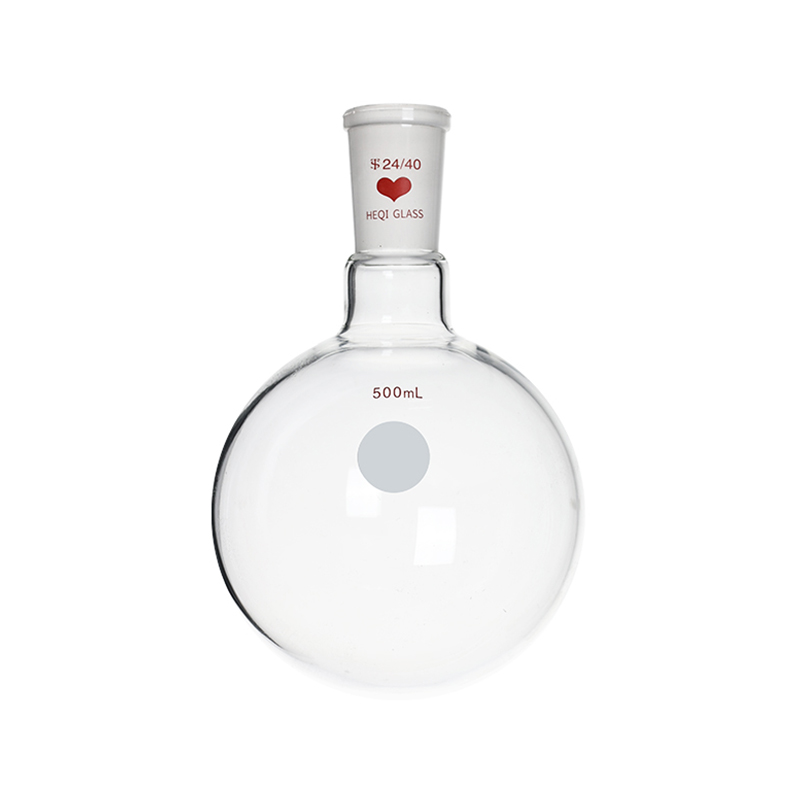 Single Neck Round Bottom Flask for Heated ReactionsThis Class A borosilicate flask provides reliable heat transfer and chemical resistance, minimizing contamination when used in heated reflux and distillation setups.View Product →
Chemical durability matters more than the price tag
Regular soda-lime glass has a significant weakness in chemical environments. Its surface is dominated by sodium ions, and contact with aqueous acids—especially alkaline solutions—promotes ion exchange. Sodium leaches into your reaction mixture or your sample. In analytical work, this can shift pH, contaminate calibration standards, and introduce an invisible source of error. In synthesis, it can interfere with stoichiometry or poison a catalyst.
Borosilicate glass is not immune to all chemical attack. Strong hydrofluoric acid dissolves any glass. But for the range of reagents used in organic synthesis, chromatography, and routine analysis, borosilicate offers far greater resistance. The B2O3-enriched network holds sodium more tightly, reducing the rate of ion exchange to below the threshold of concern for most applications.
In distillation and condensation systems, where the glass contacts hot vapors and condensed solvents continuously, this inertness is especially important. The internal surfaces stay clean, and the risk of trace contamination drops.
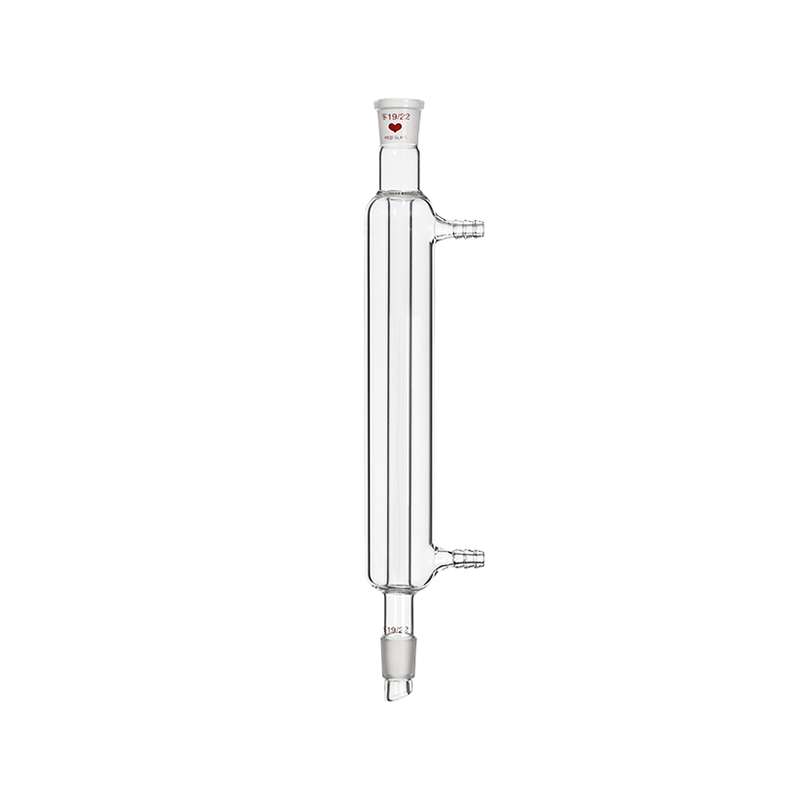 Liebig Condenser for Distillation and Solvent RecoveryDesigned for efficient condensation of low-boiling vapors, this Class A condenser maintains clean surfaces and reduces trace contamination in continuous distillation systems.View Product →
Volumetric accuracy and Class A tolerance: why material choice reaches your measurement
Volumetric glassware—volumetric flasks, graduated pipettes, burettes—must deliver accurate volumes at a reference temperature, normally 20°C. The calibration is valid only if the glass maintains its dimensions under normal laboratory temperature fluctuations. Soda-lime glass expands about three times as much as borosilicate for the same temperature change. If a volumetric flask is used at a temperature meaningfully different from its calibration point, the volume error in a soda-lime flask grows faster than it would in a borosilicate flask.
More importantly, the chemical instability of soda-lime can release sodium into the sample, altering pH and contaminating the measurement. That is an error no tolerance band can correct. This is why Class A volumetric glassware is manufactured from borosilicate-based formulations, and why the Class A error limit is only meaningful if the measurement starts from a thermally stable glass.
In practice, this impacts more than exact measurements. It changes the reproducibility of analytical procedures, especially when samples need to be decanted, diluted, and stored in the same vessel.
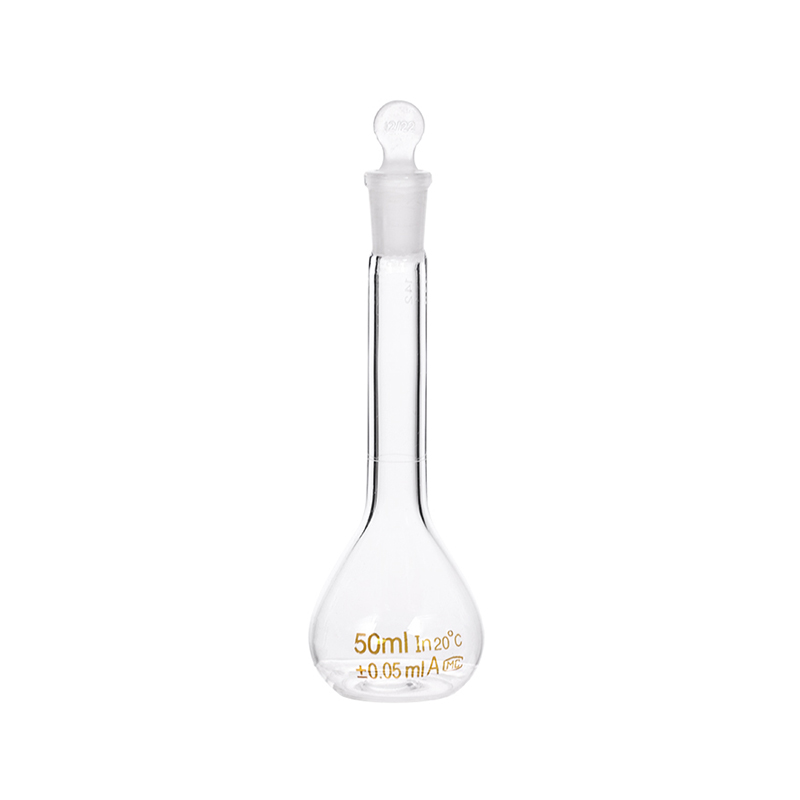 Volumetric Flask for Precise Quantitative AnalysisWith Class A certified accuracy, this volumetric flask ensures reproducible measurements for titration and calibration, reducing errors from thermal expansion in analytical work.View Product →
When regular soda-lime glass is good enough
It is easy to fall into the habit of specifying borosilicate for absolutely everything. But if you review the components in your lab, a large share of glassware does not need it.
Reagent bottles used for long-term storage of non-corrosive, non-reactive chemicals can be soda-lime. Petri dishes and coverslips for microscopy are used at ambient temperature and rarely contact aggressive reagents, so soda-lime is fine. Culture dishes and evaporation dishes that see mild thermal cycles may also be acceptable. The cost difference can be noticeable when ordering large quantities.
The key is to separate applications that involve thermal stress, direct chemical contact, or precision measurement from applications that do not.
How to make the right purchase decision
Consider three prompts before you place an order:
- Will the glassware be heated, cooled, or exposed to a rapid temperature change during use? If yes, choose borosilicate 3.3.
- Will it contact acids, bases, oxidizers, or solvents that can extract ions from glass? If yes, choose borosilicate.
- Does it need to meet a Class A accuracy specification? If yes, the glass must be borosilicate.
For routine storage and ambient-temperature work, soda-lime can be a cost-effective choice.
When you receive a quotation, confirm the material designation in the technical specification. A standard reference point is ISO 3585 for borosilicate 3.3 glass. This standard defines the composition and physical properties, giving you a verifiable baseline. Specifying this standard is especially useful when ordering through a provider that sources glassware from multiple factories. For more nuance around routine lab operations, we have published a broader guide on general laboratory tips that covers many of these operating decisions in practice.
Selecting the right glass is largely a matter of matching the material to the task. Borosilicate carries a higher initial price, but it also carries lower replacement costs, lower contamination risk, and better measurement stability. In a busy lab, a cracked flask or a contaminated sample can cost far more than the difference in material cost. When the application involves heat, chemicals, or precision measurement, borosilicate 3.3 is not a luxury—it is the practical engineering choice.