English
 Français
 Español
Chemical Material Compatibility Chart: A Practical Guide for Lab Glassware
Anyone who has watched a brand new beaker cloud over after an hour of contact with a solvent knows that material selection is not a detail you can fix later. A chemical material compatibility chart is the fastest way to judge whether your glassware, tubing, seals and storage bottles will survive the chemistry you are planning. It compresses decades of corrosion testing into a grid of letters, and it can spare you a failed reaction, a contaminated sample, or a spill that nobody wants to explain to the safety officer.
At Shanghai Heqi Glassware we have been making standard ground joint glassware since 2002, and most of the technical questions that reach our team are not about price lists or delivery schedules. They are about which material to trust with which chemical. This guide walks through how to read a compatibility chart, what its ratings actually mean, and where the numbers stop being reliable, so that glass, PTFE and plastic parts all end up in the right place.
What a Chemical Material Compatibility Chart Really Tells You
A compatibility chart is, at heart, a lookup table. One axis lists chemicals or chemical families: acetic acid, acetone, sodium hydroxide, toluene, hydrogen peroxide, hydrochloric acid. The other axis lists materials: borosilicate glass, quartz, PTFE, polypropylene, FKM elastomer, stainless steel. Where a row meets a column you find a rating that describes how much that material is expected to change after contact with that chemical, under a defined set of test conditions.
That last phrase, under a defined set of test conditions, is where most people get into trouble. A rating usually reflects a specific concentration, a specific temperature and a specific exposure time. Change any one of the three and the letter in the cell may no longer describe your situation. A material marked excellent against dilute sodium hydroxide at room temperature can behave very differently against a hot, concentrated caustic stream in a jacketed vessel.
It also helps to know where a chart came from. Some charts are compiled by regulatory bodies for transport and storage safety. Others are published by polymer and elastomer suppliers, who naturally focus on their own products. Others still are assembled by equipment makers or testing laboratories. Each was built for a purpose and each uses its own rating scale, so comparing a letter grade across two different charts is far less meaningful than comparing the underlying data behind the letters.
Treat every chart as a first filter rather than a warranty. If a chart says a chemical is aggressive toward a material, believe it and look at another option. If a chart says a material is fine, treat that as permission to run a small controlled trial, not as a promise that your production batch will be safe for the next five years.
How to Read the Rating Letters and Numbers
Most compatibility charts in circulation use a four or five step letter scale, sometimes with a numeric note attached. The letters are not standardized across the industry, so always read the legend printed beneath the table before you read the table itself.
| Rating | Usual meaning | What it looks like in practice | Suggested use |
|---|---|---|---|
| A | Excellent, no measurable effect | No weight change, no discoloration, no loss of strength after the test period | Routine service, including long contact |
| B | Good, minor effect | Slight swelling or discoloration with mechanical properties essentially unchanged | Short term or intermittent contact |
| C | Fair, moderate effect | Visible swelling, softening or surface attack with noticeably reduced performance | Avoid unless the exposure is brief and monitored |
| D | Severe effect, not recommended | Material degrades, cracks, dissolves or loses its shape | Do not use |
Numeric scales carry more information once you know what to do with them. Penetration rates are often given in mils per year, where one mil is one thousandth of an inch. A figure below two mils per year is generally read as negligible for a static vessel, while a figure above twenty mils per year means the wall will thin quickly. Swelling is usually expressed as a percentage change in volume or weight. Temperature columns, often written as a phrase such as satisfactory to a stated temperature, mark the ceiling at which the rating was still considered valid.
Two habits make those numbers far more useful. First, read the rating together with the conditions column, never in isolation. Second, write down the source and the date of the chart you used, because published data are revised from time to time as new test results arrive.
The Materials That Show Up Most Often in a Laboratory
Almost every compatibility question we receive ends up being about one of five families: borosilicate glass, quartz, PTFE, polyolefins and elastomers. Each one occupies a different corner of the chemical map, and understanding that map is more useful than memorizing individual cells.
| Material | Typical service ceiling | Strong against | Watch out for |
|---|---|---|---|
| Borosilicate glass 3.3 | About 200 C in continuous use | Acids, solvents, halogens and most organic media | Hydrofluoric acid, hot concentrated alkali, hot phosphoric acid |
| Quartz glass | Well above 1000 C | Thermal shock, high purity work, most acids | Hydrofluoric acid and alkali at high temperature |
| PTFE | About 260 C | Nearly all acids, bases and solvents | Molten alkali metals, elemental fluorine, some fluorinating agents |
| Polypropylene | About 100 to 120 C | Bases, aqueous acids and many alcohols | Strong oxidizers, aromatic and chlorinated solvents |
| Stainless steel 316 | Several hundred degrees C | Neutral media, many organics, high pressure service | Chlorides, mineral acids and wet halide solutions |
Borosilicate glass deserves a special note, because it is the material most laboratories rely on every day. Its low thermal expansion and its resistance to thermal shock come from a silica network in which boron oxide plays a structural role. That same network is what makes the glass vulnerable to fluoride ions, which attack silicon directly, and to hot concentrated alkali, which dissolves the surface layer by layer. A compatibility chart will usually mark glass as excellent for acids and only fair for strong bases, and that pattern is real rather than merely cautious.
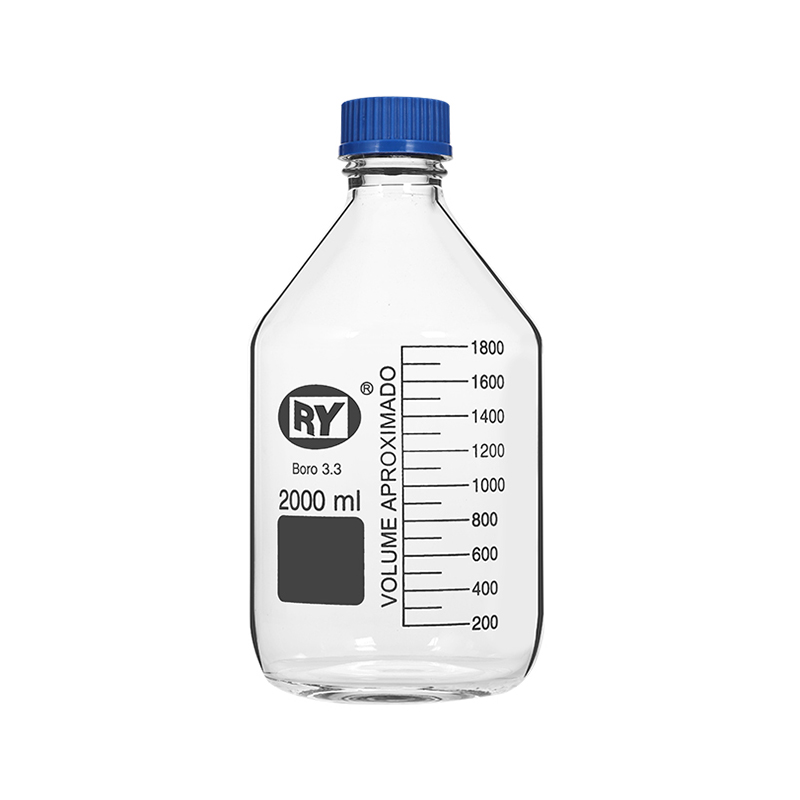 Blue Cap Borosilicate 3.3 Reagent Bottle for Laboratory StorageA borosilicate 3.3 reagent bottle with blue threaded cap, clear visibility, and multiple capacities for daily laboratory solvent and aqueous reagent storage.View Product →
Storage is where material choice becomes visible over months rather than minutes. A reagent bottle made from borosilicate 3.3 with a tight threaded cap keeps solvents and aqueous reagents stable while letting you see exactly what is inside, which is why this format appears in so many working laboratories. If you want a broader view of how these materials are grouped, the overview of chemical resistant lab glassware is a reasonable starting point.
Comparing Service Temperatures at a Glance
Charts are excellent at answering yes or no questions and poor at showing relative margins. A simple bar comparison helps you see how much headroom each material gives you before its rating is called into question. The scale below is deliberately linear, which is why the differences look dramatic.
Approximate upper service temperature by material
The lesson from a chart like this is not that one material beats another. It is that a high temperature ceiling rarely arrives alone. Quartz offers the widest thermal window but is more expensive and harder to fabricate into complex joints. PTFE handles almost every chemical but deforms under load at elevated temperature. Borosilicate glass sits in a comfortable middle ground, which is precisely why a distillation train or a reaction vessel is usually built from it and fitted with PTFE or glass components at the critical seal points.
Glass, PTFE and Plastic: Matching the Material to the Chemistry
Once you have read a chart, the practical question becomes a design question. What does the vessel body need to be, and where does a different material belong? Glass is transparent, dimensionally stable, easy to clean and resistant to almost every solvent, so it makes an outstanding body material for vessels, columns, condensers, funnels and storage containers. It is also the material that gives you an early warning, because you can see the contents and the surface.
PTFE covers the gaps that glass cannot. Because the carbon fluorine bond is extremely strong, PTFE is not attacked by the acids and bases that slowly dissolve a glass surface. That is why stopcock plugs, valve seats, sleeves and seals are so often made from it, particularly where the chemistry is basic or where a joint must move. Threaded stopcocks with PTFE plugs are a familiar example: the glass body provides the transparent, rigid pathway while the PTFE plug provides the chemically inert moving surface.
 Pear-Shaped Separatory Funnel with PTFE Plug for Corrosive ExtractionsA pear-shaped glass funnel with chemical-resistant PTFE plug and stopcock for corrosive or organic liquid extraction, available in 30 ml to 2000 ml.View Product →
A pear shaped separatory funnel with a PTFE plug illustrates the same logic in extraction work. Aqueous phases in extraction are frequently acidic or basic, and a glass plug in a strongly alkaline environment is the classic failure point in a student laboratory. Replacing just that one component changes the service life of the whole item.
Polyolefins and elastomers play a supporting role. Polypropylene wash bottles and trays are excellent for dilute acids and bases, but they soften in aromatic solvents and cannot be autoclaved indefinitely. Silicone and FKM seals are convenient but often the first part to swell, so it is worth checking them separately rather than assuming that the vessel around them is the limiting factor. For readers who want the underlying material science, our note on borosilicate glass composition explains how the 3.3 designation relates to that silica and boron oxide network.
What the Chart Cannot Tell You: Concentration, Temperature and Time
Three variables explain most of the surprises that occur after a chart has been consulted. The first is concentration. Corrosion ratings are often measured at a single concentration, usually a moderate one, and the response curve is not linear. Dilute sulfuric acid and concentrated sulfuric acid are almost different chemicals as far as materials are concerned, and a chart that lists one figure for sulfuric acid is telling you less than it first appears.
The second is temperature. As a rough working rule, every increase of ten degrees Celsius doubles the rate of most chemical attack. A material rated excellent at room temperature can move two grades by the time a jacket is running at 120 degrees, and the effect is usually worse at the seal, where heat and mechanical load meet.
The third is time, including the difference between continuous and intermittent contact. A gasket that survives a ten minute transfer may fail after a week of standing contact. If your process involves long residence times, bulk storage or reflux that runs overnight, weight the chart accordingly and use the longest foreseeable exposure rather than the shortest.
Beyond those three lies a group of effects that charts handle poorly. Mixtures can be far more aggressive than either component, and a combination of an oxidizer with an organic solvent is effectively a new chemical system. Mechanical stress accelerates environmental stress cracking in plastics, which is why a scratched polymer part fails where a smooth one survives. Residues from alkaline detergents and previous cleaning change how a surface behaves. And a chart says nothing about purity: a leached plasticizer or a dissolved ion can ruin an analysis long before the part visibly changes shape.
A Step by Step Workflow for Checking Compatibility
Given all the caveats, how should a compatibility chart be used in a working laboratory? The following sequence works well for anything from a one off extraction to a pilot scale campaign.
- List every material that will touch the chemistry, including gaskets, valve seats, tubing and any part you would normally not think about.
- Write down the real conditions: maximum concentration, maximum temperature, longest contact time and whether contact is static or flowing.
- Look up the worst case combination rather than the average one, and read the legend that belongs to the chart you are using.
- Discard any material that is rated poorly for your worst case, and flag the ones that are only marginal.
- For marginal materials, run a small trial with an actual sample, weighing and photographing it before and after exposure.
- Record the result together with the source of the chart and the date, so the next person does not repeat the work.
- Re check whenever concentration, temperature or a supplier changes, because a new resin batch or a new glass source may not behave like the old one.
Steps five and six are the ones people skip, and they are the cheapest insurance available. A coupon left in your actual process fluid for a week will tell you more about your specific case than any general table, and it takes almost no effort to set up.
Compatibility Is an Assembly Question, Not a Single Part Question
A distillation train is a good illustration. The flask might be borosilicate glass, the condenser also glass, the take off adapter fitted with a PTFE stopcock, the joints sealed with a small amount of grease or a sleeve, and the tubing leading to the receiver made from something softer altogether. Each part may score well on its own, yet the assembly fails because one component was chosen for convenience rather than compatibility. The weakest link sets the outcome for the whole apparatus.
This is why it pays to think in modules. Choose the transparent, rigid components first, since glass offers the widest solvent resistance and the best visibility. Then specify the seals, plugs and flexible parts individually, using the chart to confirm that each one is rated for your worst case. Where a joint must be both chemically inert and leak tight at temperature, a ground glass joint with a PTFE sleeve usually outperforms a soft elastomer.
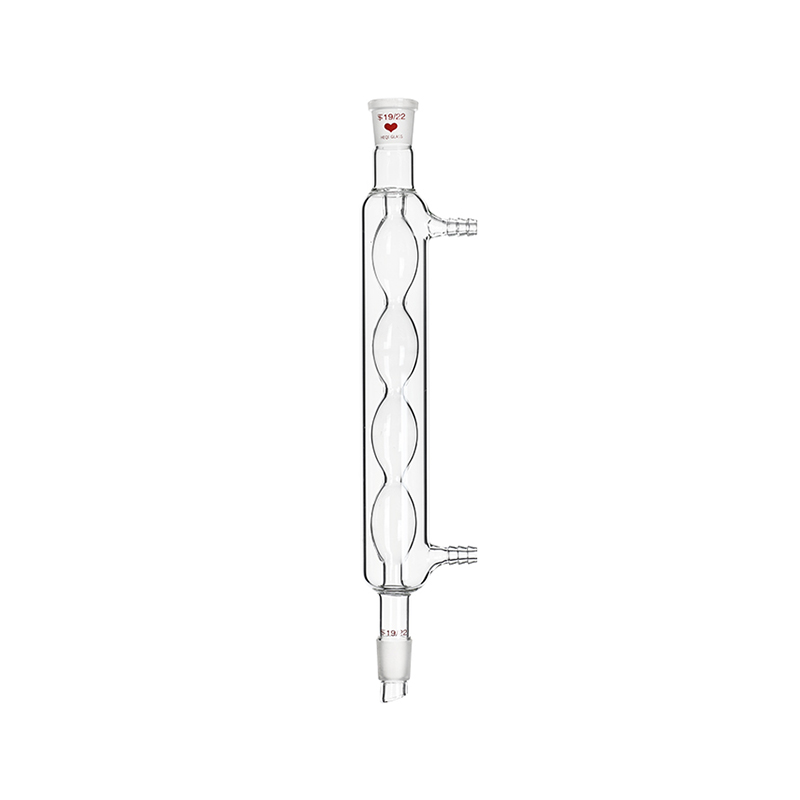 Class A Borosilicate Allihn Condenser for Analytical and Research LaboratoriesA Class A borosilicate Allihn condenser with large heat transfer area and standard joints for efficient vapor condensation in analytical and research labs.View Product →
Condensers are a case in point. An Allihn condenser in borosilicate glass with a Class A rating gives you a transparent surface, a defined joint size and predictable thermal behaviour, while the cooling medium and the vapour path determine what actually contacts the glass. If a reaction produces hydrogen fluoride or involves hot caustic vapour, no amount of good glass will save the apparatus, and the correct answer is to move that step into PTFE or polypropylene equipment.
Frequently Asked Questions
Is borosilicate glass compatible with hydrofluoric acid?
No. Fluoride ions attack the silica network directly, so even dilute hydrofluoric acid and fluoride containing etchants cause measurable surface loss. For those chemistries, PTFE, polypropylene or polyethylene vessels are the appropriate choice, and the same caution applies to any solution that can generate fluoride in situ.
Can I use a compatibility chart for mixtures?
Only with caution. Most charts list single chemicals, because that is what can be tested reproducibly. A mixture can be more aggressive than either component, particularly when an acid meets an oxidizer or when two solvents act on an elastomer together. Treat every mixture as a new entry and verify it with a small trial.
Why does a chart rate PTFE well against caustic soda but glass only fairly?
Hot alkali dissolves the surface of a glass network, slowly thinning the wall and eventually changing the fit of ground joints. PTFE has no silica to attack, so its rating stays high across the whole alkaline range. That contrast is exactly why a glass vessel with a PTFE plug or PTFE lined seal is such a common combination.
What does a note such as satisfactory to a stated temperature mean?
It is a ceiling, not a recommendation. Above that temperature the rating was no longer considered valid, which means the letter in the cell may no longer apply. Always compare the temperature at which you will actually operate against the temperature at which the rating was measured.
Do I need to re check compatibility when I change suppliers?
For critical work, yes. Borosilicate 3.3 differs from neutral glass in its thermal and chemical behaviour, and two resins with the same trade name can be formulated differently. A brief soak test on a sample of the new stock is a quick way to confirm that nothing important has shifted.
How do I run a simple compatibility check in my own laboratory?
Weigh and photograph a small coupon or an inexpensive part, immerse it in the actual process fluid at the working temperature, and inspect it at intervals over the period that matters to you. Measure the change in weight, look for clouding, crazing or softening, and record the conditions. That record is worth more than any published grid.
Compatibility charts are one of the few free tools that can prevent an expensive accident, provided they are read with the right expectations. They are screening instruments built on defined test conditions, not certificates of performance. Use them to eliminate obviously wrong materials quickly, then confirm the survivors with a small, honest test in your own conditions.
If a specific chemical question is holding up your work, our technical team is glad to look at it with you. Send us the chemistry, the temperature and the contact time, and we will help you work out which parts of an apparatus can stay in glass, which should move to PTFE, and where a custom glass component would solve the problem more elegantly than a compromise. That is what two decades of making standard ground joint glassware teaches, and it is a conversation we are always happy to have.