English
 Français
 Español
Distillation Glassware: How to Choose the Right Condenser and Assembly for Your Lab
A chemist setting up a simple distillation for the third time this week reaches for the nearest Liebig condenser, clamps it to a frame, and tightens a joint clip. The run completes, but recovery is low and the distillate carries a faint color. The cause is rarely the heating mantle alone. It is the glassware working against the process: an oversized condenser, a worn standard taper joint, a stopcock that binds under vacuum, or a receiving adapter that was never intended for reduced pressure.
What Actually Determines a Successful Distillation Setup
Distillation glassware behaves as a system, not as loose components. The practical conclusion is simple: choose each piece to match the boiling range of your liquid, the operating pressure, and the joint sizes already in your cabinet.
Every setup, from a simple one-plate still to a bench-scale fractionating column, follows the same four functional zones: vapor generation, vapor guidance, condensation, and collection. Each zone contributes one primary component and a few connecting pieces that must fit together under both atmospheric and reduced pressure.
| Zone | Primary component | Role in the separation |
|---|---|---|
| Vapor generation | Round-bottom flask | Holds the liquid, distributes heat evenly, and provides space for boiling chips or a stir bar. |
| Vapor guidance | Distillation head or fractionating column | Directs vapor toward the condenser and, when packed or fitted, separates components by boiling point. |
| Condensation | Condenser | Removes heat and converts vapor back to liquid with minimal hold-up. |
| Collection | Receiving flask with vacuum takeoff adapter | Collects the distillate and keeps the system sealed against moisture and pressure fluctuations. |
Standard taper ground joints tie these zones together. In most teaching and research laboratories, 14/23, 19/22, or 24/40 joints make components interchangeable between manufacturers. That interchangeability is the reason distillation glassware is usually sold as individual parts rather than a fixed set: you assemble the train that fits the flask and condenser you already own.
Which Condenser Matches Your Separation?
Condenser geometry decides how much vapor contacts the cooled glass surface and how fast condensate drains back. Choosing the wrong geometry does not stop the distillation; it silently reduces recovery or causes flooding. That is why condenser selection should be the first decision, before ordering any connecting adapter.
Liebig condenser: the workhorse for simple distillation
A Liebig condenser has a straight inner tube inside a water jacket. It handles common solvents such as water, ethanol, ethyl acetate, and hexane without excessive hold-up. For most small-scale work, a 300 mm to 400 mm jacket is sufficient. If you run at reflux or need better control of volatile fractions, a Class A Liebig condenser for laboratory distillation gives a precisely ground inner tube that minimizes vapor channeling and makes cleaning easier.
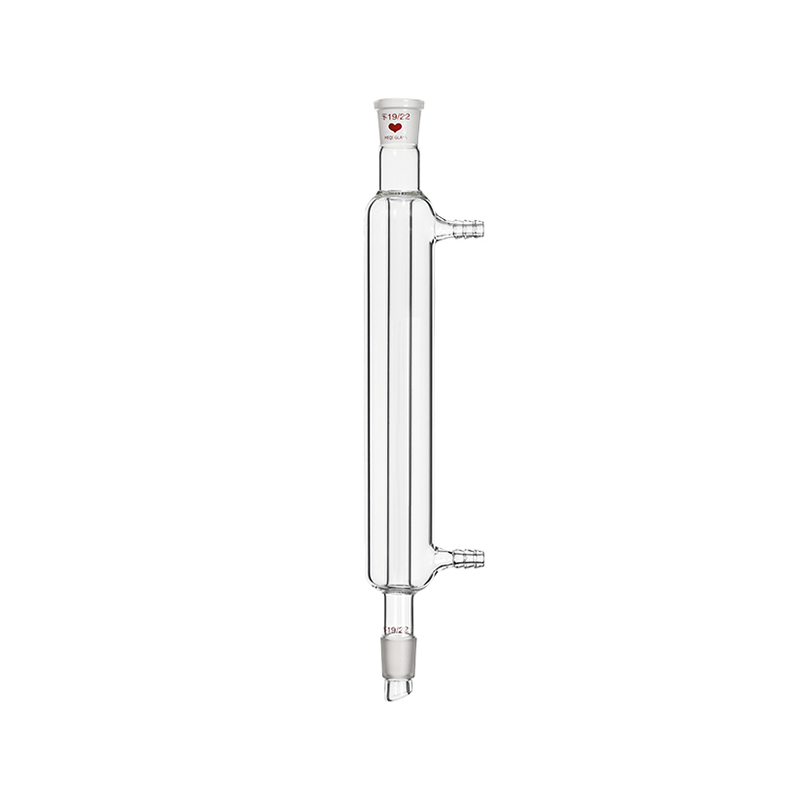 Wholesale Liebig Condenser (Class A) Suppliers, Factory - Shanghai Heqi GlasswarShanghai Heqi Glassware Co., Ltd. is China wholesale Liebig Condenser (Class A) Suppliers and Factory,Class A borosilicate glass Liebig c...View Product →
Allihn condenser: when vapors need more contact time
Allihn condensers have a series of bulbs along the inner tube, which increases the surface area per unit length and slows the vapor path. This geometry suits reflux and compounds that condense slowly. The main trade-off is hold-up: condensate clings inside the bulbs, so an Allihn condenser is not ideal when you need to recover a very small volume of product. For routine reflux in organic synthesis, a Class A Allihn condenser with standard taper joints is a dependable choice.
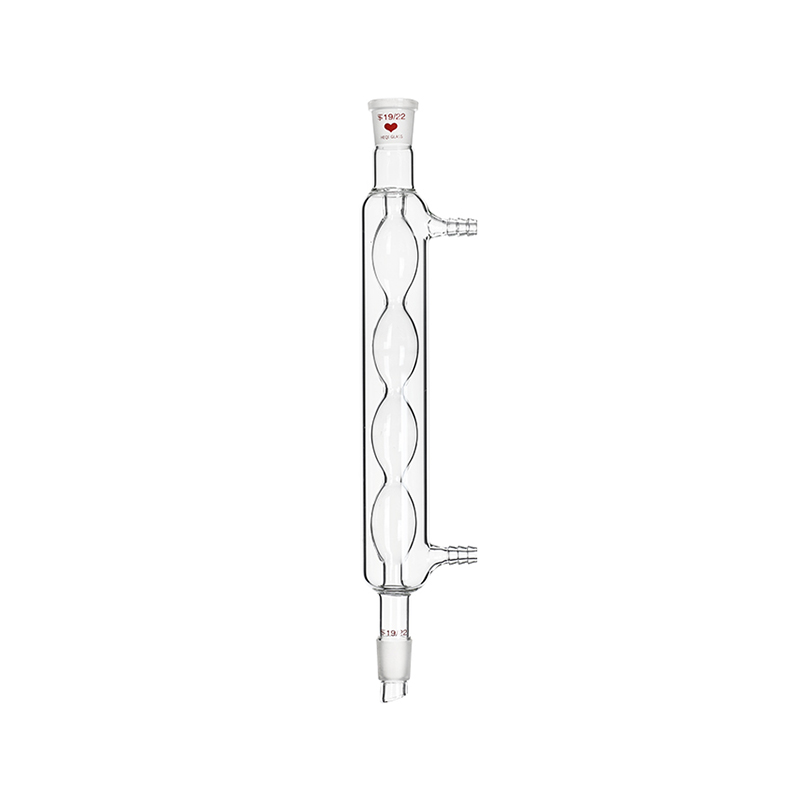 Wholesale Allihn Condenser (Class A) Suppliers, Factory - Shanghai Heqi GlasswarShanghai Heqi Glassware Co., Ltd. is China wholesale Allihn Condenser (Class A) Suppliers and Factory,Class A borosilicate glass Allihn c...View Product →
Graham condenser: compact vertical cooling
A Graham condenser uses a coiled inner tube inside a straight jacket, which creates a long condensing path in a short vertical span. This makes it the default for rotary evaporators and for compact distillation trains where headroom is limited. The coil also drains quickly, reducing the amount of product left behind.
Air condenser: no water needed for high boilers
When the distillate boils above about 150 °C, cold water in a jacket can shock the vapor and cause it to condense unevenly around the inner tube. An open glass air condenser relies on natural air cooling, which is gentler and eliminates the risk of a burst water hose. It is the right choice for aniline, nitrobenzene, and similar high-boiling liquids.
| Type | Geometry | Best for | Practical note |
|---|---|---|---|
| Liebig | Straight inner tube, outer jacket | Simple distillation of common solvents | Low hold-up; easy to clean with a brush. |
| Allihn | Bulb-shaped inner tube | Reflux and volatile or slow-condensing vapors | High surface area; moderate hold-up. |
| Graham | Coiled inner tube | Rotary evaporators and short vertical trains | Condenses in a compact footprint. |
| Air | Open glass tube | Liquids boiling above 150 °C | No coolant needed; avoids thermal shock. |
Standard Joints, Takeoff Adapters, and Vacuum Operation
In a distillation train, the weakest connection is usually an adapter, not the flask or condenser. Joints that are only slightly oversized or undercut leak vapor, and a leak becomes obvious the moment you apply vacuum. Checking every joint before assembling the train saves the most frustrating troubleshooting session of the day.
Matching joints to your existing glassware
Measure the outer diameter of the male joint at the ground zone and compare it with the female joint. A 24/40 joint that is visibly loose at the top but tight at the bottom has a taper mismatch. Joint clips keep a matched pair sealed; they do not fix a mismatched pair. Lightly greasing the ground zone with a vacuum-compatible grease is standard practice for reduced-pressure work, but grease should be applied sparingly so it does not contaminate the distillate.
Vacuum takeoff adapters and reduced-pressure operation
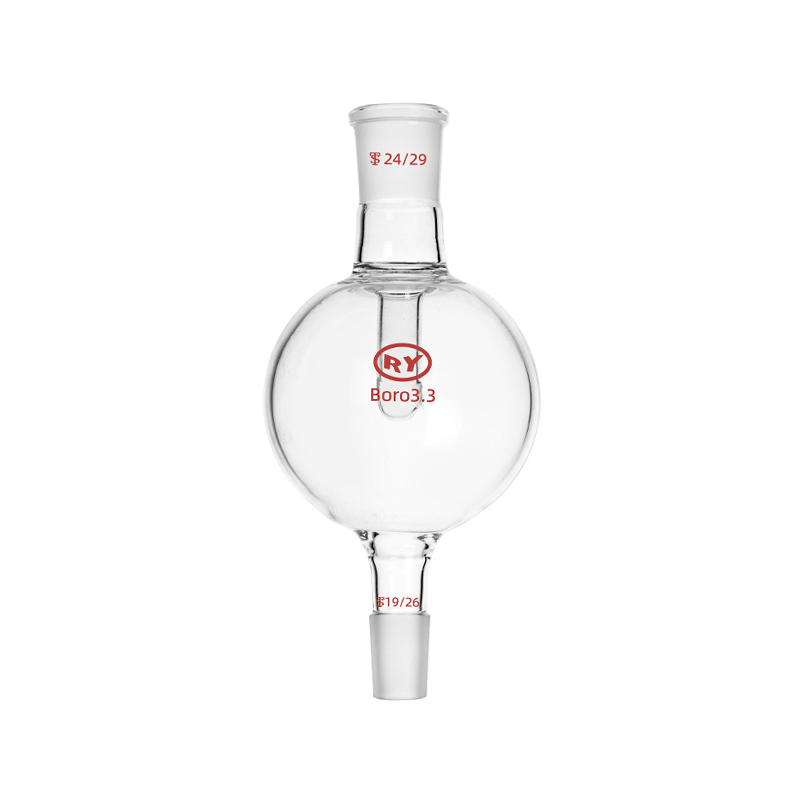
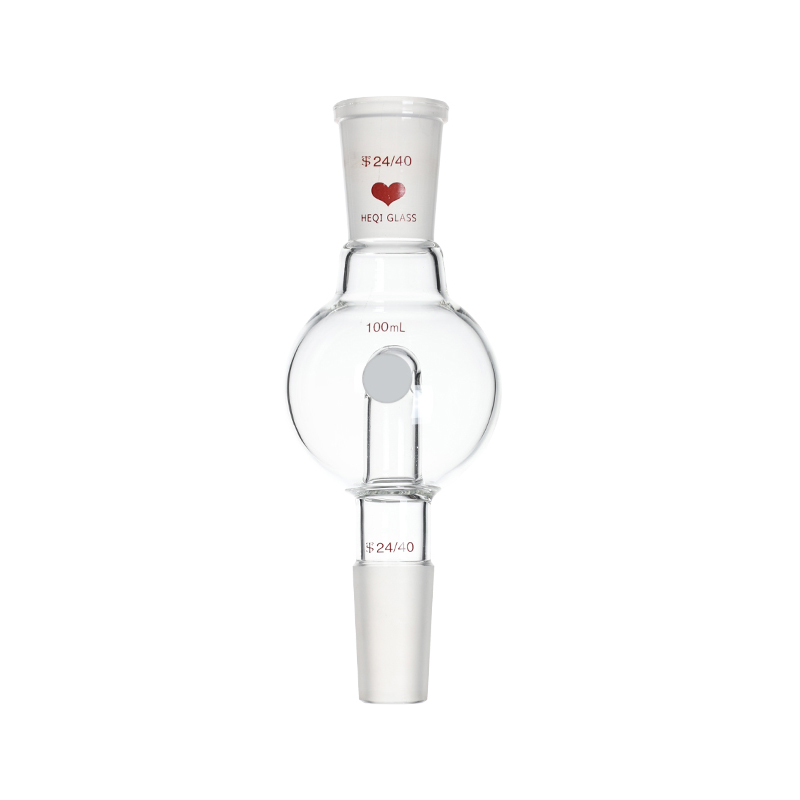
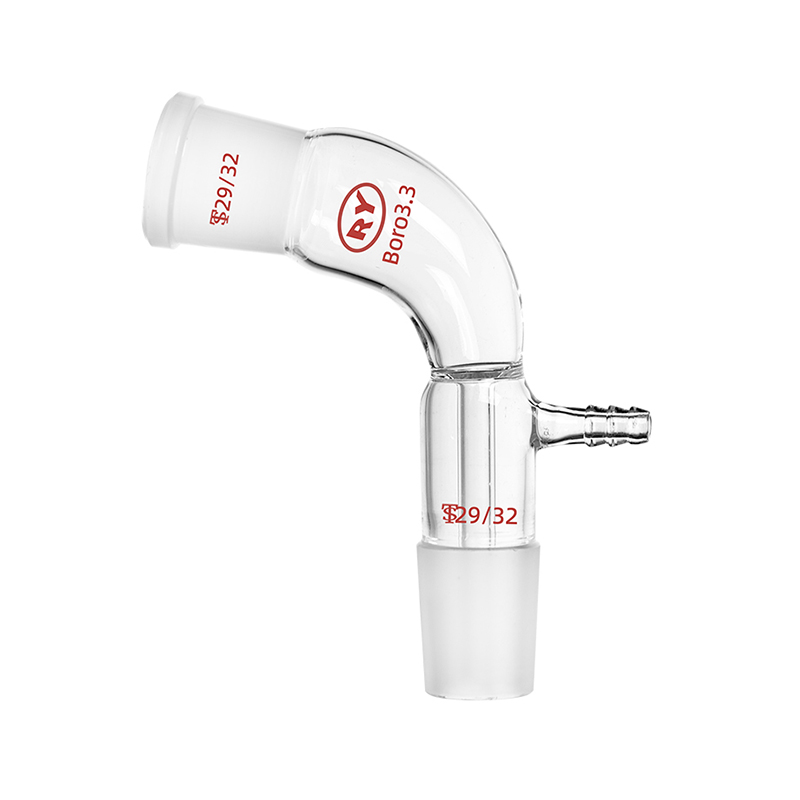
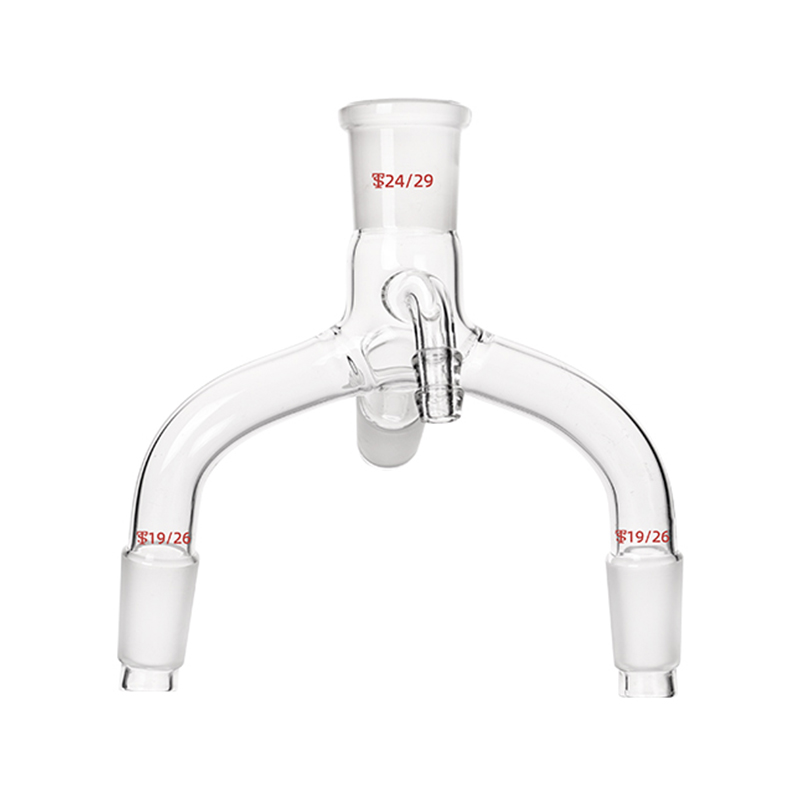
Reduced-pressure distillation changes the glassware requirements. The adapter that exits the system must pull vapor from the condenser without allowing oil mist or moisture to travel back into the receiving flask. A vacuum takeoff adapter with a standard taper joint performs that job cleanly and also gives you a place to attach a thermometer or inert gas line. For long runs, PTFE stopcock versions are more reliable than all-glass stopcocks because a glass plug can seize after repeated contact with basic solutions or when the joint warms slightly.
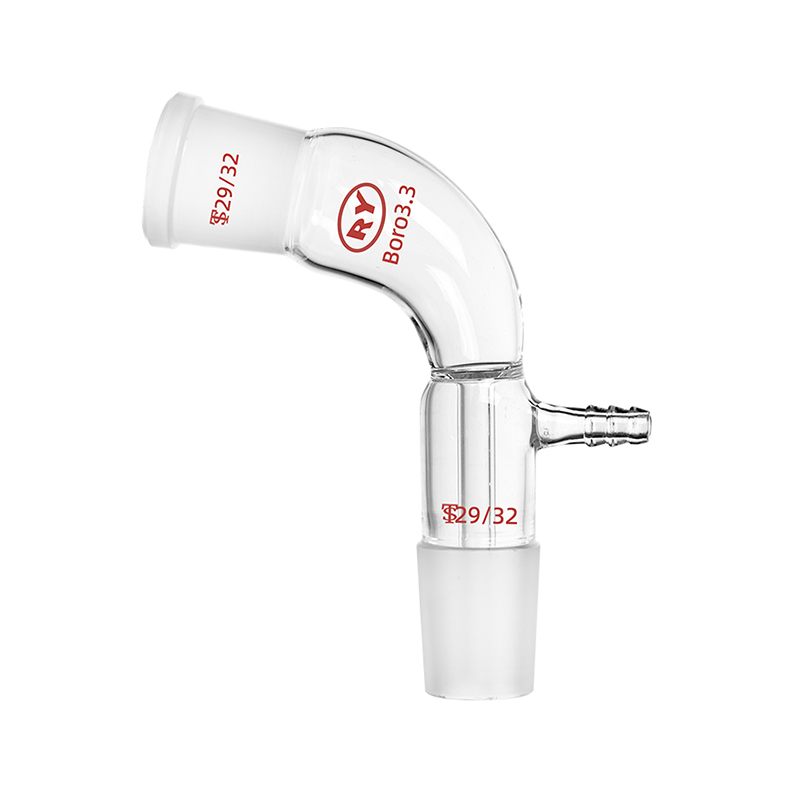 Wholesale Vacuum Take-Off Adapter Suppliers, Factory - Shanghai Heqi Glassware CShanghai Heqi Glassware Co., Ltd. is China wholesale Vacuum Take-Off Adapter Suppliers and Factory,A standard glass connector used in vac...View Product →
Glass Quality and Purchase Considerations
Most distillation glassware sold today is made from borosilicate glass 3.3, which has a low coefficient of thermal expansion and can tolerate the rapid temperature changes that occur when cold water hits a hot flask. The material matters, but the manufacturing details matter more than the label.
- Joint precision. A correctly ground standard taper distributes grease evenly and stays sealed under vacuum without grinding sounds or leaks. Inspect the joint surface for chips before each use.
- Wall thickness. Thick-walled round-bottom flasks resist vacuum collapse better than thin-walled ones. If you distil under reduced pressure, choose flasks explicitly rated for vacuum use.
- Class A designation. On measuring glassware, Class A marks a certified volume tolerance. On condensers and distillation connectors, it indicates tighter dimensional control of the inner tube and a more reliable joint fit, which directly affects recovery and reproducibility.
- Annealing quality. Poorly annealed glass develops visible strain lines when viewed through a polarizing filter and is prone to cracking. New pieces should be free of star cracks, bubbles, and internal stress marks.
A supplier that manufactures standard taper glass in-house can usually provide matching components for the same joint size across different product families, which saves you from mixing brands that do not quite align. The same production capability also enables customization for pilot-scale trains, where the joint sizes and condenser lengths differ from standard catalog items.
Operating Discipline That Extends Glassware Life
A good distillation glassware set can last for years if the operating practices are consistent. The failures we see in teaching labs and production plants alike follow the same pattern: heating a closed system, using a chipped joint, or cooling a condenser while it is still clamped to a hot flask.
Heating, bumping, and joint care
Add a boiling stone or a magnetic stir bar before heating; without a nucleation site, the liquid can superheat and bump violently into the condenser. Never seal the system completely. At least one outlet must remain open to the atmosphere or connected to the vacuum line, otherwise pressure buildup will push tapers apart and spray hot solvent across the bench. Apply heat gradually to the flask and clamp it firmly at the neck, not at the bottom.
Cleaning and storage
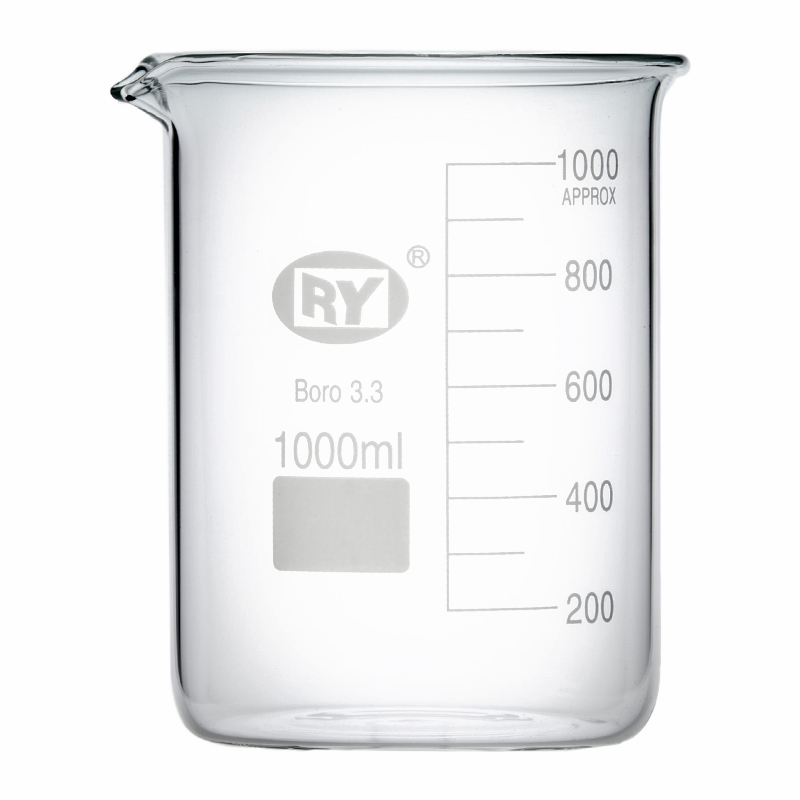
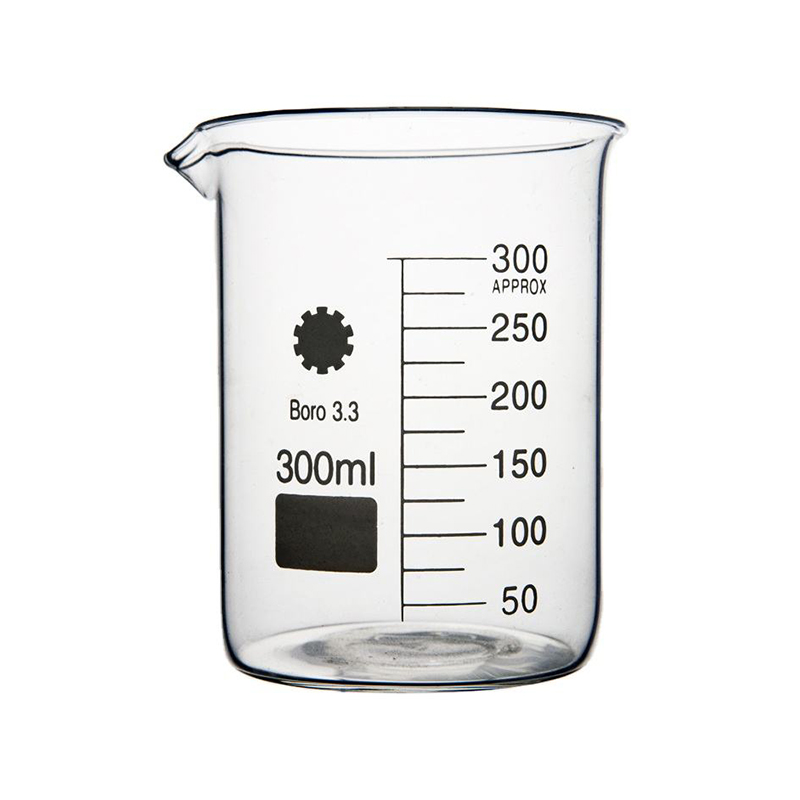
Rinse glassware immediately after use to prevent polymerized residues from bonding to the wall. Mild detergent and a soft brush remove most organic residues; abrasive pads scratch borosilicate surfaces and turn a transparent flask into a nucleation site for the next bumping event. Store condensers vertically in a rack, or clamp them by the joint area, so the inner tubes do not knock against adjacent glass. The same care extends to every vessel that touches the distillate; the use and care of laboratory beakers follows the same thermal-shock and cleaning rules, which matter just as much in a distillation train as they do at the bench. For maintenance routines that apply across the whole lab, the general laboratory tips page lists habits that keep glassware and instruments in good operating condition.
Writing the run down improves reproducibility
Record the joint size, condenser type, bath temperature, and pressure for every successful distillation. Those four numbers turn a one-off run into a reproducible process when you upgrade from a small flask to a pilot-scale reactor. If your lab follows structured experimental routines, the seven principles of experimental operation are a practical reminder of how small procedural details produce reliable data.
Distillation glassware does not need to be complicated. Match the condenser to the vapor, verify the joints before assembly, and keep the system open to the vent or vacuum line. When those three conditions hold, a simple set of standard taper components outperforms an expensive complete kit every time. For labs that scale from bench distillation to pilot runs, buying from a producer that manufactures standard taper glass in-house provides the consistency to repair, extend, or customize a train without re-engineering it from scratch.