English
 Français
 Español
Glass Column Chromatography: How to Choose, Pack, and Run a Glass Column
The reaction has just finished, and the TLC plate shows what you were hoping for: two grams of crude product with one close-running impurity. In most laboratories, the next step is still the most dependable one—load the sample onto a glass column, push solvent through a bed of silica, and collect clean fractions. Glass column chromatography remains the most flexible method for separating, purifying, and analyzing compounds in chemistry, biology, and pharmaceutical work.
The technique only performs as well as the glassware supporting it. A cracked frit, a leaking stopcock, or a column that cannot handle pressure will cost more time than the separation itself. This guide explains the selection criteria that matter, the packing habits that produce sharp bands, and the practical details that let you run glass columns faster without losing resolution.
Why Glass Column Chromatography Still Earns Its Bench Space
Prepacked plastic cartridges are convenient, but a glass column gives you control that disposables cannot match. Glass tolerates the full range of common chromatography solvents—hexane, ethyl acetate, dichloromethane, methanol, and acetone—and can be pressurized with air or nitrogen to accelerate flow. You can see the bed, adjust its height, and reuse the same column for years after a simple cleaning.
Glass columns also scale naturally. The same type of column can purify a few milligrams for analytical work or several hundred grams for a pilot batch. In pharmaceutical and fine-chemical laboratories, glass chromatography columns are routine tools for purifying synthetic intermediates; in analytical settings they isolate contaminants, drugs, vitamins, and nucleic acids; and in biochemistry laboratories they support protein purification. In teaching labs, the transparency of glass helps students see how the adsorbent bed, solvent front, and compound bands interact, while in quality control it provides a clear, traceable purification path. That range of applications is why most laboratories keep at least one glass column assembled and ready.
What to Check Before You Buy a Glass Chromatography Column
Four components decide whether a column performs well: the body, the fritted disc, the stopcock, and the reservoir. Each one should match the scale and the solvent system you actually use.
| Component | What to look for | Why it matters |
|---|---|---|
| Column body | Heavy-wall borosilicate 3.3 glass with standard taper joints | Withstands pressure from air or nitrogen and connects to existing glassware |
| Fritted disc | Sintered glass disc with porosity matched to the adsorbent | Supports the bed and keeps silica out of the stopcock |
| Stopcock | PTFE plug for daily use, glass plug for traditional setups | Controls flow rate and prevents solvent loss between runs |
| Reservoir | Built-in or detachable solvent reservoir | Holds enough eluent for a full run without constant topping up |
Column diameter should match the sample load. A wider column shortens the bed for a given mass of silica and increases flow rate; a longer, narrower column improves resolution but needs more pressure. Choose the diameter based on the mass of crude material, and the length based on how close the impurity runs to your product.
PTFE Stopcock or Glass Stopcock?
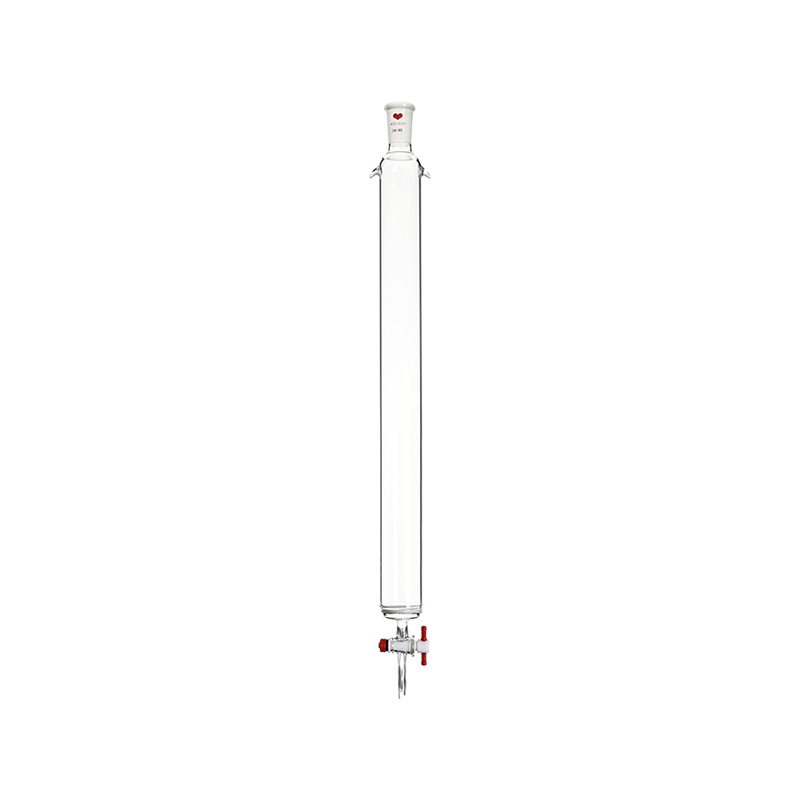
Choose PTFE for nearly every preparative application. A chromatography column with a PTFE stopcock needs no grease, will not seize after contact with hexane or ethyl acetate, and lets you adjust the flow with small, precise movements of the plug. Glass stopcocks are chemically inert and inexpensive, but they require a light film of grease, risk freezing in the barrel after standing, and can contaminate sensitive fractions if the grease dissolves into the eluent. Unless you have a specific reason to avoid PTFE, such as an unusual solvent system that attacks the plastic, choose PTFE.
 Custom Lab Chromatography Column With PTFE Stopcock Manufacturers, SuppliersShanghai Heqi Glassware Co., Ltd. is China Lab Chromatography Column With PTFE Stopcock manufacturers and Chromatography Column With PTFE...View Product →
Fritted Disc Porosity and Bed Support
The sintered disc at the bottom of the column holds the adsorbent and prevents particles from reaching the stopcock. Porosity is the specification that matters most. For flash chromatography with 230–400 mesh silica, a porosity 2 disc with a nominal pore size of 40–100 µm is the standard choice. Use porosity 1 (100–160 µm) for coarse adsorbents and higher flow rates, or porosity 3 (15–40 µm) when working with fine packings that need extra support.
Confirm that the frit is evenly sintered and free of cracks; a damaged frit lets silica leak into fractions and ruins pressure stability. When reproducibility matters—for method transfer or quality control—a Class A chromatography column with a standard joint, sintered disc, and PTFE stopcock offers the tighter tolerances and flatter frit that consistent beds require.
 Wholesale Class A Chromatography Column with Standard Joint, Sintered Disc & PTFShanghai Heqi Glassware Co., Ltd. is China wholesale Class A Chromatography Column with Standard Joint, Sintered Disc & PTFE Stopcock Sup...View Product →
Packing the Column and Running a Fast, Reproducible Separation
Packing quality determines band sharpness. For flash chromatography, weigh out enough silica to give a bed height of about 15–16 cm. This rule of thumb balances two competing needs: more silica improves resolution but slows flow and consumes more solvent; less silica shortens run time but risks poor separation of close-running compounds.
Slurry packing is the most reliable method. Mix the silica with the eluent, pour the slurry into the column in one continuous motion, and settle the bed by gentle tapping or light pressure. Keep a layer of solvent above the bed at all times—drying the bed creates channels that destroy resolution. For the same reason, never let the solvent level drop below the top of the silica once the run has started.
Load the sample as a concentrated solution, or pre-adsorb it onto a small portion of silica and add it as a dry powder on top of the bed. Cover the sample layer with sand to prevent disturbance when eluent is poured in. Secure the column with a clamp on a support stand so the assembly stays vertical and the stopcock is easy to reach.
Speed Without Sacrificing Resolution
Gravity flow is slow; pressure is the standard fix. Seal the top of the column and apply nitrogen or compressed air at a controlled pressure. This is the most effective way to run a glass column faster, and it is common practice for chemists who process several columns per day. Start with a moderate flow rate and increase it gradually—the bed should never compress to the point where the frit chokes.
Monitor the separation by collecting small fractions and checking them with TLC. A TLC developing tank lets you evaluate several fractions at once and decide exactly when the product begins and ends. Keeping consistent habits, such as following the seven principles of experimental operation, minimizes variation between runs and saves reagents.
 Custom Lab TLC Developing Tank,Chromatography Chamber Manufacturers, SuppliersShanghai Heqi Glassware Co., Ltd. is China Lab TLC Developing Tank,Chromatography Chamber manufacturers and TLC Developing Tank,Chromatog...View Product →
Cleaning and Care: Getting Many Cycles from One Column
A well-maintained glass column lasts for years, while a neglected one produces failed runs and wasted hours. Rinse the column thoroughly with the eluent immediately after a separation, then wash with a mild laboratory detergent and water. For frits clogged with fine silica, use an ultrasonic bath with a suitable cleaning solution; never use hydrofluoric acid on any glass component.
Disassemble the PTFE stopcock, wipe the plug, and rinse the barrel. If a glass stopcock is used, remove all grease with a solvent before storing the column. Store columns upright with stopcocks slightly open so residual solvent cannot form stubborn residues. These habits follow the same logic as the general laboratory tips experienced technicians apply to all reusable glassware.
Prepare the Solvent, Then Trust the Column
Before loading any sample, make sure the eluent is properly dried and degassed. Trace water changes the activity of the silica and can turn a clean separation into a smeared one. Laboratories that handle moisture-sensitive compounds often pass solvents through a gas drying tower or take them from a dedicated solvent purification system.
Glass column chromatography works because it is simple: a stable bed, a controlled flow, and patient fraction collection. Buy a column with a matched frit and a dependable PTFE stopcock, pack it with consistent technique, apply pressure when you need speed, and clean it after every run. That combination will purify your compounds reliably—and the next column will run faster than the last.