English
 Français
 Español
What Is a Graduated Cylinder Used For? A Complete Guide to Graduated Cylinders
What Is a Graduated Cylinder Used For?
A graduated cylinder is used to measure the volume of a liquid with high precision, typically accurate to within 1% of the reading. It is a tall, narrow container marked with evenly spaced volume lines (graduations) running from the bottom to the top, and it is one of the most common pieces of glassware found in chemistry labs, biology labs, pharmacies, and industrial quality-control settings.
Unlike a beaker or flask, which are designed mainly to hold, mix, or heat liquids, a graduated cylinder exists for one core purpose: accurate volume measurement. Its narrow diameter reduces the surface area of the liquid, which minimizes reading error and makes it far more precise than wide-mouthed containers for measuring exact amounts of a liquid, whether that's water, a chemical reagent, or a solvent.
Common Applications of Graduated Cylinders
Graduated cylinders show up in far more settings than just a chemistry classroom. Below are the most frequent real-world uses.
1. Chemistry and Physics Labs
Students and researchers use graduated cylinders to measure precise volumes of solutions before mixing reagents, diluting acids, or preparing standard solutions. For example, preparing a 0.1 molar (M) solution often requires measuring exactly 100 mL of a stock solution — a task a graduated cylinder handles with much greater accuracy than a beaker, which is often only accurate to ±5-10%.
2. Biology and Medical Laboratories
In biology labs, graduated cylinders measure culture media, buffer solutions, and reagents for experiments such as DNA extraction or cell culture preparation. In clinical and pharmaceutical settings, they are used to measure liquid medications, syrups, and compounding ingredients where dosage accuracy directly affects patient safety.
3. Determining the Volume of Irregular Solid Objects
A graduated cylinder can also measure the volume of an irregularly shaped solid object, such as a rock or a small metal part, using the water displacement method. The object is submerged in a known volume of water, and the rise in water level equals the object's volume. This technique is a staple in introductory science classes for teaching the concept of displacement.
4. Culinary and Industrial Measurement
Outside of formal labs, graduated cylinders (or similarly graduated measuring vessels) are used in food science, brewing, and quality-control processes in manufacturing, where consistent liquid volumes affect product quality, such as measuring flavoring concentrates or checking fill volumes on a production line.
How to Read a Graduated Cylinder Correctly
Most liquids in a graduated cylinder form a curved surface called a meniscus due to surface tension. Reading the cylinder correctly is critical to getting an accurate measurement, and it follows three consistent steps:
- Place the cylinder on a flat, level surface.
- Bring your eye level even with the liquid surface (not above or below it), a technique that avoids parallax error.
- Read the measurement at the bottom of the curve for most liquids like water, since this is the lowest point of the meniscus.
One important exception: liquids like mercury form a convex (upward-curving) meniscus rather than a concave one, so the reading is taken from the top of the curve instead. Failing to correct for the meniscus is one of the most common sources of error in lab measurements, and it can introduce a discrepancy of 0.1 mL to 0.5 mL depending on the cylinder's diameter.
Types of Graduated Cylinders
Graduated cylinders are generally classified by material and by manufacturing tolerance (accuracy class), and choosing the right type depends on how precise the measurement needs to be.
By Material
Glass graduated cylinders (often borosilicate glass) resist chemical corrosion and can tolerate higher temperatures, making them the standard choice for work involving acids, solvents, or heat. Plastic graduated cylinders (typically polypropylene or polymethylpentene) are less breakable and lighter, which makes them popular in field settings, classrooms with younger students, or anywhere breakage is a safety concern.
By Accuracy Class
Graduated cylinders are typically manufactured to one of two tolerance standards, as shown in the table below.
| Accuracy Class | Typical Tolerance (100 mL) | Best Use Case |
|---|---|---|
| Class A | ±0.5 mL | Quantitative research, certified lab work |
| Class B | ±1.0 mL | General lab work, teaching, routine measurement |
Class A cylinders are typically etched with a permanent, colorfast marking and are the standard for any procedure requiring documented, reproducible accuracy, such as titrations or formal quantitative analysis. Class B cylinders are perfectly adequate for most everyday lab or educational tasks.
Graduated Cylinder vs. Other Volume-Measuring Tools
A common point of confusion is when to use a graduated cylinder versus other lab glassware. The table below clarifies the differences.
| Tool | Typical Accuracy | Primary Purpose |
|---|---|---|
| Graduated Cylinder | ±0.5-1% | Precise volume measurement |
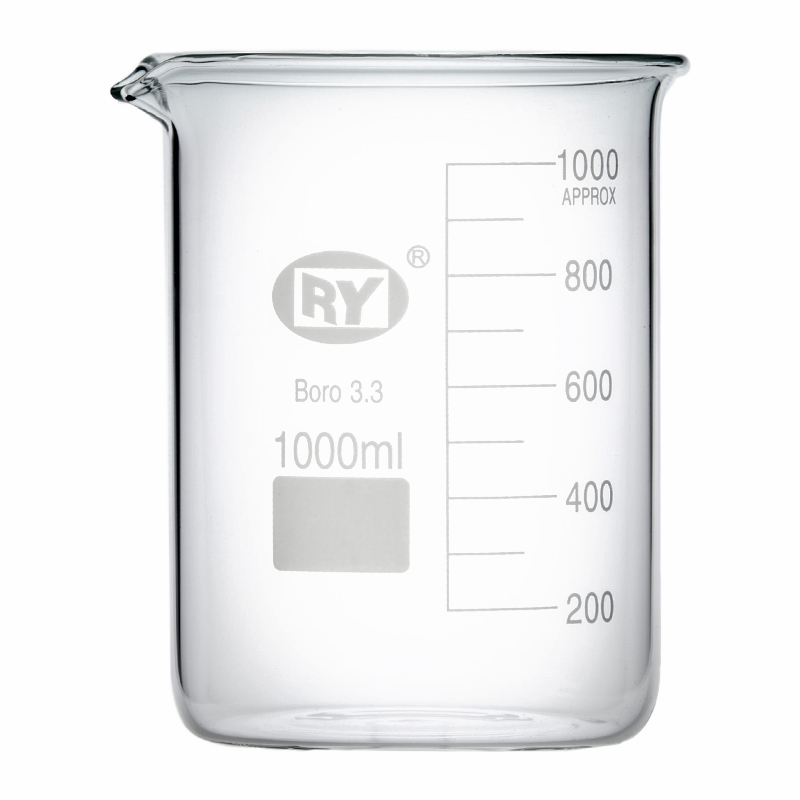
| Beaker | ±5-10% | Mixing, heating, rough volume estimates |
| Volumetric Flask | ±0.1-0.3% | Preparing a single, exact solution volume |
| Pipette | ±0.1-1% | Transferring small, precise liquid volumes |
In short: reach for a beaker when precision doesn't matter much, a volumetric flask when you need one exact volume for a solution, a pipette for small, precise transfers, and a graduated cylinder for general-purpose measuring across a range of volumes.
Common Sizes of Graduated Cylinders
Graduated cylinders come in a range of capacities to suit different tasks, and choosing the right size affects both accuracy and convenience. Common sizes include:
- 10 mL and 25 mL — used for small, precise volumes in micro-scale experiments
- 50 mL and 100 mL — the most common sizes for general lab and classroom use
- 250 mL and 500 mL — used for larger batches of solutions or reagents
- 1,000 mL and 2,000 mL — used in industrial, bulk, or large-scale prep work
A useful rule of thumb: choose the smallest cylinder that can hold your target volume. Because the graduation marks are proportionally larger on smaller cylinders, a 100 mL measurement taken in a 100 mL cylinder is more accurate than the same measurement taken in a 1,000 mL cylinder.
Best Practices for Accurate Measurements
Following a few simple habits significantly improves the reliability of readings taken with a graduated cylinder:
- Always place the cylinder on a flat, stable, and level surface before reading.
- Pour liquid slowly as you approach the target volume to avoid overshooting the mark.
- Use a dropper or pipette for the last few drops when precision matters most.
- Read at eye level with the bottom of the meniscus, not from above or below.
- Rinse and dry the cylinder between uses to prevent cross-contamination of chemicals.
- Avoid measuring hot liquids in glass cylinders not rated for thermal shock, since rapid temperature changes can cause cracking.
In laboratories that require documented accuracy, cylinders should also be periodically checked for calibration drift, especially plastic cylinders, which can warp slightly over years of repeated use and cleaning.