Introduction to Lab Pear Shape Flasks
The Evolution and Significance of Specialized Laboratory Glassware
In modern chemical research, pharmaceutical formulation, and industrial synthesis, the reliability of glassware dictates the safety and reproducibility of experimental outcomes. Among the myriad vessels utilized in laboratories, the lab pear shape flask occupies a unique and indispensable niche. Designed to bridge the gap between traditional round-bottom vessels and specialized micro-reaction containers, this flask geometry addresses specific hydrodynamic and thermal challenges encountered during complex liquid handling, solvent evaporation, and organic synthesis.
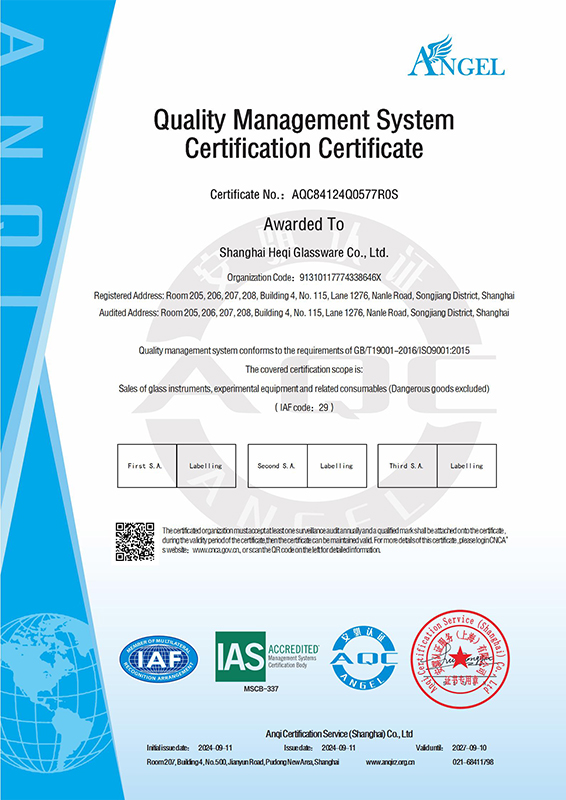
The manufacturing of laboratory glassware is an intricate science that merges artistic craftsmanship with rigorous industrial standards. Drawing upon decades of specialized expertise since its establishment in March 2002, Shanghai Heqi Glassware Co., Ltd. has dedicated its operations to advancing the R&D and production of standard-mouth glass instruments. Through the establishment of modern production bases strategically positioned in Songjiang, Chengdu, Jiaxing, and Yancheng, the enterprise has successfully transitioned from traditional manual glassblowing to mechanized and semi-mechanized production methodologies. By integrating state-of-the-art assembly-line industrial processes, Shanghai Heqi Glassware Co., Ltd. ensures that every lab pear shape flask achieves exceptional dimensional precision, uniform wall thickness, and superior chemical durability.
Structural Anatomy and Geometrical Dynamics of Lab Pear Shape Flasks
The defining characteristic of a lab pear shape flask is its tapered, pyriform body geometry. Unlike spherical vessels designed for uniform distribution across large boiling volumes, the pear-shaped configuration converges downward into a narrower base. This distinctive contour offers profound functional advantages in experimental setups involving limited sample volumes, fractional distillation, and rotary evaporation recovery.
To fully comprehend why laboratories worldwide integrate these vessels into their daily operations, it is essential to examine their core structural parameters and compare them directly against standard alternative glassware configurations:
| Parameter / Feature |
Lab Pear Shape Flask |
Standard Round Bottom Flask |
Erlenmeyer Flask |
| Bottom Geometry |
Tapered, pyriform profile converging at the base |
Symmetric spherical contour |
Flat bottom with conical upper walls |
| Residue Recovery Efficiency |
Exceptionally High: Narrow bottom gathers micro-volumes effectively |
Moderate: Spherical curve spreads tiny residues over a wider surface |
Low-Moderate: Flat corners trap small droplets |
| Stirring & Vortex Dynamics |
Optimized for magnetic stirring bars; prevents dead zones in small volumes |
Standard fluid mixing; excellent for boiling chips |
Prone to splashing at high agitation speeds |
| Thermal Shock Resistance |
High (Borosilicate Glass 3.3, uniform stress distribution) |
Very High (Optimal spherical stress dispersion) |
Moderate (Flat base creates thermal stress concentration points) |
| Primary Application Focus |
Rotary evaporation, solvent recovery, micro-synthesis |
General reflux, bulk distillation, large-scale reactions |
Titration, culture growth, temporary solution mixing |
Engineering Insight: The transition from manual fabrication to mechanized precision at production facilities such as those operated by Shanghai Heqi Glassware Co., Ltd. guarantees that the inner taper angle and neck-to-body transition of each lab pear shape flask maintain strict geometric tolerances. This eliminates structural weak points and ensures flawless compatibility with standard taper ground joints.
Material Integrity: Borosilicate Glass 3.3 and Thermal Endurance
The operational longevity of any laboratory vessel depends fundamentally on the quality of its raw materials. High-grade lab pear shape flasks are universally manufactured from Borosilicate Glass 3.3, a low-expansion material renowned for its extraordinary resistance to thermal shock and chemical attack. With a very low coefficient of linear thermal expansion, this glass formulation allows vessels to undergo rapid temperature fluctuations—such as moving directly from an ice bath to a heating mantle—without structural failure.
Furthermore, the chemical inertness of Borosilicate Glass 3.3 ensures that aggressive reagents, concentrated acids, strong alkalis, and organic solvents do not leach into or contaminate sensitive chemical mixtures. Upholding these rigorous material standards, Shanghai Heqi Glassware Co., Ltd. implements stringent quality control protocols across its specialized workshops for glass and metalworking, ensuring that every batch of lab pear shape flasks meets international safety and performance benchmarks.
Understanding Lab Pear Shape Flasks: Design, Structure, and Specifications
Structural uniqueness and aerodynamic geometry
The structural design of a lab pear shape flask centers around its aerodynamic, pyriform geometry. By transitioning smoothly from a standard taper neck into a downward-converging tapered base, this geometry prevents liquid stagnation and promotes uniform fluid movement. In industrial and research applications, this contour minimizes sample loss and optimizes fluid behavior during high-speed rotation or magnetic stirring.
Standard taper joints and ground glass compatibility
Precision is vital when integrating glassware into complex manifold assemblies. Lab pear shape flasks are manufactured with standard taper ground glass joints to ensure a secure, airtight seal with condensers, stoppers, and adapters. This interchangeability streamlines multi-step chemical workflows without requiring proprietary adapters.
Material composition (Borosilicate Glass 3.3) and thermal resistance
Constructed exclusively from premium Borosilicate Glass 3.3, these flasks offer exceptional resistance to chemical corrosion and extreme thermal shock. Their low thermal expansion coefficient allows them to withstand rapid temperature shifts, making them dependable vessels for heating, cooling, and distillation processes.
Key Applications of Lab Pear Shape Flasks in Industrial and Research Laboratories
In modern chemical engineering, fine chemical synthesis, and pharmaceutical research, laboratory glassware must serve exacting functional roles. The lab pear shape flask is heavily relied upon across several specialized operational workflows where fluid dynamics, sample preservation, and phase separation are critical. Understanding these applications helps laboratories optimize their consumable selection and workflow efficiency.
Rotary Evaporation and Solvent Recovery Processes
The most prominent application of a lab pear shape flask is within rotary evaporation systems used for the removal of volatile solvents following extraction, organic synthesis, or concentration steps. When dealing with precious or limited-volume reaction mixtures, standard spherical evaporation flasks often present recovery challenges because small droplets adhere to the wide curvature and become difficult to harvest. The tapering bottom of a lab pear shape flask concentrates liquid residues into a compact pool at the base. This geometry allows the rotating system to sweep the entire sample efficiently, maximizing recovery rates during solvent stripping.
To support advanced laboratory setups, Shanghai Heqi Glassware Co., Ltd. integrates its standard-mouth glass manufacturing expertise into producing compatible components, supplying high-quality glassware, lab consumables, and experimental equipment that ensure seamless integration with rotary evaporators and distillation units.
Micro-Scale Distillation and Fractional Separation
In organic chemistry laboratories, fractional distillation and micro-scale synthesis frequently involve limited reactant volumes ranging from a few milliliters to a few hundred milliliters. Using oversized round-bottom vessels in these scenarios results in excessive dead volume, vapor condensation losses, and poor thermal control. A lab pear shape flask provides an ideal reaction and distillation chamber for small-batch operations. Its geometry facilitates smooth boiling characteristics when used with appropriate boiling stones or magnetic stirring bars, minimizing bumping and localized overheating.
Organic Synthesis under Controlled Environments
Complex organic synthesis often requires multi-neck adapters or custom-angled glassware configurations. Lab pear shape flasks can be fitted with standard taper ground joints to connect reflux condensers, addition funnels, and inert gas inlets. Because laboratories frequently require customized small-scale and pilot-scale equipment solutions, Shanghai Heqi Glassware Co., Ltd. leverages its in-house capabilities in design, production, and custom fabrication of glass components to tailor flask dimensions and joint sizes according to specific experimental parameters.
Technical Advantages Over Standard Round Bottom Flasks
Choosing the correct vessel geometry directly impacts experimental yields, processing times, and operational safety. A detailed technical comparison highlights why laboratories specify lab pear shape flasks over standard round bottom alternatives in specific scenarios:
| Performance Metric |
Lab Pear Shape Flask |
Standard Round Bottom Flask |
Operational Impact |
| Sample Recovery Precision |
High concentration of liquid at the narrow bottom tip |
Dispersed liquid film across a wide spherical radius |
Significantly reduces loss of high-value compounds during extraction |
| Compatibility with Rotary Evaporator Bump Traps |
Direct, secure coupling with standard vapor ducts and clips |
Requires identical volume matching; less adaptable to micro-vessels |
Minimizes mechanical vibration stress during high-speed rotation |
| Agitation & Vortex Efficiency |
Encourages uniform vortex formation without magnetic bar dead zones |
Can allow swirling dead zones at smaller liquid depths |
Enhances reaction kinetics and heat transfer rates |
| Thermal Gradient Distribution |
Gradual wall transition prevents localized hot spot cracking |
Uniform spherical heat absorption |
Maintains structural integrity across repeated thermal cycling |
Technical Integration: Backed by dedicated R&D teams combining expertise in chemical R&D, mechanical design, and precision processing, Shanghai Heqi Glassware Co., Ltd. continuously refines the thermal and mechanical resilience of its glassware. By replacing traditional manual methods with mechanized industrial processes, the company ensures that every lab pear shape flask delivers reliable performance under rigorous laboratory conditions.
Lab Pear Shape Flasks
In equipping professional laboratories and pilot-plant facilities, standardizing glassware catalogs requires meticulous attention to dimensional metrics, joint sizes, and volumetric capacities. A high-performing lab pear shape flask must bridge universal laboratory standards with customized engineering parameters to accommodate diverse experimental setups.
To meet the precise demands of large-scale laboratory installations and institutional supply chains, Shanghai Heqi Glassware Co., Ltd. maintains extensive production lines dedicated to standard-mouth glass instruments. Through its advanced manufacturing bases in Songjiang, Chengdu, Jiaxing, and Yancheng, the enterprise ensures that every catalog specification adheres to rigorous dimensional accuracy, providing laboratories with reliable components for distillation, reaction, and solvent recovery.
Below is a standardized technical specification matrix outlining typical volumetric tiers, standard taper joint configurations, and wall thickness parameters for industrial-grade lab pear shape flasks:
| Nominal Capacity (mL) |
Standard Joint Size (NS) |
Approximate Body Diameter (mm) |
Wall Thickness Tolerance (mm) |
Primary Usage Tier |
| 10 mL |
14/23 or 10/19 |
31 mm |
1.5 mm – 1.8 mm |
Micro-scale synthesis and trace extraction |
| 25 mL |
14/23 or 19/26 |
40 mm |
1.8 mm – 2.0 mm |
Small-volume rotary evaporation |
| 50 mL |
19/26 or 24/29 |
51 mm |
1.8 mm – 2.2 mm |
Standard organic solvent stripping |
| 100 mL |
24/29 or 29/32 |
64 mm |
2.0 mm – 2.5 mm |
Preparative distillation and reflux |
Manufacturing Excellence and Quality Assurance for Bulk Buyers
The transition from basic workshop fabrication to advanced industrial production is critical for maintaining consistency across large volume orders. When laboratories and industrial plants procure glassware in bulk, structural uniformity and defect-free annealing are paramount to preventing catastrophic failures under thermal and mechanical stress.
Operating out of specialized workshops tailored for glass processing, metalworking, and final assembly, Shanghai Heqi Glassware Co., Ltd. employs mechanized and semi-mechanized manufacturing techniques. This industrial shift replaces traditional, highly variable manual glassblowing with standardized assembly-line protocols, significantly reducing internal stress points and structural flaws in every lab pear shape flask.
Raw Material Sourcing and Strict Quality Control Standards
Quality assurance begins with pristine raw material selection. Utilizing pure Borosilicate Glass 3.3, production cycles incorporate precise temperature-controlled annealing lehrs to eliminate residual mechanical stresses introduced during shaping. Each batch undergoes rigorous dimensional checks, optical clarity inspection, and standard taper joint leak testing to ensure absolute compatibility with ground glass stoppers and metal clips.
Operational Support: Delivering on its service commitment of providing responsive support and ample inventory, Shanghai Heqi Glassware Co., Ltd. ensures that large-scale orders are backed by fast delivery and comprehensive quality documentation. In addition to standard catalog items, the company supports specialized chemical and pharmaceutical processing requirements through custom glass fabrication.
Precision annealing and dimensional accuracy testing
Every production run undergoes strict annealing control to relieve internal glass stresses. Dimensional accuracy testing ensures that ground joints, wall thickness, and outer diameters match strict international tolerances.
Compliance with international laboratory glassware standards (ISO/ASTM)
Manufacturing processes adhere to recognized global benchmarks, ensuring that each vessel meets structural safety, thermal endurance, and dimensional interchangeability requirements mandated by modern research institutions.
Factors for Large-Scale Procurement and Customization Options
When institutional clients, research facilities, and industrial manufacturing plants undertake large-scale procurement of laboratory glassware, evaluating supplier capabilities extends beyond basic unit pricing. Supply chain stability, inventory depth, packaging integrity, and custom fabrication flexibility are critical determinants of long-term operational success.
To ensure that clients experience seamless fulfillment from initial inquiry to final delivery, Shanghai Heqi Glassware Co., Ltd. combines ample warehouse inventory with rapid turnaround capabilities. The enterprise supplies a comprehensive portfolio of high-quality glass instruments, lab consumables, and experimental equipment from its centralized production and distribution centers. Furthermore, for laboratories requiring specialized glassware configurations, the in-house engineering team collaborates directly with researchers to deliver tailored solutions.
Volume Tiers, Capacity Ranges, and Joint Variations
Project managers evaluating catalog options must consider volumetric scalability ranging from micro-scale 10 mL containers up to heavy-duty 2000 mL synthesis vessels. Standardizing joint sizes ensures interchangeability across existing rotary evaporators and distillation setups. Custom OEM and ODM requirements—including non-standard neck angles, multi-neck additions, or specialized graduation markings—are fully supported through the dedicated glass and metalworking workshops maintained by Shanghai Heqi Glassware Co., Ltd.
Logistics, Packaging Integrity, and Transit Safety
Glassware transit safety is a primary concern for bulk shipments. To mitigate breakage risks during international transport, rigorous drop-test validations and reinforced multi-layer carton packaging with shock-absorbing inserts are utilized. This attention to logistics detail ensures that every shipment arrives intact and ready for immediate laboratory deployment.
Frequently Asked Questions (FAQ)
What is the primary advantage of using a pear-shaped flask over a round-bottom flask in rotary evaporation?
The tapered, pyriform geometry of a lab pear shape flask concentrates liquid residues into a narrow bottom pool rather than spreading them across a wide spherical surface. This allows rotating systems to harvest micro-volumes and high-value extracts with significantly higher recovery efficiency.
Can these flasks withstand high temperatures and rapid thermal shocks during heating?
Yes. Fabricated strictly from high-grade Borosilicate Glass 3.3, these vessels possess an extremely low coefficient of thermal expansion, enabling them to endure rapid temperature transitions between heating mantles and cooling baths without structural cracking.
What are the available standard joint sizes and volumetric capacities for bulk orders?
Standard catalog capacities range from 10 mL to 2000 mL, featuring precision-ground standard taper joints. Custom volumetric tiers and specialized joint dimensions can also be fabricated upon request.
What is the minimum order quantity (MOQ) and typical lead time for custom OEM manufacturing?
MOQ and lead times vary depending on the complexity of custom glass configurations and tooling requirements. Dedicated engineering teams work closely with clients to establish optimized production schedules and efficient delivery timelines.
How are fragile glassware shipments packaged to ensure damage-free delivery for large-scale procurement?
Shipments undergo strict drop-test validation and are secured in reinforced, multi-layer corrugated packaging featuring custom-molded shock-absorbing inserts. This safeguards fragile components against impact and ensures safe arrival during domestic and international transit.


 English
 Français
 Español