What Are Lab Overhead Stirrers?
Lab overhead stirrers are specialized laboratory instruments that utilize a motor to drive a stirring shaft and impeller, performing tasks such as mixing, dispersing, emulsifying, dissolving, and homogenizing experimental samples. Unlike traditional magnetic stirrers, which rely on a magnetic field to drive a stir bar, overhead stirrers employ a mechanical drive system to transmit motor power directly to the stirring assembly; this enables higher torque output and more stable stirring performance.
Thanks to their robust power capabilities and versatility, lab overhead stirrers are widely used across industries such as chemical R&D, pharmaceuticals, advanced materials, biotechnology, food processing, cosmetics, and fine chemicals, serving as a crucial link between laboratory research and industrial production.
For modern corporate R&D departments, laboratory stirring equipment must go beyond simple mixing; it must meet diverse requirements including formulation development, process optimization, experimental reproducibility, and small-scale production validation. Consequently, high-performance overhead stirrers have increasingly become the preferred choice for research institutions and corporate laboratories alike.
Working Principle of Lab Overhead Stirrers
Laboratory overhead stirrers primarily consist of a drive motor, a control system, a stirring shaft, a chuck, and an impeller. During operation, the motor drives the shaft to rotate according to preset parameters; the impeller generates both axial and radial flow within the liquid, ensuring thorough contact between components and achieving uniform mixing.
By adjusting rotation speed and torque, and selecting appropriate impeller types, the equipment can handle materials with varying viscosities and characteristics. For instance, low-viscosity liquids typically require higher speeds to enhance circulation efficiency, whereas high-viscosity materials rely more heavily on the equipment's torque output capability.
In chemical and pharmaceutical R&D, experiments often go beyond simple liquid mixing to involve complex processes such as dissolution, reaction, dispersion, and heat transfer. Consequently, a stable and reliable mechanical stirring system is crucial for ensuring the validity of experimental results.
Value of Lab Overhead Stirrers in the B2B Market
As the chemical, pharmaceutical, new material, and new energy industries evolve, corporate requirements for laboratory equipment are rising. R&D professionals focus not only on the equipment's ability to perform stirring but also on the accuracy of experimental data, operational stability, and the feasibility of scaling up processes from the laboratory to production.
Lab Overhead Stirrers primarily serve:
- Pharmaceutical R&D centers
- Chemical and materials companies
- Universities and research institutions
- Food and cosmetics R&D departments
- New energy material laboratories
- Third-party testing agencies
- Laboratory equipment distributors
In these settings, overhead stirrers are commonly used for formulation development, material testing, reaction experiments, small-batch production, and process parameter optimization.
For example, the pharmaceutical industry requires thorough mixing of drug solutions and excipients; the new materials industry demands uniform dispersion of high-viscosity polymers or slurries; and the cosmetics industry needs precise control over emulsification processes to ensure stable product performance. All these applications place high demands on the precision and reliability of the stirring equipment.
Key Performance Characteristics of Lab Overhead Stirrers
High-Torque Stirring Capability
High torque is a key advantage that distinguishes laboratory overhead stirrers from standard stirring equipment. When processing high-viscosity materials—such as resins, adhesives, polymer solutions, coatings, and creams—significant resistance is generated during stirring; standard magnetic stirrers often struggle to maintain stable operation.
Overhead stirrers utilize mechanical drive systems to deliver consistent power, ensuring stable stirring performance even with materials that exhibit significant viscosity changes, thereby enhancing experimental efficiency.
Precise Speed Control
Modern laboratory overhead stirrers typically feature digital controls, allowing users to adjust rotation speeds based on experimental requirements and monitor operational status in real time.
Precise speed control enables R&D personnel to:
- Maintain consistent experimental conditions
- Improve experimental reproducibility
- Optimize formulation processes
- Minimize human error
For corporate R&D departments, this stability is crucial for subsequent product development and quality control.
Flexible Selection of Stirring Attachments
Different materials require different stirring methods; consequently, overhead stirrers typically support a variety of impeller configurations.
Common types include:
- Propeller-style impellers: Suitable for rapid circulation and mixing of low-viscosity liquids
- Paddle-style impellers: Suitable for general laboratory mixing tasks
- Anchor-style impellers: Suitable for stirring high-viscosity materials
- Dissolver discs: Suitable for powder dispersion and emulsification processes
By simply swapping attachments, a single unit can meet the experimental needs of multiple industries.
Integrated Application of Laboratory Overhead Stirrers with Glassware and Reaction Equipment
In chemical R&D and pharmaceutical experimentation, overhead stirrers are rarely used in isolation; instead, they are typically paired with laboratory glass reaction vessels, distillation systems, circulation units, and other related equipment.
For instance, when used with glass reactors or laboratory reaction systems, the stirrer integrates with the glass vessel to provide stable mechanical agitation, facilitating processes such as:
- Chemical reaction mixing
- Temperature-controlled experiments
- Solvent processing
- Sample synthesis
- Process validation (from lab-scale to pilot-scale)
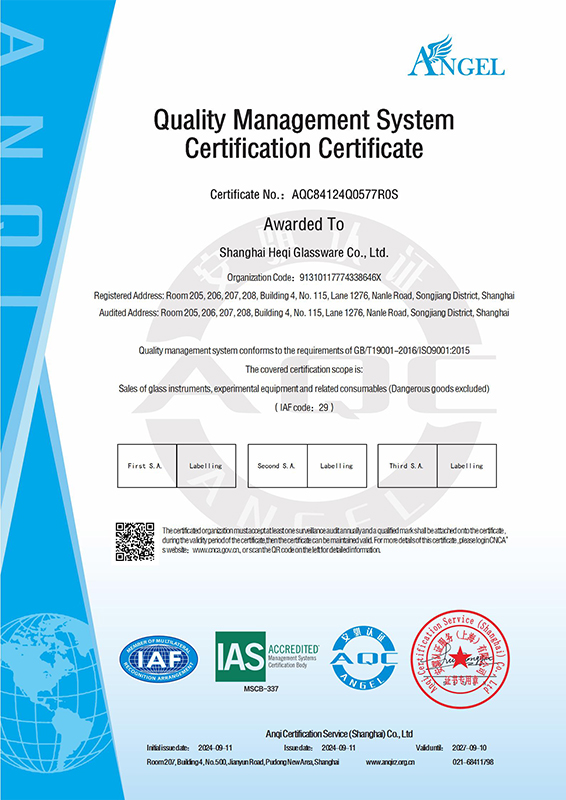
As a professional laboratory equipment supplier, Shanghai Heqi Glassware Co., Ltd. has long specialized in the R&D and manufacturing of standard-joint glassware, providing laboratory equipment and customized solutions to the chemical R&D and pharmaceutical industries.
Established in 2002, Shanghai Heqi has expanded significantly over the years, setting up production bases in regions including Songjiang, Chengdu, Jiaxing, and Yancheng. By integrating advanced technology, manufacturing processes, and management expertise, the company has transitioned from traditional manual craftsmanship to mechanized and semi-mechanized production methods. The introduction of assembly-line production has enabled the company to boost efficiency while continuously enhancing product quality.
In recent years, Shanghai Heqi has assembled expert teams across chemical R&D, mechanical design and machining, and electronic control systems. The company operates three specialized workshops dedicated to glass manufacturing, metal machining, and equipment assembly, producing a wide range of products, including:
- Glass Reactors
- Rotary Evaporators
- Distillation Units
- High and Low-Temperature Circulation Systems
- Vacuum Pumps
- Laboratory Stirrers
- UV Analyzers
Leveraging its capabilities in independent design, manufacturing, and custom glass component fabrication, Shanghai Heqi provides comprehensive solutions tailored to the specific needs of clients at various stages of R&D—ranging from laboratory-scale testing to pilot-scale production.
Key Industry Applications of Lab Overhead Stirrers
Pharmaceutical Industry
Pharmaceutical R&D demands high standards for mixing uniformity, stability, and experimental reproducibility. Lab overhead stirrers are used for:
- Drug formulation development
- Suspension preparation
- Raw material mixing
- Formulation experiments
When integrated with laboratory reactor systems, they assist companies in managing the entire process from R&D validation to process optimization.
Chemical and New Materials Industries
Chemical companies often handle complex material systems, such as:
- Polymer materials
- Resins
- Adhesives
- Coatings
- Composite materials
Overhead stirrers provide stable power, enabling researchers to perform material mixing and performance testing.
Cosmetics Industry
Cosmetics R&D involves extensive emulsification, dispersion, and homogenization processes. Overhead stirrers are used for:
- Cream development
- Lotion testing
- Serum development
- Gel preparation
They help companies enhance product stability and consistency.
Key Factors for B2B Customers Purchasing Laboratory Overhead Stirrers
For corporate procurement clients, selecting equipment involves more than just price; it requires a comprehensive evaluation of performance, quality, and the supplier's service capabilities.
First, attention should be paid to key equipment specifications, including:
- Maximum stirring capacity
- Maximum torque
- Speed range
- Motor performance
- Continuous operation capability
For applications involving high-viscosity materials, maximum torque is often more critical than maximum rotational speed.
Second, it is important to consider whether the supplier possesses R&D and manufacturing capabilities. A professional supplier should not only offer standard products but also have the ability to design equipment, optimize structures, and provide customized development based on specific application requirements.
For overseas clients and laboratory equipment distributors, additional key evaluation criteria include OEM/ODM support, rapid delivery capabilities, after-sales technical service, and the ability to ensure long-term supply.
Future Trends in Laboratory Overhead Stirrers
Driven by advancements in laboratory automation and smart manufacturing, laboratory overhead stirrers are evolving towards greater intelligence, high precision, and multifunctionality.
Future equipment will place increased emphasis on:
- Digital control
- Experimental data logging
- Automated operation
- Real-time torque monitoring
- Modular design
At the same time, the continued growth of sectors such as pharmaceuticals, new energy, and advanced materials will drive rising demand for laboratory and pilot-scale equipment.


 English
 Français
 Español