Why Is a Cold Finger Condenser Widely Used in Laboratory Solvent Recovery and Condensation Processes?
What Is a Cold Finger Condenser and How Does It Support Laboratory Cooling Applications?
A Cold Finger Condenser is a specialized laboratory glassware component designed for efficient vapor condensation and solvent recovery during chemical experiments. Unlike traditional external cooling condensers, a Cold Finger Condenser uses a cooled inner tube structure that directly provides a low temperature surface for vapor contact. This design allows laboratories to perform controlled condensation processes in applications involving solvent purification, evaporation control, and chemical synthesis.
In research laboratories, maintaining suitable temperature conditions is an important part of experimental operation. Many chemical procedures involve volatile solvents that need to be captured and reused instead of being released into the environment. A Lab Cold Finger Condenser provides a practical cooling solution by creating a cold surface where vapor can condense into liquid form during laboratory processes.
The structure of a Cold Finger Condenser usually includes an inner cooling tube surrounded by the vapor path. Cooling media such as chilled liquid or dry ice mixtures can be introduced into the cold finger section, creating a concentrated cooling area. When heated vapor reaches this surface, it loses heat and returns to liquid form, supporting efficient solvent recovery and controlled reaction conditions.
Because of its compact design and focused cooling performance, a Cold Finger Condenser is commonly used in laboratories where space efficiency and precise temperature control are required. It can be integrated with reaction vessels, evaporation systems, and other laboratory glassware assemblies to support different experimental workflows.
Applications of Cold Finger Condensers cover various laboratory fields, including organic chemistry, pharmaceutical research, material testing, and academic experiments. Researchers often use this type of condenser in procedures where solvent evaporation needs to be controlled and recovered effectively.
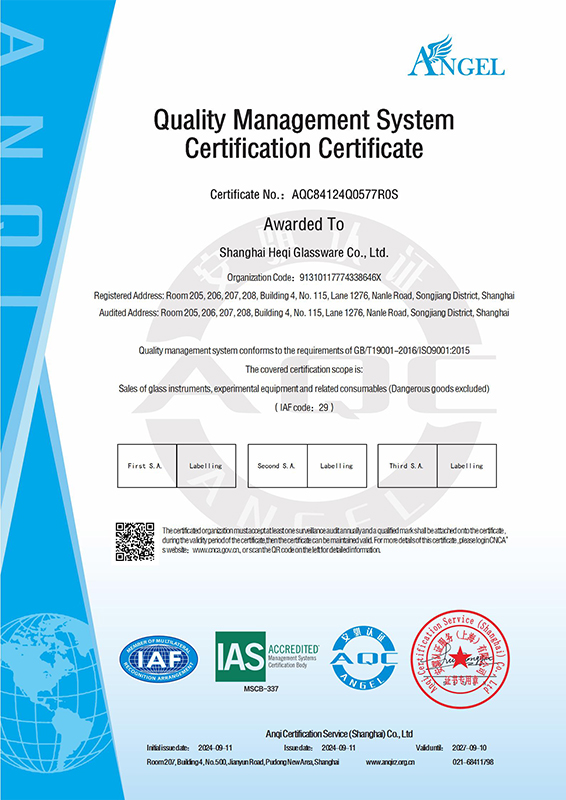
Shanghai Heqi Glassware Co., Ltd. provides laboratory equipment solutions for chemical research, pharmaceutical industries, universities, and scientific institutions. Founded in March 2002, the company is China Lab Cold Finger Condenser Suppliers and Lab Cold Finger Condenser Manufacturers, specializing in the research, development, and production of standard mouth glass instruments and related laboratory equipment.
With production bases located in Songjiang, Chengdu, Jiaxing, and Yancheng, Shanghai Heqi combines glass manufacturing experience with modern production management. The company applies mechanized and semi mechanized production methods to improve manufacturing consistency and supports industrial production processes to enhance product quality control.
Shanghai Heqi does not only provide individual laboratory glassware products. The company supplies complete laboratory equipment solutions, including glass reactors, rotary evaporators, distillation units, high and low temperature circulation systems, vacuum pumps, stirrers, and UV analyzers. This product range helps the company understand how different laboratory components work together in practical applications.
How Does a Cold Finger Condenser Improve Solvent Recovery Efficiency in Laboratories?
Solvent recovery is an important procedure in many chemical and pharmaceutical laboratories. During heating, solvents may evaporate from reaction systems or evaporation equipment. Without effective condensation, valuable solvents may be lost, affecting experimental efficiency and increasing material consumption.
A Cold Finger Condenser helps solve this challenge by providing a dedicated cooling surface inside the condensation area. The cold surface captures solvent vapor and converts it back into liquid, allowing it to return to the experimental system or be collected separately for further use.
The concentrated cooling design of a Cold Finger Condenser makes it suitable for applications requiring direct cooling performance. Compared with some traditional condenser structures, this design provides a different approach by placing the cooling source closer to the vapor contact area.
In organic chemistry laboratories, Cold Finger Condensers are often used during reactions involving volatile solvents. Researchers can combine them with reaction flasks and other glassware to create a controlled experimental environment. This helps maintain solvent levels and supports stable reaction conditions.
| Application Field |
Cold Finger Condenser Function |
Laboratory Purpose |
| Organic Chemistry Research |
Condenses solvent vapor during chemical reactions |
Maintains solvent circulation and reaction stability |
| Pharmaceutical Experiments |
Supports controlled evaporation and recovery |
Improves laboratory process management |
| Material Research |
Provides low temperature condensation support |
Helps control experimental conditions |
| Academic Laboratories |
Demonstrates condensation principles |
Supports teaching and practical experiments |
The effectiveness of a Cold Finger Condenser depends on several factors, including glass quality, cooling method, connection compatibility, and manufacturing precision. Laboratories need equipment that can integrate smoothly with existing reaction systems and provide stable performance during repeated experiments.
Shanghai Heqi Glassware Co., Ltd. understands that laboratory equipment selection requires consideration of the complete experimental process. Through experience in glass production and laboratory system integration, the company supports customers who require reliable laboratory glassware for chemical and research applications.
Why Is Glass Material Important for Lab Cold Finger Condenser Performance?
The material used in a Cold Finger Condenser directly influences its stability, durability, and suitability for laboratory applications. High borosilicate glass is commonly selected for laboratory condensers because it provides resistance to temperature changes and chemical exposure.
Laboratory experiments often involve repeated heating and cooling cycles. A suitable glass material helps reduce the influence of thermal changes during operation and supports reliable use in different experimental environments. Chemical resistance is also important because condensers may come into contact with organic solvents and laboratory reagents.
For buyers searching for Lab Cold Finger Condenser Suppliers, product quality is closely related to manufacturing capability. Accurate glass processing, proper connection design, and consistent production standards influence how effectively the condenser works with other laboratory equipment.
Shanghai Heqi has established specialized workshops for glass production, metalworking, and assembly. These manufacturing capabilities allow the company to provide laboratory equipment solutions that combine product design, production control, and application experience.
As a professional Lab Cold Finger Condenser Manufacturer, Shanghai Heqi focuses on supporting customers who need laboratory glass instruments and customized equipment solutions. The company works with chemical, pharmaceutical, and research industries by providing products designed according to different laboratory requirements.
What Should Buyers Know When Selecting a Lab Cold Finger Condenser for Different Experimental Systems?
What Factors Should Be Considered When Choosing a Cold Finger Condenser for Laboratory Equipment?
Selecting a suitable Cold Finger Condenser requires laboratories to evaluate different factors related to experimental requirements, equipment compatibility, cooling methods, and supplier capability. Since laboratory processes may involve different solvents, temperatures, and reaction systems, buyers need to choose glassware that matches their specific applications.
The first factor is the intended laboratory process. A Cold Finger Condenser is commonly used for solvent recovery, low temperature condensation, evaporation control, and chemical reaction applications. Buyers should understand whether the condenser will be used with reaction vessels, evaporation systems, or customized laboratory equipment before making a selection.
Connection compatibility is another important consideration. Laboratory systems often include multiple components such as round bottom flasks, adapters, reaction vessels, vacuum systems, and circulation equipment. A suitable Lab Cold Finger Condenser should have accurate dimensions and proper connection design to ensure smooth integration with existing laboratory setups.
The cooling method should also match the experimental requirements. Different laboratory procedures may require different cooling conditions depending on the solvent characteristics and operating temperature. Understanding the relationship between cooling performance and application requirements helps buyers select the appropriate condenser structure.
Manufacturing experience is also important when choosing Lab Cold Finger Condenser Suppliers. Professional suppliers should understand laboratory glassware production, product inspection, and equipment compatibility. This knowledge allows suppliers to provide more suitable solutions for different research and industrial applications.
| Selection Factor |
Importance for Laboratory Use |
Buyer Consideration |
| Application Requirement |
Determines suitable condenser design |
Match the product with experimental procedures |
| Equipment Compatibility |
Ensures connection with laboratory systems |
Check glassware structure and joint requirements |
| Cooling Method |
Affects condensation efficiency |
Select according to temperature control needs |
| Supplier Experience |
Supports product quality and service |
Evaluate manufacturing and customization capability |
How Is a Lab Cold Finger Condenser Applied in Chemical and Pharmaceutical Laboratories?
A Lab Cold Finger Condenser is widely used in laboratories where controlled condensation and solvent management are required. In chemical research, it is often connected with reaction systems to capture evaporated solvents and maintain stable experimental conditions.
During organic synthesis, many reactions require heating for a specific period. As solvents evaporate during heating, the Cold Finger Condenser provides a cooling surface that allows vapor to return to liquid form. This process helps maintain solvent concentration and supports continuous reaction operation.
In pharmaceutical laboratories, controlled experimental conditions are important during compound preparation and testing procedures. A Lab Cold Finger Condenser can be integrated into laboratory setups where solvent recovery and temperature management are required. Its compact structure makes it suitable for research environments with limited space and complex equipment arrangements.
Material research laboratories also use Cold Finger Condensers for procedures involving evaporation, crystallization preparation, and temperature controlled experiments. Researchers can combine the condenser with other laboratory glassware to create a suitable experimental system according to project requirements.
Educational laboratories use Cold Finger Condensers as part of chemical teaching equipment. They help students understand condensation principles, heat transfer processes, and the relationship between temperature control and chemical experiments.
| Industry Application |
Common Usage |
Equipment Combination |
| Chemical Research |
Solvent condensation and reaction support |
Reaction flasks and laboratory glass assemblies |
| Pharmaceutical Development |
Controlled evaporation processes |
Reaction systems and laboratory equipment |
| Academic Research |
Experimental teaching and demonstrations |
Educational glassware setups |
| Industrial Testing |
Laboratory scale process evaluation |
Customized experimental systems |
Shanghai Heqi Glassware Co., Ltd. supports these application areas by providing laboratory equipment and glassware solutions. The company combines manufacturing experience with knowledge of chemical and pharmaceutical laboratory requirements, helping customers select suitable equipment combinations.
Why Are Experienced Lab Cold Finger Condenser Manufacturers Important for Buyers?
Choosing experienced Lab Cold Finger Condenser Manufacturers helps laboratories obtain products that meet practical application requirements. Laboratory glassware needs accurate processing, stable quality, and compatibility with different experimental systems.
A professional manufacturer should understand not only glass production but also how laboratory equipment operates together. For example, the connection between a condenser and reaction vessel affects installation convenience and experimental stability. Product design should consider the complete laboratory workflow rather than only the individual component.
Shanghai Heqi Glassware Co., Ltd. has years of experience in laboratory equipment manufacturing. The company focuses on standard mouth glass instruments and provides supporting laboratory solutions for chemical research, pharmaceutical applications, and scientific experiments.
Through its production facilities and technical team, Shanghai Heqi provides support for glass component manufacturing, equipment assembly, and customized laboratory systems. The company has brought together professionals in chemical research and development, mechanical design and processing, and electronic control to improve its ability to provide integrated laboratory solutions.
The company also supplies various laboratory products used together with condensers, including glass reactors, rotary evaporators, distillation units, high and low temperature circulation systems, vacuum pumps, stirrers, and UV analyzers. This product knowledge helps Shanghai Heqi better understand the requirements of customers searching for Lab Cold Finger Condenser Suppliers.
How Can Customized Laboratory Glassware Solutions Support Different Cold Finger Condenser Applications?
Different laboratories may have different equipment structures and experimental procedures. Standard Cold Finger Condenser products can meet common applications, while customized solutions may be needed for special reaction systems, pilot scale equipment, or unique laboratory processes.
Shanghai Heqi Glassware Co., Ltd. provides customized laboratory solutions through its capabilities in product design, glass fabrication, and equipment integration. The company works with customers to understand application requirements and provide suitable combinations of laboratory instruments.
Customized laboratory glassware can help users improve equipment matching and create more suitable experimental setups. This is especially important for research institutions and industrial laboratories that operate specialized reaction systems.
With experience in glass manufacturing and laboratory equipment supply, Shanghai Heqi supports customers looking for reliable China Lab Cold Finger Condenser Suppliers. The company focuses on providing practical laboratory solutions based on product quality, manufacturing capability, and application understanding.
FAQ About Cold Finger Condenser
What Is a Cold Finger Condenser Used For in Laboratory Applications?
A Cold Finger Condenser is used for controlled vapor condensation, solvent recovery, and cooling applications in laboratory experiments. It provides a cooled inner surface that allows vapor to condense into liquid form during chemical reactions, evaporation procedures, and laboratory scale preparation processes. It is commonly used in chemistry, pharmaceutical research, and scientific laboratories where stable condensation performance is required.
How Does a Lab Cold Finger Condenser Work?
A Lab Cold Finger Condenser works by circulating a cooling medium through the inner cold finger section to create a low temperature surface. When vapor contacts this cooled area, heat is removed and the vapor changes back into liquid. This process helps laboratories recover solvents and maintain suitable experimental conditions during heating or evaporation procedures.
What Is the Difference Between a Cold Finger Condenser and a Traditional Condenser?
The main difference is the cooling structure and condensation method. A Cold Finger Condenser uses an internal cooled tube that provides direct cooling inside the condensation area, while traditional condensers usually rely on external cooling water surrounding the vapor path. The cold finger design provides a concentrated cooling area and is suitable for applications requiring compact equipment structures and controlled condensation.
Why Should Buyers Choose Professional Lab Cold Finger Condenser Suppliers?
Professional Lab Cold Finger Condenser Suppliers can provide products with consistent manufacturing quality, accurate glass processing, and better compatibility with laboratory systems. Experienced suppliers understand laboratory applications and can support customers with suitable product selection, customization requirements, and equipment matching.
What Materials Are Commonly Used for Cold Finger Condenser Manufacturing?
High borosilicate glass is commonly used for Cold Finger Condenser manufacturing because it provides good thermal stability and chemical resistance. Laboratory condensers are often exposed to heating cycles, cooling processes, and chemical substances, so suitable glass materials help maintain reliable performance during regular laboratory operation.
Can a Cold Finger Condenser Be Customized for Special Laboratory Systems?
Yes, Cold Finger Condensers can be customized according to different laboratory equipment structures and application requirements. Customized solutions may involve specific connection designs, glass components, or integration with reaction systems and other laboratory equipment. Suppliers with glass fabrication and laboratory equipment experience can provide more suitable solutions for specialized applications.


 English
 Français
 Español