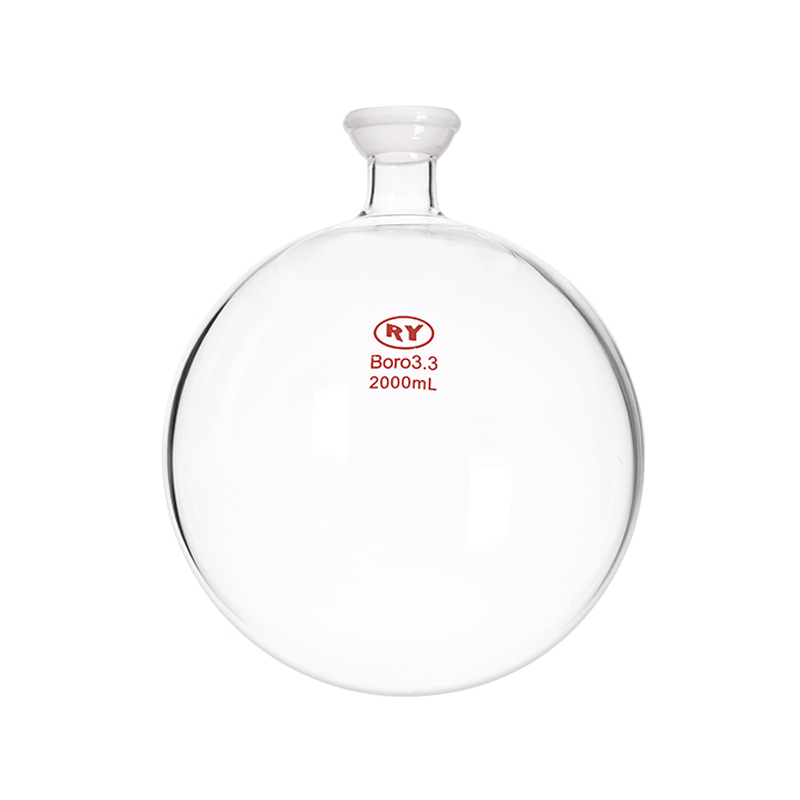
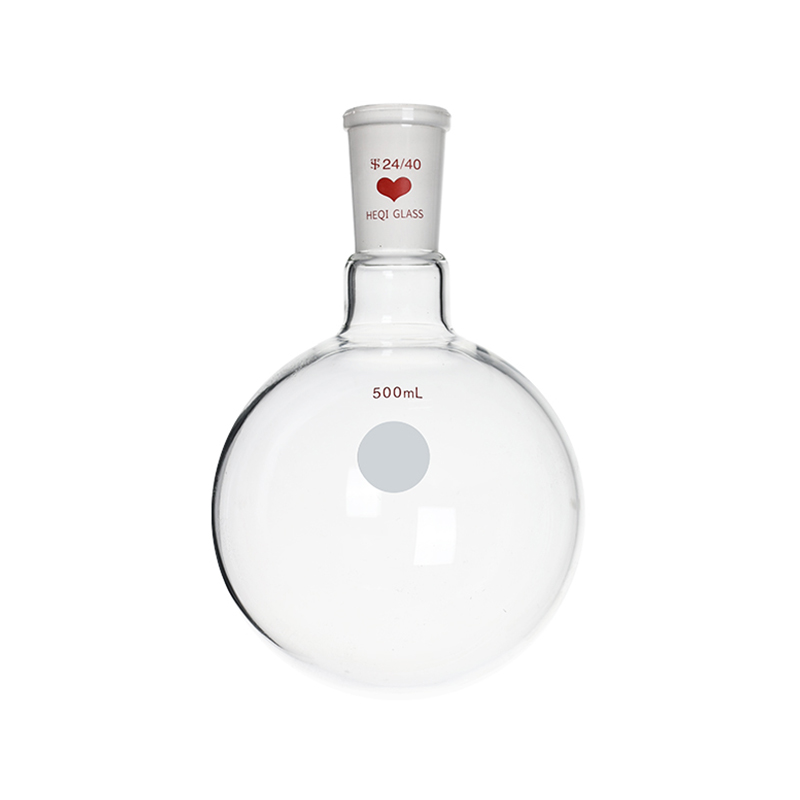
Key Advantages of Round Bottom Lab Glassware
The round bottom shape isn't just a traditional design choice — it provides specific, practical advantages that explain why it remains the default vessel shape for heated chemistry applications rather than being replaced by flat-bottomed alternatives.
- Even heat distribution — the curved shape allows uniform contact with a heating mantle, spreading heat evenly across the vessel surface and reducing the risk of localized hot spots that could cause uneven boiling or thermal stress.
- Better mechanical strength under heat — without flat surfaces or sharp internal corners, round bottom flasks distribute thermal expansion stress more evenly, reducing the risk of cracking during repeated heating and cooling cycles.
- Ideal compatibility with heating mantles and rotary evaporators — the spherical shape is specifically what allows these flasks to seat properly in standard heating mantles and rotate smoothly on a rotary evaporator without wobbling.
- Easier to clean thoroughly — the absence of flat corners means residue is less likely to collect in hard-to-reach spots, making round bottom flasks generally easier to rinse out completely compared to flat-bottomed alternatives.
- Available in flexible neck configurations — single, two, and three-neck versions allow the same basic vessel shape to support a wide range of setups, from simple reflux to more complex reactions requiring simultaneous stirring, temperature monitoring, and reagent addition.
The main practical trade-off is that round bottom flasks can't stand upright on their own and require a stand, clamp, or heating mantle for support, which is simply part of using this vessel shape correctly.
These advantages compound when a lab standardizes across its glassware inventory rather than mixing several different systems, since staff spend less time hunting for compatible parts and more time actually running experiments. We're happy to walk through your current inventory and suggest where standardizing on this product category might simplify day-to-day operations, particularly for labs juggling several different glassware systems left over from different past suppliers.
Where Round Bottom Lab Glassware Is Used
Round bottom flasks are genuinely one of the most universally used pieces of lab glassware, showing up across nearly every type of wet-chemistry workflow rather than being limited to a specific niche.
- Reflux reactions — the classic application, where a round bottom flask connects to a condenser to allow extended heating without losing solvent to evaporation.
- Distillation — round bottom flasks serve as both the boiling vessel and, in some configurations, the receiving flask throughout a distillation setup.
- Rotary evaporation — round bottom flasks are specifically designed to work with rotary evaporator systems, where the spherical shape allows smooth rotation and efficient solvent removal.
- General organic and inorganic synthesis — the vast majority of small to medium-scale reactions in chemical R&D are carried out in round bottom flasks, often multi-neck versions supporting stirring and reagent addition simultaneously.
- Natural product and botanical extraction — extraction and concentration steps frequently use round bottom flasks in combination with rotary evaporation or reflux setups.
- University and teaching laboratories — round bottom flasks are a foundational piece of equipment in virtually every organic and general chemistry course, given their central role in reflux and distillation technique.
If your lab does any kind of heated reaction, extraction, or distillation work, round bottom flasks are almost certainly already a core part of your equipment inventory, and this tag covers the full range of sizes and configurations you're likely to need.
Across all of these settings, the common thread is a need for dependable, repeatable performance rather than a highly specialized one-off solution, which is exactly the kind of use case this product category is built around. If your application doesn't fit neatly into the categories above, it's still worth reaching out, since many processes combine elements of more than one of these use cases and we can usually still recommend a suitable configuration.
Round Bottom Lab Glassware Specifications
The table below summarizes typical capacity ranges, neck configurations, and joint specifications for round bottom flasks in our catalog. Neck count and joint size should be selected based on your specific setup requirements, and we're glad to advise on the right configuration for a particular reaction or process.
| Parameter | Typical Value |
| Base Material | Borosilicate Glass 3.3 |
| Neck Configurations | Single-neck, two-neck, three-neck, four-neck |
| Capacity Range | 10ml to 20L, depending on configuration |
| Standard Joint Sizes | 14/23, 19/26, 24/29, 29/32, 34/35 |
| Wall Thickness | 1.5mm – 3.5mm, depending on capacity and product type |
| Neck Angle Options (Multi-Neck) | Straight center neck with angled side necks, typically 20° offset |
| Compatible Equipment | Heating mantles, rotary evaporators, clamp stands |
| Custom Configurations | Available for non-standard capacities or neck arrangements on request |
For rotary evaporator applications specifically, confirming the joint size matches your evaporator's connecting joint is essential, since a mismatch here is one of the more common ordering mistakes we help buyers avoid.
We periodically review these specifications against evolving international standards to make sure our production tolerances stay aligned with what buyers expect from a reputable manufacturer, and we're glad to share more detailed dimensional drawings for any specific item in this range on request. If a particular parameter isn't listed here, it's worth asking directly rather than assuming a default value, since some characteristics can vary meaningfully between product variants within the same general category, particularly neck wall thickness on larger multi-neck configurations and how it affects clamp point selection during extended reflux runs.
Frequently Asked Questions
What's the difference between single, two, and three-neck flasks?
Single-neck flasks handle simple heating or storage; two and three-neck versions allow simultaneous connections for stirring, temperature monitoring, reagent addition, or reflux condensers depending on the setup.
How do I know what size flask I need for my rotary evaporator?
This depends on your typical sample volume and your evaporator's joint size; let us know both and we can recommend an appropriate capacity and configuration.
Can round bottom flasks be heated directly over a flame?
Standard borosilicate 3.3 flasks can tolerate brief direct flame exposure, but a heating mantle is generally recommended for more even, controlled heating and better safety during extended use.
Why does my flask wobble in the heating mantle?
This usually indicates a mismatch between flask size and mantle size; the mantle should be sized to match the flask's specific capacity for proper, stable contact.
Are all necks on a multi-neck flask the same joint size?
Not always — center and side necks can have different standard joint sizes depending on the configuration, so it's worth confirming each neck's size individually when ordering accessories.
Do you offer custom neck angle configurations?
Yes, custom angle and neck arrangement configurations can be produced on request for specialized setups beyond our standard catalog offerings.
Can you supply matched sets of round bottom flasks in graduated sizes for a teaching lab?
Yes, we can put together a set spanning a range of capacities suited to typical coursework, based on your specific curriculum needs.
Joint Sealing on Round Bottom Flasks
Round bottom flasks rely on the same standard ground taper joint system used across most of our other glassware, but there are a few considerations specific to how these joints get used given the flask's shape and typical support requirements.
Because a round bottom flask can't stand on its own, it needs to be supported by a clamp, stand, or heating mantle throughout use, which means the joint connection at the neck is often bearing some mechanical load from the flask's own weight in addition to sealing pressure from whatever component is connected above it. This makes proper clamping technique important not just for safety but for joint longevity, since a poorly supported flask can put uneven stress on its neck joint over repeated use, particularly with larger, heavier flasks holding significant liquid volume.
For multi-neck flasks, each neck joint needs to be considered individually, since a three-neck flask might have a condenser sealed with grease on the center neck, a thermometer adapter with a rubber sleeve on one side neck, and an addition funnel with a ground joint on the other, meaning three different sealing approaches are potentially in use simultaneously on a single vessel. Checking each connection point individually, rather than assuming uniform sealing performance across all necks just because one joint is properly sealed, is generally good practice for any multi-neck setup running an extended reaction.
Getting this right the first time is generally simpler than troubleshooting a marginal seal after a process is already underway, so we'd always recommend confirming the appropriate sealing approach for your specific application before finalizing your order, particularly if you're working with an unfamiliar reagent, an unusual operating temperature, or an application outside typical everyday lab conditions where standard assumptions might not hold.
Payment Terms & Shipping
Round bottom flasks ship under our standard commercial terms, and being one of our highest-volume product lines, logistics for standard sizes are generally well established and efficient.
- Payment methods — T/T, L/C, and Alibaba Trade Assurance, with a 30% deposit and balance due before shipment typical for new buyers, adjustable for established accounts placing recurring orders.
- Sample orders — available for most standard configurations, useful if you're confirming joint compatibility with existing heating mantles or rotary evaporators before a bulk order.
- Lead times — standard single, two, and three-neck configurations typically ship within 12–20 days given high production volume; custom neck configurations or unusual capacities generally take 20–30 days.
- Packaging — flasks are individually wrapped with particular attention to the neck and joint areas, then packed into foam-lined cartons appropriately sized for the flask's capacity range.
- Shipping — FOB Shanghai standard, with sea freight for bulk orders and air freight available for smaller or time-sensitive shipments.
Because round bottom flasks are frequently ordered in mixed batches covering several sizes and neck configurations for a single lab setup, combining everything into one purchase order is generally the most efficient approach.
We understand that international shipping timelines are often a critical part of planning a lab setup or expansion, so we try to communicate realistic lead times upfront rather than optimistic ones that later slip. If your project has a hard deadline, let us know early so we can flag any potential scheduling risk before you commit to a purchase order, rather than discovering a conflict partway through production.
Compliance, Environmental & Safety Certification
Round bottom flasks carry the same base material certifications as the rest of our borosilicate catalog, and being such a widely used product category, documentation requests here are fairly common and well established.
- ISO 9001 quality management certification covers production of round bottom flasks the same as the rest of our catalog.
- RoHS and REACH compliance — applies across all glass components in this product range, relevant for buyers shipping into the EU and similarly regulated markets.
- Wall thickness and dimensional verification — available on request for buyers requiring documentation as part of an internal equipment qualification process.
- Hydrolytic resistance certification — Class 1 hydrolytic resistance documentation is available, confirming suitability for standard chemical and pharmaceutical applications.
- Third-party testing — SGS or equivalent testing can be arranged for buyers needing independent verification of dimensional accuracy or material composition for their own procurement files.
If your organization requires standardized documentation across a large recurring order of round bottom flasks, we can typically prepare a consolidated certificate covering the full batch rather than issuing separate paperwork for each individual size ordered.
Compliance documentation matters most when it's actually usable by your own internal audit or procurement process, so rather than sending a generic packet, we'd rather understand what your specific requirements are and provide exactly what's needed in the format your team expects. This approach has generally worked well for buyers in regulated industries who need documentation that fits directly into an existing internal quality system, particularly across large mixed-size batch orders.


 English
 Français
 Español