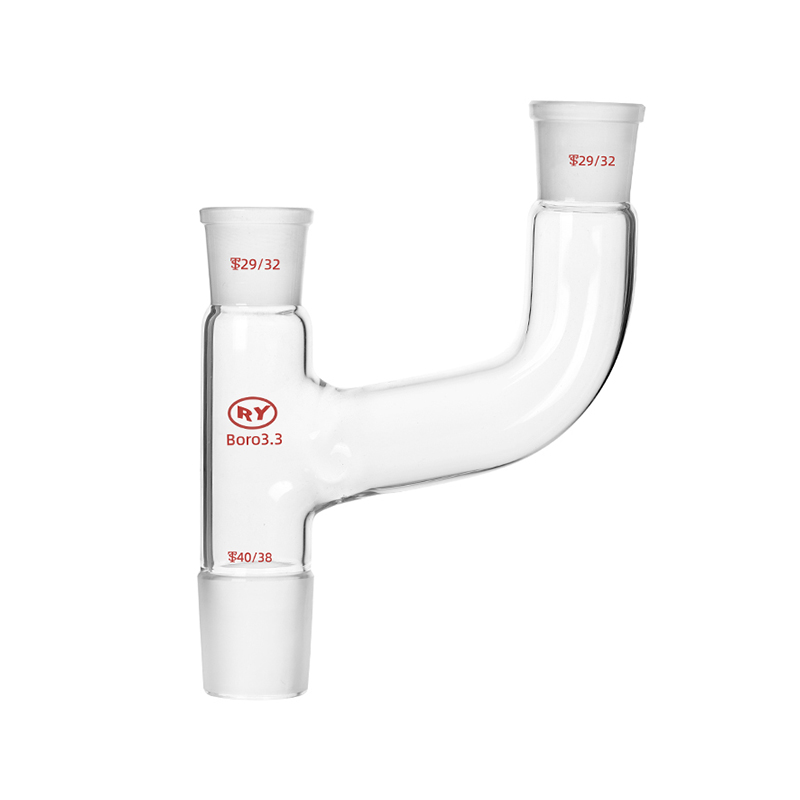
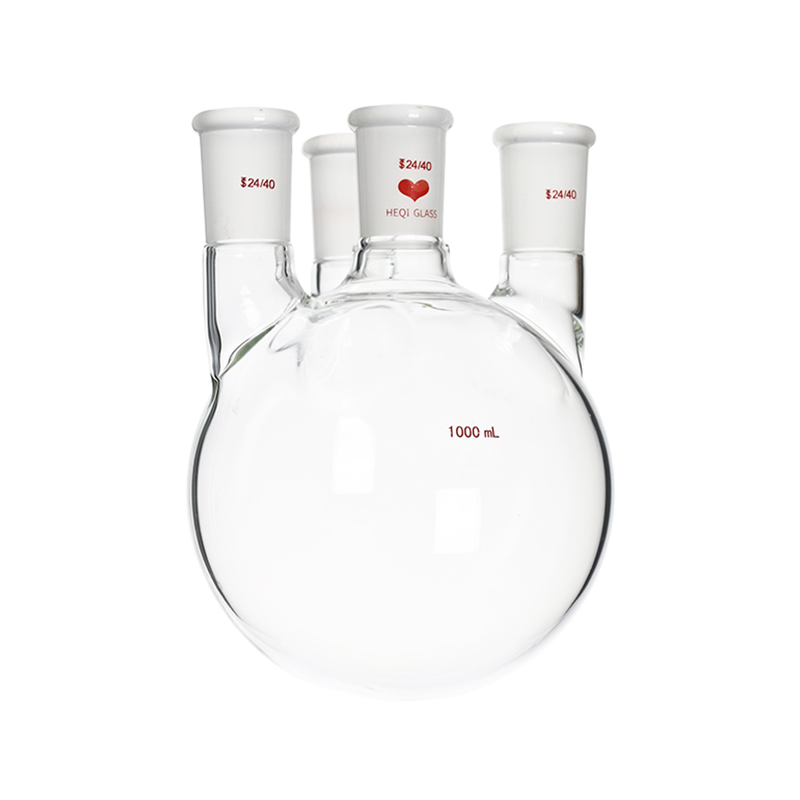
Key Advantages of Multi-Neck Vessels
Multi-neck vessels solve a fundamental limitation of single-neck flasks, and the specific advantages are worth understanding clearly since they directly determine what kind of reaction procedures become practical.
- Enables complex, controlled reaction setups — multiple necks allow simultaneous stirring, temperature monitoring, and controlled reagent addition, which is essential for reactions that can't simply be mixed and heated without active management.
- Flexible configuration options — center and angled side necks in various sizes allow the same basic vessel to support a wide range of equipment combinations depending on the specific reaction requirements.
- Supports safer handling of exothermic or sensitive reactions — having dedicated ports for temperature monitoring and controlled dropwise addition allows much finer control over reaction conditions than would be possible in a single-neck vessel.
- Compatible with inert atmosphere work — separate necks can be dedicated to inert gas inlet and outlet lines, allowing a reaction to be run under nitrogen or argon while still accommodating stirring and other necessary connections.
- Scales naturally from bench to pilot work — the same multi-neck configuration principles used in small-scale lab synthesis translate directly to larger pilot-scale vessels, supporting a consistent process design as work scales up.
The main consideration when selecting a multi-neck vessel is planning ahead for exactly which pieces of equipment need to connect simultaneously, since retrofitting additional connection points onto an already-purchased single or two-neck flask generally isn't practical.
These advantages compound when a lab standardizes across its glassware inventory rather than mixing several different systems, since staff spend less time hunting for compatible parts and more time actually running experiments. We're happy to walk through your current inventory and suggest where standardizing on this product category might simplify day-to-day operations, particularly for labs juggling several different glassware systems left over from different past suppliers or older equipment purchases.
Where Multi-Neck Vessels Are Used
Multi-neck vessels are foundational equipment for any reaction procedure requiring more than basic heating and stirring, which places them at the center of most serious synthesis and process development work.
- Controlled reagent addition reactions — procedures requiring a reagent to be added slowly and carefully, often via a dropping or addition funnel, while simultaneously stirring and monitoring temperature, are a core use case for three and four-neck vessels.
- Exothermic and temperature-sensitive synthesis — reactions requiring active temperature monitoring alongside controlled addition depend on having dedicated ports for both a thermometer probe and an addition funnel.
- Inert atmosphere and air-sensitive chemistry — reactions run under nitrogen or argon require dedicated gas inlet and outlet connections in addition to stirring and reflux condenser ports.
- Reflux reactions with simultaneous monitoring — a center neck for the condenser combined with a side neck for temperature monitoring is a standard configuration across chemical R&D.
- Pilot-scale process development — scale-up work translating a bench-scale multi-neck reaction into pilot equipment relies on maintaining the same functional connection points at larger scale.
- Advanced teaching laboratory coursework — organic chemistry and process chemistry courses covering realistic synthesis technique introduce multi-neck vessels as students progress beyond basic single-neck procedures.
If your reaction requires more than simple heating and stirring — particularly if it involves controlled addition, careful temperature management, or an inert atmosphere — a multi-neck vessel is generally a necessity rather than an optional upgrade.
Across all of these settings, the common thread is a need for dependable, repeatable performance rather than a highly specialized one-off solution, which is exactly the kind of use case this product category is built around. If your application doesn't fit neatly into the categories above, it's still worth reaching out, since many processes combine elements of more than one of these use cases and we can usually still recommend a suitable configuration based on your specific workflow.
Multi-Neck Vessel Specifications
The table below summarizes typical neck configurations and specifications for multi-neck vessels in our catalog. Center and side neck sizes can differ within the same flask, so it's worth confirming each neck's specific dimensions when planning accessory purchases.
| Parameter | Typical Value |
| Base Material | Borosilicate Glass 3.3 |
| Neck Configurations | Two-neck, three-neck, four-neck |
| Capacity Range | 50ml to 20L, depending on configuration |
| Center Neck Joint Sizes | 19/26, 24/29, 29/32, 34/35 |
| Side Neck Joint Sizes | 14/23, 19/26, 24/29 (typically smaller than center neck) |
| Side Neck Angle | Typically 20° offset from vertical center axis |
| Vessel Shape Options | Round bottom standard; select flat bottom configurations available |
| Custom Configurations | Available for non-standard neck counts, angles, or sizes on request |
When ordering accessories such as thermometer adapters or addition funnels for a multi-neck flask, specifying which neck position (center or a specific side neck) each accessory needs to fit helps us confirm the correct joint size for each individual connection point.
We periodically review these specifications against evolving international standards to make sure our production tolerances stay aligned with what buyers expect from a reputable manufacturer, and we're glad to share more detailed dimensional drawings for any specific item in this range on request. If a particular parameter isn't listed here, it's worth asking directly rather than assuming a default value, since some characteristics can vary meaningfully between product variants within the same general category or capacity range, particularly side neck spacing on larger four-neck configurations, which affects how many accessories can be mounted comfortably at once.
Frequently Asked Questions
How do I choose between a two-neck and a three-neck flask?
This depends on how many simultaneous connections your reaction requires; a two-neck flask typically handles stirring plus one additional function, while three-neck flasks support stirring, monitoring, and controlled addition simultaneously.
Are the side necks always the same size as the center neck?
Not usually — side necks are often smaller than the center neck, which is typically sized for a stirrer or condenser. Confirming each neck's specific size is important when ordering matching accessories.
Can I run an inert atmosphere reaction in a standard three-neck flask?
Yes, as long as you have appropriate gas inlet and outlet connections on two of the necks, with the third available for stirring or another required function.
Do multi-neck flasks need more support than single-neck flasks?
Generally yes, since fully equipped multi-neck setups carry more combined weight from attached accessories, so more robust or multiple-point clamping is generally recommended.
Can you produce custom neck angle configurations for a specific setup?
Yes, custom neck angles and arrangements can be produced on request for specialized reaction setups beyond our standard catalog configurations.
What's the maximum number of necks available on a single vessel?
Four-neck configurations are our standard maximum offering, though we're happy to discuss more specialized multi-port vessel designs for particularly complex setups.
Can you supply matching accessories along with a multi-neck flask order?
Yes, we can quote condensers, thermometer adapters, and addition funnels sized to match each neck of your chosen flask in the same order.
Do you offer multi-neck flasks with mixed center and side joint sizes on request?
Yes, custom joint size combinations across different necks can be produced to match specific existing accessories or process requirements.
Managing Multiple Simultaneous Seals
Multi-neck vessels introduce a genuinely different sealing consideration compared to single-neck flasks, since several different joints, each potentially connected to a different type of accessory, need to be properly sealed at the same time for the overall setup to perform reliably.
A typical three-neck configuration might have a reflux condenser sealed with grease or a PTFE sleeve on the center neck, a thermometer adapter using a rubber or PTFE sleeve around the probe shaft on one side neck, and an addition funnel sealed with its own ground joint on the other side neck — three different connection types, each requiring individual attention rather than a single uniform sealing approach applied across the whole vessel. This means troubleshooting a leak on a multi-neck setup requires checking each connection point separately, since a problem at one neck won't necessarily be obvious if the others are all sealing properly.
It's also worth considering how the combined weight and mechanical load of all connected accessories affects the vessel's overall support requirements, since a fully equipped three or four-neck flask with condenser, thermometer, and addition funnel attached is considerably heavier and more complex to support safely than a single-neck flask, generally requiring more robust clamping at multiple points rather than a single clamp at the neck alone.
Getting this right the first time is generally simpler than troubleshooting a marginal seal after a process is already underway, so we'd always recommend confirming the appropriate sealing approach for your specific application before finalizing your order, particularly if you're working with an unfamiliar reagent, an unusual operating temperature, or an application outside typical everyday lab conditions where standard assumptions about sealing performance might not hold as reliably.
Payment Terms & Shipping
Multi-neck vessels ship under our standard commercial terms, with production complexity scaling somewhat with neck count and configuration.
- Payment methods — T/T, L/C, and Alibaba Trade Assurance, with a 30% deposit and balance due before shipment standard for new buyers, adjustable for established accounts.
- Sample orders — available for most standard configurations, worth considering if you need to confirm neck angle and size compatibility with existing accessories before a larger order.
- Lead times — standard two and three-neck configurations typically ship within 15–25 days; four-neck or custom angle configurations generally take 25–35 days given the added manufacturing complexity.
- Packaging — multi-neck vessels are individually wrapped with particular attention to protecting each neck joint, then packed into custom-fitted foam cartons given their more complex shape compared to single-neck flasks.
- Shipping — FOB Shanghai standard, with sea freight for bulk orders and air freight available for smaller or time-sensitive shipments.
For buyers ordering a multi-neck vessel alongside matching accessories like condensers, thermometer adapters, and addition funnels, it's generally most efficient to place everything in one purchase order so we can confirm full compatibility across the entire assembly before shipment.
We understand that international shipping timelines are often a critical part of planning a lab setup or expansion, so we try to communicate realistic lead times upfront rather than optimistic ones that later slip. If your project has a hard deadline, let us know early so we can flag any potential scheduling risk before you commit to a purchase order, rather than discovering a conflict partway through production once materials and labor have already been committed.
Compliance, Environmental & Safety Certification
Multi-neck vessels carry the same base material certifications as the rest of our borosilicate catalog, and given their role in more complex synthesis work, documentation requests here often extend to specific configuration details.
- ISO 9001 quality management certification covers production of multi-neck vessels the same as the rest of our catalog.
- RoHS and REACH compliance — applies across all glass components in this product range, relevant for buyers shipping into the EU and similarly regulated markets.
- Hydrolytic resistance certification — Class 1 hydrolytic resistance documentation is available, confirming suitability for pharmaceutical and chemical R&D applications.
- Neck angle and joint size verification — dimensional checks on each individual neck are part of our standard quality control, with documentation available on request for buyers needing this recorded for equipment qualification.
- Third-party testing — SGS or equivalent testing can be arranged for buyers needing independent dimensional verification across all necks of a specific vessel configuration.
If your process operates under a documented equipment qualification framework requiring verification of each individual neck's dimensions and joint tolerance, let us know and we can provide detailed per-neck documentation alongside your order.
Compliance documentation matters most when it's actually usable by your own internal audit or procurement process, so rather than sending a generic packet, we'd rather understand what your specific requirements are and provide exactly what's needed in the format your team expects. This approach has generally worked well for buyers in regulated industries who need documentation that fits directly into an existing internal quality system without extra back-and-forth.


 English
 Français
 Español