Custom Lab Lab Glass Stopcocks & Valves

Lab Glass Stopcocks & Valves

-- Steady & Reliable Manufacturer --

What Are Lab Glass Stopcocks & Valves?

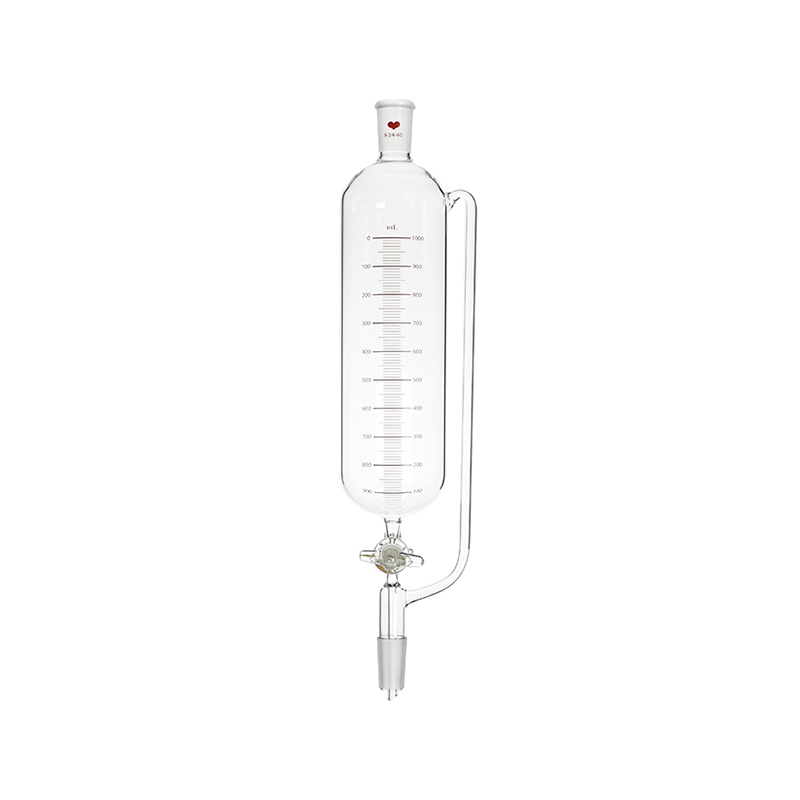
Lab glass stopcocks and valves are the components responsible for controlling the flow of liquid or gas through a glass system — opening, closing, or diverting flow at a specific point in a burette, separatory funnel, vacuum line, or gas manifold. They typically consist of a glass barrel with a matching plug, either ground glass or PTFE, that rotates within the barrel to align or block an internal bore, and the precision of that fit is what determines how reliably the valve seals when closed and how smoothly it operates when adjusted.

At Shanghai Heqi, we manufacture stopcocks and valves in both plain ground glass and PTFE-plug configurations, covering straight two-way designs as well as three-way and multi-port configurations used for more complex flow control needs. This tag groups together every stopcock and valve product across our catalog — those built into burettes and separatory funnels as well as standalone inline valves used in vacuum lines and gas manifolds — which is useful for buyers who need a replacement stopcock for existing equipment, or who are specifying flow control components for a new piece of custom glassware being built from scratch. Getting stopcock selection right matters more than it might seem, since flow control accuracy and long-term reliability often depend more on stopcock quality than on the rest of the glass assembly around it.

Buyers new to this category often start by matching an existing setup or replacing a single worn component, and our team is glad to help identify the right specification if you're not sure exactly what you need. We keep detailed production records for this product line, which makes it straightforward to source matching replacement parts even years after an original order, without needing to guess at dimensions from memory or re-measure an entire assembly from scratch.

Key Advantages of Lab Glass Stopcocks & Valves

Stopcock and valve performance comes down to a combination of plug material, bore precision, and mechanical design, and it's worth understanding what each of these actually contributes before assuming any stopcock will work equally well for a given application.

  • Precise, repeatable flow control — a well-manufactured stopcock provides consistent, predictable flow adjustment across its full range of motion, which matters directly for titration accuracy in burette applications.
  • PTFE plug options eliminate grease — unlike traditional ground glass stopcocks that typically need vacuum grease to seal properly, PTFE-plug stopcocks generally seal without any lubricant, avoiding grease contamination in sensitive applications.
  • Multiple bore and port configurations — straight two-way stopcocks handle simple on/off or flow-rate control, while three-way and multi-port configurations allow diverting flow between multiple paths from a single valve body.
  • Durable under repeated cycling — both our ground glass and PTFE stopcock designs are built to withstand frequent opening and closing over extended use without excessive wear affecting seal quality.
  • Compatible with demanding chemical environments — PTFE-plug versions in particular hold up well against aggressive acids, bases, and organic solvents that might degrade standard rubber or grease-sealed alternatives more quickly.

Choosing between a ground glass and a PTFE stopcock generally comes down to whether grease-free operation and broader chemical resistance are priorities for your specific application, or whether the simpler, lower-cost ground glass option is sufficient.

These advantages compound when a lab standardizes across its glassware inventory rather than mixing several different systems, since staff spend less time hunting for compatible parts and more time actually running experiments. We're happy to walk through your current inventory and suggest where standardizing on this product category might simplify day-to-day operations, particularly for labs juggling several different glassware systems left over from different past suppliers.

Where Lab Glass Stopcocks & Valves Are Used

Stopcocks and valves are functional components embedded throughout a wide range of lab equipment, which is why this tag spans several distinct application areas rather than a single product type.

  • Titration and volumetric analysis — burette stopcocks control the precise, incremental flow of titrant, where consistency and drip control directly affect measurement accuracy.
  • Liquid-liquid extraction — separatory funnel stopcocks manage the controlled draining of the lower liquid layer following phase separation, requiring a reliable seal to prevent premature dripping.
  • Vacuum line control — inline stopcocks and valves allow sections of a vacuum manifold to be isolated, vented, or connected to different vacuum sources as needed during multi-step procedures.
  • Inert atmosphere and gas handling setups — Schlenk-line style configurations rely on precise stopcock control to switch between vacuum and inert gas without introducing air into a sensitive reaction.
  • Chromatography columns — stopcocks at the base of gravity or flash chromatography columns control eluent flow rate during sample separation.
  • Custom pilot-scale glass equipment — reactors, distillation columns, and sampling points on larger glass equipment frequently incorporate stopcocks for controlled sampling or material transfer during a process run.

Whenever a process step depends on controlled, on-demand flow through a glass system rather than a simple always-open connection, a properly specified stopcock or valve is generally the right component to look at.

Across all of these settings, the common thread is a need for dependable, repeatable performance rather than a highly specialized one-off solution, which is exactly the kind of use case this product category is built around. If your application doesn't fit neatly into the categories above, it's still worth reaching out, since many processes combine elements of more than one of these use cases and we can usually still recommend a suitable configuration.

Lab Glass Stopcock & Valve Specifications

The table below summarizes typical configurations and specifications for stopcocks and valves in our catalog. Bore size and plug material should be matched to your specific flow rate and chemical compatibility requirements, and we're glad to advise on the right combination for your application.

ParameterTypical Value
Base MaterialBorosilicate Glass 3.3 barrel
Plug Material OptionsGround glass or virgin PTFE
Configuration TypesStraight two-way, three-way, multi-port
Bore Diameter Range1mm, 2mm, 4mm, 6mm (custom bore available)
Standard Joint Sizes14/23, 19/26, 24/29, 29/32
Lubricant RequirementRecommended for ground glass plugs; not required for PTFE plugs
Chemical ResistanceDetermined by plug material; PTFE offers broadest resistance
Typical Use RatingStandard laboratory vacuum and atmospheric pressure applications

For applications requiring high-precision, fine flow control — such as slow titration near the endpoint — a smaller bore size combined with a well-fitted plug generally provides the smoothest, most controllable flow adjustment.

We periodically review these specifications against evolving international standards to make sure our production tolerances stay aligned with what buyers expect from a reputable manufacturer, and we're glad to share more detailed dimensional drawings for any specific item in this range on request. If a particular parameter isn't listed here, it's worth asking directly rather than assuming a default value, since some characteristics can vary meaningfully between product variants within the same general category, particularly around plug fit tolerance on custom bore sizes and how that interacts with different PTFE hardness grades used across our stopcock plug range.

Frequently Asked Questions

Should I choose a ground glass or PTFE stopcock?
PTFE is generally preferred for grease-free operation and broader chemical resistance, while ground glass remains a simpler, lower-cost option for less demanding applications where grease isn't a concern.

Why does my burette stopcock drip even when fully closed?
This usually indicates worn grease, a slightly out-of-spec plug fit, or mineral buildup affecting the seal. Cleaning and regreasing often resolves it; persistent dripping may indicate the stopcock needs replacement.

Can I get a stopcock with a custom bore size for a specific flow rate?
Yes, send us your required flow rate and we can recommend an appropriate bore diameter, or produce a custom size if needed.

Do PTFE stopcocks ever need maintenance?
Occasionally the retention nut needs minor tightening as the PTFE settles in with use, but they don't require the periodic regreasing that ground glass stopcocks do.

Are three-way stopcocks harder to seal than standard two-way ones?
Not inherently, though the added complexity of multiple flow paths means it's worth double-checking all ports are properly seated during assembly, particularly for vacuum applications.

Can you supply a stopcock to fit a joint size from another manufacturer?
Generally yes, as long as it follows a standard international taper size; send us the specification and we can confirm compatibility.

Do you offer bulk pricing on stopcocks for labs equipping multiple burettes or separatory funnels?
Yes, volume pricing is available; send us the quantity and configuration needed and we can provide a tiered quote.

About
Shanghai Heqi Glassware Co., Ltd.

One point of professionalism, one point of service, one point of companionship—allow me to be your reliable partner on the path forward!

Shanghai Heqi was founded in March 2002, It is China Lab Glass Stopcocks & Valves Manufacturers and Custom Lab Glass Stopcocks & Valves Suppliers, Specializing in the R&D and production of standard-mouth glass instruments. Over the years, the company has established production bases in locations such as Songjiang, Chengdu, Jiaxing, and Yancheng. By integrating technology, craftsmanship, and management expertise, Heqi has adopted mechanized and semi-mechanized techniques to replace traditional manual methods. It has also introduced assembly-line industrial processes to replace simple workshop-style production, thereby reducing costs and improving quality.

To deliver on its service commitment of “you make a call, we handle the rest,” Heqi also supplies a range of high-quality glass instruments, lab consumables, and experimental equipment from both domestic and international brands. With ample inventory, fast delivery, and premium service, the company ensures full support for its clients.

In recent years, Shanghai Heqi has brought together experts in chemical R&D, mechanical design and processing, and electronic control to form a dedicated R&D team. The company has also set up three specialized workshops for glass, metalworking, and assembly. These facilities produce a variety of small and pilot-scale equipment, including glass reactors, rotary evaporators, distillation units, high- and low-temperature circulation systems, vacuum pumps, stirrers, and UV analyzers.

Leveraging its in-house capabilities in design, production, and custom fabrication of glass components, Shanghai Heqi continuously enhances product quality and service standards. It also supports the chemical and pharmaceutical industries by enabling customized small-scale and pilot-scale equipment solutions.


Contact Us
Our custom service team is ready to provide you with expert advice and personalized solutions.