Custom Lab Large-Capacity Lab Glass Vessels

Large-Capacity Lab Glass Vessels

-- Steady & Reliable Manufacturer --

What Are Large-Capacity Lab Glass Vessels?

Large-capacity lab glass vessels cover bottles, carboys, flasks, and reaction vessels built to hold significant liquid volumes, generally starting around 5 liters and extending up to 50 liters or more, intended for bulk storage, large-batch reactions, and process work that has outgrown standard bench-scale glassware but doesn't yet require full pilot-plant equipment. These vessels bridge a practical gap between everyday laboratory glassware and dedicated production-scale process equipment, giving labs and small-scale manufacturers a way to work with meaningfully larger quantities of solvent, reagent, or reaction mixture without needing to jump straight to specialized industrial equipment.

At Shanghai Heqi, our large-capacity range is manufactured with proportionally heavier wall construction than our standard bench glassware, reflecting both the increased hydrostatic pressure a full large vessel places on its own walls and the additional handling stress these items experience during routine use and transport. This tag brings together every large-capacity vessel across our catalog, which is particularly relevant for buyers scaling up bulk solvent storage, running larger batch reactions than standard flasks can accommodate, or managing waste and rinse collection at a scale beyond what typical bench-size containers can practically handle during a busy production or research schedule.

Buyers new to this category often start by matching an existing setup or replacing a single worn component, and our team is glad to help identify the right specification if you're not sure exactly what you need. We keep detailed production records for this product line, which makes it straightforward to source matching replacement parts even years after an original order, without needing to guess at dimensions from memory or re-measure an entire assembly from scratch. This is particularly useful for labs maintaining equipment over many years across multiple purchase cycles and staff turnover.

Key Advantages of Large-Capacity Vessels

Moving to larger-capacity glassware solves specific practical problems that become increasingly relevant as a lab's material volumes grow, and it's worth being clear about exactly what this equipment scale contributes.

  • Handles bulk volumes efficiently — a single large vessel reduces the number of individual containers needed for bulk storage or processing, cutting down on handling time and simplifying inventory management.
  • Supports consistent batch processing — running a larger batch in one vessel, rather than splitting the same total volume across several smaller containers, helps maintain more consistent reaction conditions throughout the entire batch.
  • Practical bridge toward pilot-scale production — large-capacity glassware provides a useful intermediate step for labs transitioning from bench-scale development toward eventual pilot or production-scale operation.
  • Reduces per-unit handling and cleaning time — managing fewer, larger containers is generally more time-efficient than managing many smaller ones holding the same total volume, particularly for routine tasks like cleaning and storage.
  • Cost-effective for bulk solvent and reagent storage — purchasing and storing solvents in larger bulk containers is often more economical per unit volume than buying and managing many smaller bottles.

The trade-off is that large-capacity vessels are considerably heavier and less portable than standard bench glassware, requiring appropriate handling equipment, stands, and sometimes dedicated floor or bench space designed to support their weight safely.

These advantages compound when a lab standardizes across its glassware inventory rather than mixing several different systems, since staff spend less time hunting for compatible parts and more time actually running experiments. We're happy to walk through your current inventory and suggest where standardizing on this product category might simplify day-to-day operations, particularly for labs juggling several different glassware systems left over from different past suppliers or older equipment purchases made before current staff joined.

Where Large-Capacity Vessels Are Used

Large-capacity glassware is specified wherever a process or storage need has genuinely outgrown standard bench-scale containers, which covers a range of scale-up and bulk-handling scenarios across several industries.

  • Bulk solvent and reagent storage — labs and small manufacturers purchasing solvents in bulk quantities rely on large-capacity bottles and carboys for practical, cost-effective storage.
  • Larger batch chemical reactions — process development moving beyond bench-scale synthesis toward larger test batches often uses large-capacity reaction vessels before committing to full pilot-plant equipment.
  • Bulk waste and rinse collection — facilities generating significant waste solvent or rinse water volumes benefit from large-capacity collection vessels that don't need frequent emptying throughout a busy production day.
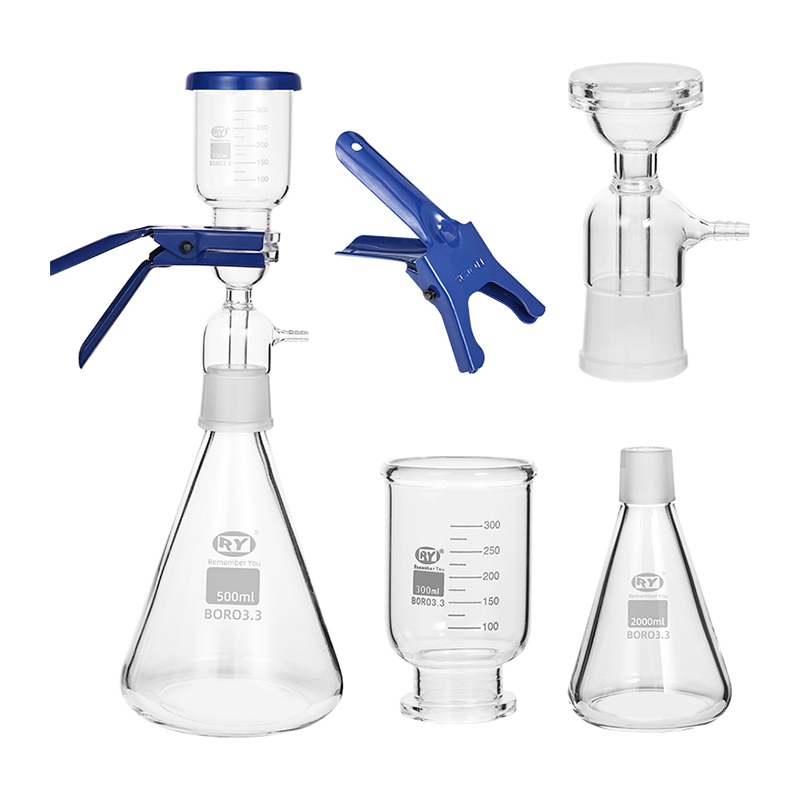
  • Large-volume filtration and extraction — processes handling substantial liquid volumes during filtration or extraction steps require correspondingly sized vessels to manage the material efficiently.
  • Pilot-scale production runs — early pilot-scale manufacturing often uses large-capacity glass vessels before transitioning to dedicated stainless steel or larger glass-lined production equipment.
  • Bulk culture media preparation — biological and pharmaceutical labs preparing large batches of culture media rely on large-capacity vessels to support their production or research-scale needs.

If your current bench-scale glassware requires frequent refilling or emptying to keep up with your actual material volumes, large-capacity vessels are generally worth considering as the more practical, efficient equipment scale for that specific need.

Across all of these settings, the common thread is a need for dependable, repeatable performance rather than a highly specialized one-off solution, which is exactly the kind of use case this product category is built around. If your application doesn't fit neatly into the categories above, it's still worth reaching out, since many processes combine elements of more than one of these use cases and we can usually still recommend a suitable configuration based on your specific workflow and budget.

Large-Capacity Vessel Specifications

The table below summarizes typical capacity ranges and construction characteristics for large-capacity vessels in our catalog. Wall thickness and handling features scale up considerably compared to standard bench glassware, reflecting both the weight and pressure considerations involved at this scale.

ParameterTypical Value
Base MaterialBorosilicate Glass 3.3
Capacity Range5L to 50L, with larger custom capacities available on request
Common Product TypesCarboys, large storage bottles, large flasks, large reaction vessels
Wall Thickness4.0mm – 8.0mm, depending on capacity
Handling FeaturesReinforced neck and handle areas designed for safe lifting and transport
Standard Joint / Neck Sizes34/35 taper joints; GL80 and larger threaded necks
Support RequirementsDedicated stands, cages, or carts recommended for safe handling when full
Custom ConfigurationsAvailable for non-standard capacities or specialized fitting requirements on request

Given the weight of a fully filled large-capacity vessel, we'd always recommend confirming appropriate support and handling equipment as part of your initial planning, rather than assuming standard bench-scale handling practices will transfer directly to this equipment scale.

We periodically review these specifications against evolving international standards to make sure our production tolerances stay aligned with what buyers expect from a reputable manufacturer, and we're glad to share more detailed dimensional drawings for any specific item in this range on request. If a particular parameter isn't listed here, it's worth asking directly rather than assuming a default value, since some characteristics can vary meaningfully between product variants within the same general category or capacity range depending on manufacturing batch.

Frequently Asked Questions

What's the maximum capacity you offer for large glass vessels?
Our standard catalog extends to 50L, with larger custom capacities available on request depending on the specific vessel type and intended application.

Do large-capacity vessels need special support equipment?
Yes, dedicated stands, cages, or carts are generally recommended for safe handling once a vessel is filled, given the significant weight involved at this scale.

Can large flasks use standard ground taper joints?
Standard taper joints work up to a point, but very large vessel openings often benefit from flange-style sealing instead, which handles larger diameters more practically than an oversized ground joint.

Is large-capacity glassware more fragile than smaller vessels?
The glass itself isn't inherently more fragile, but the combined weight and stress of a full large vessel means handling errors have more serious consequences than with lighter bench-scale glassware.

Do you offer large-capacity vessels with reinforced handles for lifting?
Yes, our large-capacity product line includes reinforced neck and handle areas specifically designed to support safe lifting and transport when full.

What shipping method do you recommend for large-capacity orders?
Sea freight is generally the practical choice given the size and weight involved; we can advise on specific crating and freight arrangements based on your order.

Can you help me decide between a few different options in this category for my specific application?
Yes, we're happy to discuss your intended use in more detail and recommend the most suitable configuration, since the right choice often depends on details specific to your process that aren't always obvious from a general product description alone.

About
Shanghai Heqi Glassware Co., Ltd.

One point of professionalism, one point of service, one point of companionship—allow me to be your reliable partner on the path forward!

Shanghai Heqi was founded in March 2002, It is China Large-Capacity Lab Glass Vessels Manufacturers and Custom Large-Capacity Lab Glass Vessels Suppliers, Specializing in the R&D and production of standard-mouth glass instruments. Over the years, the company has established production bases in locations such as Songjiang, Chengdu, Jiaxing, and Yancheng. By integrating technology, craftsmanship, and management expertise, Heqi has adopted mechanized and semi-mechanized techniques to replace traditional manual methods. It has also introduced assembly-line industrial processes to replace simple workshop-style production, thereby reducing costs and improving quality.

To deliver on its service commitment of “you make a call, we handle the rest,” Heqi also supplies a range of high-quality glass instruments, lab consumables, and experimental equipment from both domestic and international brands. With ample inventory, fast delivery, and premium service, the company ensures full support for its clients.

In recent years, Shanghai Heqi has brought together experts in chemical R&D, mechanical design and processing, and electronic control to form a dedicated R&D team. The company has also set up three specialized workshops for glass, metalworking, and assembly. These facilities produce a variety of small and pilot-scale equipment, including glass reactors, rotary evaporators, distillation units, high- and low-temperature circulation systems, vacuum pumps, stirrers, and UV analyzers.

Leveraging its in-house capabilities in design, production, and custom fabrication of glass components, Shanghai Heqi continuously enhances product quality and service standards. It also supports the chemical and pharmaceutical industries by enabling customized small-scale and pilot-scale equipment solutions.


Contact Us
Our custom service team is ready to provide you with expert advice and personalized solutions.