Custom Lab Reflux & Condensation Lab Assemblies

Reflux & Condensation Lab Assemblies

-- Steady & Reliable Manufacturer --

What Are Reflux & Condensation Lab Assemblies?

Reflux and condensation lab assemblies cover the condensers and related components specifically used to cool and return vaporized solvent back into a reaction vessel, allowing a reaction mixture to be heated for extended periods without progressively losing solvent to evaporation. A typical reflux setup pairs a round bottom flask with a condenser mounted vertically above it, where rising vapor cools against the condenser's internal surface and drips back down into the flask, maintaining a stable liquid volume throughout what might be a reaction running for hours at elevated temperature.

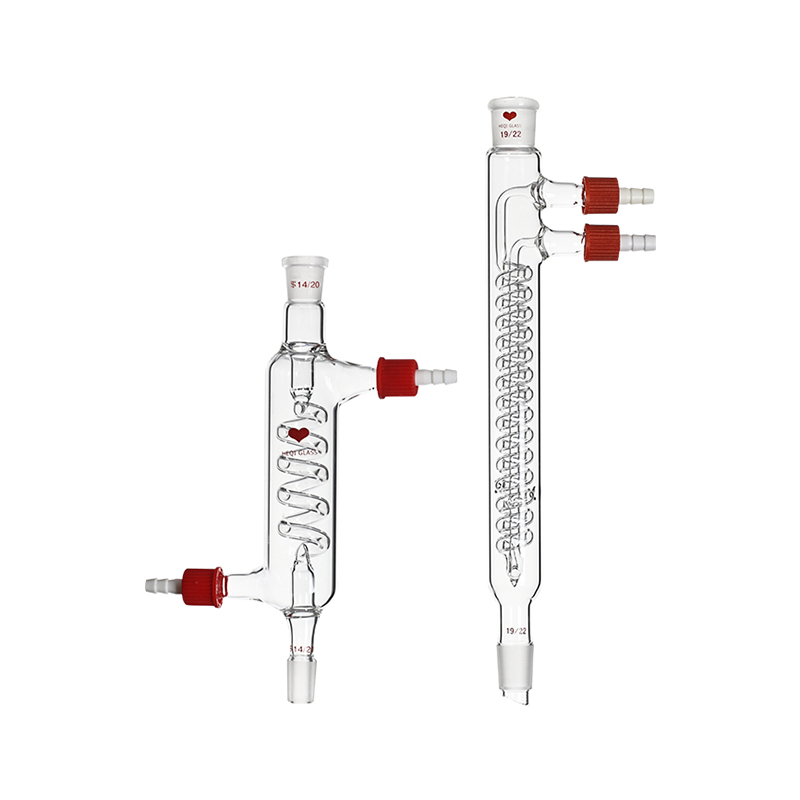
At Shanghai Heqi, our condenser range spans several classic designs — Liebig, Allihn, Graham (coil), and Dimroth condensers — each offering a different balance of cooling efficiency, physical length, and suitability for particular vapor loads or solvent boiling points, manufactured from our standard borosilicate 3.3 glass with standard taper joints connecting to the rest of a reaction assembly. This tag brings together every condenser and reflux-related component in our catalog, which is genuinely core equipment for the majority of organic synthesis and extraction work, since extended heating under reflux is one of the most common procedures across chemical R&D, making a well-matched condenser selection important for getting consistent, reliable results.

Buyers new to this category often start by matching an existing setup or replacing a single worn component, and our team is glad to help identify the right specification if you're not sure exactly what you need. We keep detailed production records for this product line, which makes it straightforward to source matching replacement parts even years after an original order, without needing to guess at dimensions from memory or re-measure an entire assembly from scratch. This is particularly useful for labs maintaining equipment over many years across multiple purchase cycles and staff turnover.

Key Advantages of Our Condenser & Reflux Range

Different condenser designs solve slightly different cooling challenges, and having a range of options available means a reflux setup can be matched appropriately to the specific solvent and scale involved rather than using a single generic design for every application.

  • Range of cooling efficiencies — Allihn and Graham (coil) condensers provide greater cooling surface area for higher vapor loads or lower-boiling solvents, while simpler Liebig condensers handle more moderate reflux conditions efficiently and economically.
  • Enables extended reaction times without solvent loss — a properly matched condenser allows a reflux reaction to run for hours without meaningful solvent depletion, which is essential for reactions requiring extended heating to reach completion.
  • Flexible length and joint configuration options — our condenser range spans multiple lengths and standard joint sizes, allowing appropriate selection based on available bench height and the rest of your glass assembly's joint sizing.
  • Dimroth condensers for vertical or angled reflux — the internal coil design of a Dimroth condenser performs effectively even when mounted at an angle, useful for certain rotary evaporator and space-constrained setups.
  • Consistent, well-understood connection standards — standard ground taper joints mean condensers integrate directly with the rest of our flask and adapter product range without requiring specialized connecting hardware.

Selecting the right condenser type for your specific solvent boiling point and reaction scale generally makes a bigger practical difference than most buyers initially expect.

These advantages compound when a lab standardizes across its glassware inventory rather than mixing several different systems, since staff spend less time hunting for compatible parts and more time actually running experiments. We're happy to walk through your current inventory and suggest where standardizing on this product category might simplify day-to-day operations, particularly for labs juggling several different glassware systems left over from different past suppliers or older equipment purchases made before current staff joined.

Where Reflux & Condensation Assemblies Are Used

Reflux and condensation equipment is genuinely foundational across most heated chemistry work, showing up wherever a reaction or process needs sustained heating without progressive solvent loss.

  • Organic synthesis reactions — the majority of reflux-based organic synthesis procedures depend on a properly matched condenser to maintain stable reaction conditions over extended heating periods.
  • Solvent recovery via reflux distillation — combining reflux with controlled distillation allows solvent recovery processes to separate components efficiently while managing vapor return through the condenser.
  • Extraction procedures involving heated solvent — certain extraction methods rely on sustained solvent reflux to maximize extraction efficiency from plant material or other solid matrices over an extended process.
  • Distillation with reflux ratio control — more sophisticated distillation setups use a condenser to control reflux ratio, balancing vapor return against distillate collection for improved separation efficiency.
  • Pilot-scale process development — scale-up work testing reflux-dependent reactions at larger volumes relies on appropriately sized condensers matched to the increased vapor load involved.
  • Teaching laboratories covering reflux technique — introductory and intermediate organic chemistry coursework universally covers reflux setup and technique as a foundational laboratory skill.

If your procedure involves heating a solvent-containing mixture for more than a few minutes, a properly configured reflux and condensation assembly is almost certainly part of the correct setup for that work.

Across all of these settings, the common thread is a need for dependable, repeatable performance rather than a highly specialized one-off solution, which is exactly the kind of use case this product category is built around. If your application doesn't fit neatly into the categories above, it's still worth reaching out, since many processes combine elements of more than one of these use cases and we can usually still recommend a suitable configuration based on your specific workflow and budget.

Condenser & Reflux Assembly Specifications

The table below summarizes the common condenser types and related specifications in our catalog. Selecting the right type and length depends on your specific solvent, reaction scale, and available bench space, and we're glad to advise on the appropriate choice for a given application.

ParameterTypical Value
Base MaterialBorosilicate Glass 3.3
Common Condenser TypesLiebig, Allihn, Graham (coil), Dimroth
Available Lengths200mm, 300mm, 400mm, 500mm (jacket length)
Standard Joint Sizes14/23, 19/26, 24/29, 29/32
Water Connection TypeStandard hose barb fittings, sized for common laboratory tubing
Cooling Water Flow DirectionCountercurrent (bottom-in, top-out) recommended for efficiency
Compatible EquipmentRound bottom flasks, multi-neck vessels, distillation setups
Custom ConfigurationsAvailable for non-standard lengths or joint sizes on request

For higher-boiling solvents requiring less aggressive cooling, a simpler Liebig condenser is often perfectly adequate and more economical than a more elaborate Allihn or coil design, and this is generally the first, most economical configuration worth trying before upgrading to a more complex design for demanding low-boiling solvents.

We periodically review these specifications against evolving international standards to make sure our production tolerances stay aligned with what buyers expect from a reputable manufacturer, and we're glad to share more detailed dimensional drawings for any specific item in this range on request. If a particular parameter isn't listed here, it's worth asking directly rather than assuming a default value, since some characteristics can vary meaningfully between product variants within the same general category or capacity range depending on manufacturing batch.

Frequently Asked Questions

Which condenser type should I use for a typical organic solvent reflux?
A standard Liebig or Allihn condenser is generally adequate for most common organic solvents; Allihn provides somewhat more cooling surface area for higher vapor loads or lower-boiling solvents.

Why is my condenser dripping liquid back too slowly, causing overflow?
This can indicate a condenser that's undersized for your vapor load, insufficient cooling water flow, or incorrect mounting angle preventing proper drainage back to the flask.

Which direction should cooling water flow through the condenser?
Countercurrent to vapor flow generally works best — water entering at the bottom (coolest zone) and exiting at the top improves overall cooling efficiency.

Can a Dimroth condenser be mounted at an angle?
Yes, its internal coil design is specifically suited to angled or non-vertical mounting, unlike some other condenser types that require a more strictly vertical orientation.

Do you offer custom condenser lengths for specific bench height constraints?
Yes, custom lengths can be produced on request for setups with specific height or space limitations beyond our standard catalog offerings.

What hose size do your condensers use for water connections?
Standard hose barb fittings sized for common laboratory tubing are used across our condenser range; let us know if you need a specific size confirmed for your existing tubing.

Can you help me decide between a few different options in this category for my specific application?
Yes, we're happy to discuss your intended use in more detail and recommend the most suitable configuration, since the right choice often depends on details specific to your process that aren't always obvious from a general product description alone.

About
Shanghai Heqi Glassware Co., Ltd.

One point of professionalism, one point of service, one point of companionship—allow me to be your reliable partner on the path forward!

Shanghai Heqi was founded in March 2002, It is China Reflux & Condensation Lab Assemblies Manufacturers and Custom Reflux & Condensation Lab Assemblies Suppliers, Specializing in the R&D and production of standard-mouth glass instruments. Over the years, the company has established production bases in locations such as Songjiang, Chengdu, Jiaxing, and Yancheng. By integrating technology, craftsmanship, and management expertise, Heqi has adopted mechanized and semi-mechanized techniques to replace traditional manual methods. It has also introduced assembly-line industrial processes to replace simple workshop-style production, thereby reducing costs and improving quality.

To deliver on its service commitment of “you make a call, we handle the rest,” Heqi also supplies a range of high-quality glass instruments, lab consumables, and experimental equipment from both domestic and international brands. With ample inventory, fast delivery, and premium service, the company ensures full support for its clients.

In recent years, Shanghai Heqi has brought together experts in chemical R&D, mechanical design and processing, and electronic control to form a dedicated R&D team. The company has also set up three specialized workshops for glass, metalworking, and assembly. These facilities produce a variety of small and pilot-scale equipment, including glass reactors, rotary evaporators, distillation units, high- and low-temperature circulation systems, vacuum pumps, stirrers, and UV analyzers.

Leveraging its in-house capabilities in design, production, and custom fabrication of glass components, Shanghai Heqi continuously enhances product quality and service standards. It also supports the chemical and pharmaceutical industries by enabling customized small-scale and pilot-scale equipment solutions.


Contact Us
Our custom service team is ready to provide you with expert advice and personalized solutions.